
Table of Contents
- What Air Quality Testing Actually Measures
- Health Symptoms Linked to Toxic Mold and Poor Air Quality
- Signs You Need an Air Quality Test
- Professional Mold Inspection vs DIY Kits: What’s the Difference?
- Indoor Air Quality Testing Cost: What to Expect
- When Air Quality Testing Is Worth It (and When It Isn’t)
- Frequently Asked Questions
Last Updated: September 30, 2026
What Air Quality Testing Actually Measures
Is air quality testing worth it? For many homeowners, the answer depends entirely on what the test can reveal. Air quality testing is the process of collecting and analyzing air samples to identify and quantify airborne contaminants like mold spores, volatile organic compounds, particulate matter, and carbon monoxide. This guide from The Mold Consultant, LLC breaks down what those results mean and when they justify the cost.
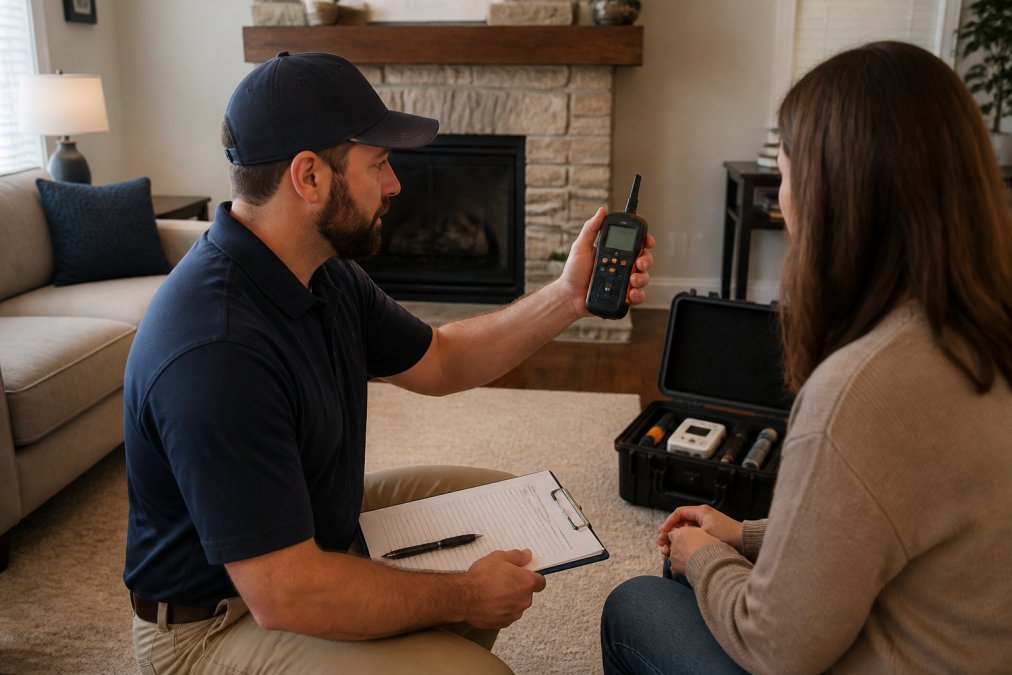
A standard assessment measures several distinct categories of pollutants. Understanding each one helps you interpret your results accurately.
Common Indoor Air Pollutants and Their Sources
Mold spores are among the most common concerns. They thrive in damp environments caused by leaks, high humidity, or poor ventilation.
Volatile organic compounds (VOCs) come from paints, cleaning supplies, and new furniture. Particulate matter includes dust, pollen, and combustion byproducts.
A single spot test can miss a problem entirely. Mold spore levels fluctuate with humidity and air exchange rate, so a one-time sample may not reflect your home’s typical conditions.
Health Symptoms Linked to Toxic Mold and Poor Air Quality
The health symptoms linked to toxic mold and poor air quality often mimic common allergies, which is why many people overlook them. Common complaints include chronic coughing, sneezing, nasal congestion, and itchy or watery eyes.
Signs You Need an Air Quality Test
You need an air quality test if you notice visible mold growth, musty odors, or a recent water leak that was not thoroughly dried. Other indicators include condensation on windows, high humidity levels, and unexplained respiratory symptoms.
Check your HVAC system’s condensation pan and drain lines first. A slow, unnoticed leak there is one of the most frequent sources of hidden mold growth found during inspections.
Professional Mold Inspection vs DIY Kits: What’s the Difference?
The main difference between a professional mold inspection and a DIY kit is the depth of analysis and interpretation. DIY kits typically provide a petri dish or a single air sample you mail to a lab, with results you must interpret yourself.
| Feature | Professional Inspection | DIY Kit |
|---|---|---|
| Equipment | Calibrated sensors, moisture meters | Petri dish or single pump |
| Interpretation | Certified inspector analysis | Self-interpretation |
| Source Identification | Yes, locates moisture intrusion | No |
| False Result Risk | Lower | Higher |
| Documentation | Detailed report for disputes | Limited |
Indoor Air Quality Testing Cost: What to Expect
Indoor air quality testing cost varies based on the size of the property, the number of samples collected, and the specific contaminants being tested for. Most providers quote per project rather than a flat rate, so the only reliable way to compare quotes is to normalize them against what each one actually includes.
What Drives the Price
- Square footage and layout. A 1,200-square-foot single-story home needs fewer sample points than a 3,000-square-foot multi-level home with a finished basement.
- Number and type of samples. Air samples (spore trap, viable, or non-viable), surface samples (tape lift or swab), and bulk samples are priced differently. A typical assessment collects two to four outdoor control samples plus several indoor samples.
- Specialty testing. Radon, asbestos, formaldehyde, and VOC testing each require separate equipment and lab analysis, and each adds to the total.
- Lab turnaround. Standard turnaround is usually included; rush analysis is a paid upgrade.
- Report depth. A one-page pass/fail summary costs less than a written protocol suitable for a landlord-tenant dispute or an insurance claim.
DIY Versus Professional: The Real Cost Comparison
A DIY mold test kit typically runs $10-$50 at a hardware store or online, plus $30-$75 for lab analysis if the kit requires mailing a sample. That looks cheap until you account for what it does not do: it does not locate the moisture source, it does not map hidden intrusion, and it does not produce documentation that holds up in a dispute.
How to Compare Quotes Without Getting Burned
Ask every provider the same four questions:
- How many air samples, surface samples, and outdoor controls are included?
- Is moisture mapping included, or billed separately?
- What does the written report contain, raw lab data, interpretation, or both?
- Is the inspector certified, and by whom?
Request the sample count and the report format in writing before you book. Two quotes at the same price can differ by hundreds of dollars in real value depending on what is included.
For current pricing and package options, visit The Mold Consultant, LLC’s website. Many homeowners find that a targeted inspection is more cost-effective than repeated DIY tests that fail to resolve the issue.
The goal of testing is not just to find mold, but to locate the moisture source causing it. Without addressing that root cause, remediation will only be a temporary fix.
When Air Quality Testing Is Worth It (and When It Isn’t)
Air quality testing is worth it when you have a known moisture problem, unexplained health symptoms, or a legal or real estate need for documentation. It is less critical if you have no signs of moisture, no health complaints, and no recent water damage.
Consider testing if you answer yes to any of these:
- Recent water leak or flooding
- Visible mold or musty odor
- Chronic respiratory symptoms at home
- Purchasing or selling a property
- Tenant or insurance dispute requiring evidence
What Counts as a ‘Safe’ Level
This is the question most guides skip, and it is the one that determines whether your result actually matters. There is no single universal threshold for indoor air quality, but there are established reference points:
- Mold spores. The most common professional benchmark is a comparison between indoor and outdoor spore counts. If indoor levels of a given spore type exceed outdoor levels, that suggests an indoor amplification source. Certain water-damage indicators, such as Stachybotrys (black mold) or Chaetomium, are generally treated as a concern when found indoors regardless of count.
- Carbon monoxide. The U.S. Consumer Product Safety Commission advises that CO levels in a home should not exceed 9 ppm over an 8-hour period, and any reading above zero on a calibrated monitor warrants investigation of combustion appliances.
- Radon. The EPA action level is 4 picocuries per liter (pCi/L) (the EPA). At or above that, mitigation is recommended; between 2 and 4 pCi/L, the EPA suggests considering mitigation.
- Particulate matter. The EPA’s Air Quality Index translates PM2.5 concentrations into categories, with readings above 35 µg/m³ (the ‘unhealthy for sensitive groups’ threshold) generally considered a concern indoors as well.
- VOCs and formaldehyde. There is no single residential numeric standard, which is why VOC results are best interpreted as a relative comparison, indoor versus outdoor, or before versus after a change, rather than against a fixed pass/fail line.
What to Do After a Bad Result: A Remediation Roadmap
Testing is only useful if it changes what you do next. Here is the sequence that actually resolves the problem:
- Fix the moisture source first. Mold cannot grow without water. Until the leak, condensation, or humidity problem is corrected, any remediation is temporary. This is the step most homeowners skip.
- Isolate and contain. For areas larger than roughly 10 square feet of mold growth, the EPA recommends containment and, in many cases, a professional remediator to prevent spores from spreading to unaffected rooms.
- Remove, don’t just kill. Dead mold spores still trigger allergic reactions. Remediation means physical removal of contaminated materials, not spraying them with a biocide and calling it done.
- Dry and verify. Structural materials must be dried to acceptable moisture content before reconstruction. A post-remediation verification test confirms the work succeeded.
- Address the air. After remediation, run HEPA filtration and consider ventilation improvements to reduce the residual spore load.
- Re-test to confirm. A clearance test after remediation is the only way to know the fix worked. Skipping it is how homeowners end up paying twice.
Seasonal and Environmental Context
Whether testing is worth it also depends on where you live and when. Homes in humid climates face year-round moisture pressure; homes in cold climates see condensation problems in winter when warm indoor air meets cold surfaces. Wildfire smoke events can push indoor PM2.5 well above outdoor levels in homes without adequate filtration, making testing worthwhile even without any mold concern.
Homeowners, landlords, and real estate agents who need defensible documentation and a clear remediation roadmap rather than a simple pass/fail result.
Frequently Asked Questions
What are the downsides of using air quality monitors?
Consumer-grade monitors often lack the sensor accuracy needed to detect mold spores, volatile organic compounds, or formaldehyde at low levels. They may miss pollutants entirely or produce false readings due to humidity changes. Many only measure particulate matter and carbon dioxide, not the full range of airborne contaminants. Professional air quality testing uses calibrated equipment and lab analysis to give you a complete picture of what’s actually in your air.
How much does professional indoor air quality testing cost?
Indoor air quality testing cost varies based on the number of samples, the types of pollutants tested, and the size of your home. Testing for mold, volatile organic compounds, and particulate matter typically involves multiple air samples and lab analysis. For current pricing, visit The Mold Consultant, LLC’s website or call to discuss your specific situation. Many homeowners find the cost is far less than repeated remediation attempts that miss the root cause.
How do I know if I actually need air quality testing or if I’m being paranoid?
If you’ve had water damage, visible mold, musty odors, or unexplained health symptoms like headaches or respiratory issues, testing gives you concrete answers. A professional mold inspection can identify hidden moisture intrusion points that aren’t visible. If you’re buying a home or managing rental properties, testing provides documentation for disputes or insurance claims. When you can’t see a problem but suspect one, testing replaces guesswork with data.
Can air quality testing prove that mold is causing my health symptoms?
Air quality testing identifies what’s in your air, including mold spores, volatile organic compounds, and particulate matter. It can confirm elevated levels compared to outdoor baseline measurements. However, linking specific health symptoms to mold exposure requires medical evaluation. What testing does provide is objective evidence of indoor air pollutants that may be contributing to respiratory health issues, allergic reactions, or sick building syndrome. This data helps you and your doctor make informed decisions.