
Table of Contents
- How to Interpret Mold Lab Results: Understanding Your Report
- Mold Test Report Example: Key Fields and Terminology
- Mold Spore Count Interpretation: Reading Sp/m³ and Species Data
- Indoor vs Outdoor Mold Levels: Why the Comparison Matters
- Air, Surface, Bulk, and Dust Tests: What Each One Tells You
- What to Do After a Positive Mold Test: A Step-by-Step Decision Path
- Limitations of Mold Testing and Health Sensitivity
- Conclusion
- Frequently Asked Questions
Last Updated: October 16, 2026
How to Interpret Mold Lab Results: Understanding Your Report
Mold lab results are the written record of what a laboratory found in the samples collected from your home. They tell you which mold types were present, how many spores were counted, and how your indoor air compares to the air outside. This guide from The Mold Consultant, LLC walks through every field on a typical report so you can read it with confidence.
The core idea is simple. A mold test does not give you a pass or fail grade. It gives you a comparison. Your indoor sample is measured against an outdoor baseline, and the gap between the two is what matters most.
Here is what most guides get wrong: they treat one high number as proof of a problem. In practice, a single elevated count means very little without context. You need the sample location, the method used, and the outdoor control to make sense of it.
Below, we break down a real report field by field, explain the units, and give you a clear path for what to do next. If you would rather have a trained eye read the report for you, our mold inspection service covers exactly that.
Mold Test Report Example: Key Fields and Terminology
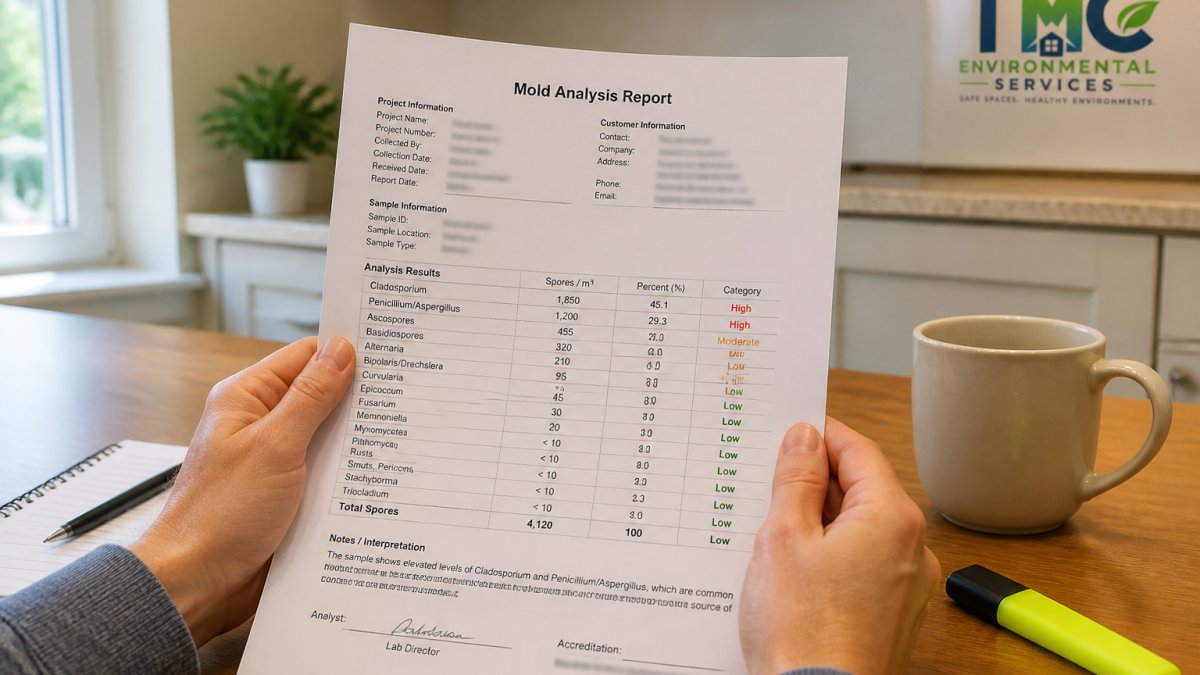
A mold test report example usually opens with a summary page, then lists each sample with its own data block. The summary is where you start, but the detail pages are where the truth lives.
Every report should show these fields:
- Sample number and location (for example, “Living Room, north wall”)
- Sampling method (air, surface, bulk, or dust)
- Collection date and time
- Laboratory analysis method
- Detection limit for that sample
- Spore count by type, in spores per cubic meter (sp/m³)
- Outdoor control sample for comparison
If any of those are missing, the report is incomplete. A count without a location or a method cannot be interpreted.
Sample Location, Method, and Detection Limit
Sample location is the exact spot the sample came from. “Kitchen” is too vague. “Kitchen, under sink cabinet, back panel” tells you something.
Sampling method matters because each method measures a different thing. An air sample captures what you breathe. A surface sample captures what has settled or grown on a material.
Detection limit is the smallest count the lab can reliably report. If your detection limit is 100 sp/m³ and your result reads “below detection,” that does not mean zero. It means the lab could not count anything under that floor.
Mold Spore Count Interpretation: Reading Sp/m³ and Species Data
Mold spore count interpretation starts with the unit. Spores per cubic meter (sp/m³) tells you how many spores were found in one cubic meter of air. The number alone is not good or bad. It only becomes meaningful next to your outdoor sample. Significant discrepancies between these indoor and outdoor concentrations often necessitate immediate action toward removing mold spores to restore healthy air quality.
Species data is the second half of the picture. Labs group findings into categories like:
- Common outdoor molds (Cladosporium, Alternaria, basidiospores)
- Water-damage molds (Stachybotrys, Chaetomium, Ulocladium)
- Soil and dust molds (Penicillium/Aspergillus, which are grouped because they look alike under a microscope)
A high count of Cladosporium indoors often just means outdoor air drifted in. A smaller count of Chaetomium indoors is a stronger signal, because that mold grows on wet building materials, not in open air.
Non-Detects, Sampling Uncertainty, and Report Quality
A non-detect means the lab found nothing above its detection limit. It does not prove the area is clean. It proves the sample did not capture mold at that moment.
Sampling uncertainty is real. Two samples taken an hour apart from the same room can differ. Air moves. Spores settle and re-suspend.
So how do you judge report quality? Check these:
- Was an outdoor control sample collected at the same time?
- Does each sample list a detection limit?
- Are spore types identified, not just totaled?
- Is the lab accredited?
- Are collection times and locations documented?
If you can tick all five, you have a report worth acting on. If not, the numbers are shaky.
The most common mistake we see is a homeowner ordering one indoor air sample with no outdoor control. Without a baseline, that single number cannot be interpreted at all, and you have paid for a result you cannot use.
Indoor vs Outdoor Mold Levels: Why the Comparison Matters
Indoor vs outdoor mold levels is the single most useful comparison on any report. Outdoor air always contains mold. The question is whether your indoor air has more, or different types, than the air right outside your door.
A practical way to read the comparison:
| Indoor vs Outdoor | What It Usually Means | Next Step |
|---|---|---|
| Indoor lower than outdoor | Normal, no clear indoor source | No action needed |
| Indoor similar to outdoor | Typical, same types present | Monitor moisture |
| Indoor higher, same types | Possible indoor growth or poor ventilation | Inspect for moisture |
| Indoor higher, water-damage types present | Strong signal of hidden growth | Professional inspection |
| Water-damage mold found indoors only | Likely active growth indoors | Professional inspection |
The pattern matters more than any single number. Different species indoors than outdoors, especially water-damage types, points to a source inside the building.
Air, Surface, Bulk, and Dust Tests: What Each One Tells You
Each test type answers a different question. Picking the right one is half the battle.
Air sampling measures what is floating in the air you breathe. It is best for checking overall indoor air quality and for post-remediation verification.
Surface sampling (a swab or tape lift) tells you what is growing or settled on a specific spot. It confirms whether a stain is mold, but it cannot tell you how far spores have spread.
Bulk sampling removes a piece of material, like a section of drywall, and analyzes it directly. It is useful when you need to know if a material is contaminated.
Dust sampling collects settled dust and can reveal mold history over time. It is helpful when you suspect past growth that has since dried out.
A common mistake is ordering an air test when the real question is “is this black stain mold?” That calls for a surface sample.
If you have visible growth on one wall but no musty odor elsewhere, ask for both a surface sample at the stain and an air sample in the room. The surface confirms what it is; the air shows whether it has spread.
What to Do After a Positive Mold Test: A Step-by-Step Decision Path
A positive result is a starting point, not a verdict. Here is how we walk clients through it.
Step 1: Confirm the source. A report shows mold is present. It rarely shows where it comes from. Find the moisture first.
Step 2: Check the outdoor control. If indoor and outdoor counts are similar, you may not have an indoor problem.
Step 3: Look at species. Water-damage molds indoors, with no outdoor source, warrant attention.
Step 4: Fix the moisture. No remediation lasts if the water source stays. This is the step most people skip.
Step 5: Decide on remediation. Small, dry, contained growth may be a DIY job. Large or hidden growth needs a professional.
Step 6: Verify after cleanup. A post-remediation test confirms the work actually cleared the problem.
Our post-remediation verification service exists for that last step. It gives you a written record that the area passed.
Limitations of Mold Testing and Health Sensitivity
Mold testing has real limits, and we tell clients this upfront. A test measures spores in the air or on a surface at one moment. It cannot measure mycotoxins, the compounds some molds produce. It cannot tell you how a person will react.
Health effects vary widely. Some people notice nothing. Others, especially those with allergies, asthma, or a weakened immune system, react to levels that bother no one else. Sensitive individuals may have symptoms at counts that look “normal” on paper.
This is why no single threshold number decides anything. A count that is fine for one home may be a problem for a sensitive occupant. The EPA’s guidance on mold and moisture and the CDC’s mold health information both stress that the presence of mold and damp conditions, not a specific count, is what drives health concerns.
If you have health symptoms and a mold concern, bring your report to your doctor. We can provide the environmental data; your doctor interprets your health.
A mold count is a clue, not a diagnosis. Use it to find moisture, confirm growth, and verify cleanup. Do not use it to self-diagnose a health condition.
Conclusion
Reading a mold report gets easier once you stop looking for a magic number. Check the method, the location, the detection limit, and the outdoor control. Then let the pattern guide your next move.
If the report leaves you with more questions than answers, that is normal. At The Mold Consultant, LLC, we offer non-destructive mold inspection, air quality testing, and neutral documentation you can rely on. We are locally owned, we have more than a decade in the field, and we back our findings in writing. Call now to schedule an inspection and get a clear read on your results.
Frequently Asked Questions
What is considered a high mold score on a lab report?
There is no single number that defines a high mold score. Labs report spore counts in spores per cubic meter (sp/m³), and what matters is how indoor levels compare to outdoor baseline samples taken the same day. An indoor count that is significantly higher than outdoor levels, or that contains species not found outdoors, usually warrants attention. A qualified inspector can review the full report and sampling context to determine whether the findings are elevated.
What does a positive mold test look like?
A positive mold test typically shows mold spores or fungal growth in the sample. On an air sample report, that means spore counts above the detection limit, often with species identified. On a surface or bulk sample, it means the lab confirmed mold growth on the material. A positive result does not by itself tell you whether the building is safe. It confirms mold is present and should be paired with a moisture investigation to find the source.
Can a mold test result tell you whether a building is safe?
No. Mold lab results show what was captured at the sampling location on the day of testing. They do not measure health risk, air quality throughout the building, or hidden mold behind walls. Individual sensitivity varies widely, and there are no federal standards for mold exposure. Use the report as one piece of evidence alongside a visual inspection and moisture readings. For health concerns, consult a physician.
What should you do after receiving a positive mold test?
Start by identifying the moisture source, since mold cannot grow without water. Review the report with your inspector to understand which areas were sampled and what species were found. If the affected area is small and the moisture issue is fixed, cleaning may be enough. Larger or hidden growth usually calls for professional remediation followed by post-remediation verification. Keep the report for insurance, real estate, or landlord documentation.