
Table of Contents
- Why Visual Mold Inspections Are Insufficient: The Limits of Looking
- What a Visual Mold Inspection Includes (and Its Blind Spots)
- Mold Inspection vs. Mold Testing: Understanding the Difference
- How to Test for Mold You Can’t See
- Using a Moisture Meter for Mold Inspection
- Thermal Imaging for Moisture Detection: Seeing What’s Hidden
- When to Call a Professional Mold Inspector
- Frequently Asked Questions
Last Updated: October 14, 2026
Why Visual Mold Inspections Are Insufficient: The Limits of Looking
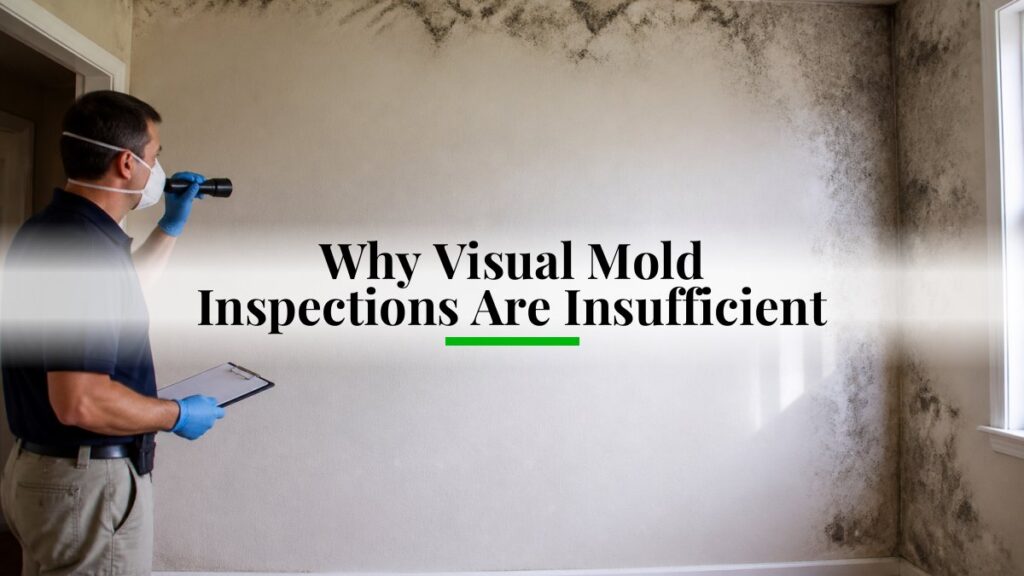
Visual mold inspections are non-invasive assessments for visible mold growth, moisture damage, and conditions that support mold, using the inspector’s eyes, nose, moisture meters, and thermal cameras.
That gap matters. Over a decade of inspecting homes and commercial buildings shows the same pattern: the mold you can see is rarely the whole story.
This guide explains what a visual inspection can and cannot detect, when to add testing, and how to choose the right next step.
A visual inspection tells you where mold is visible and where moisture is likely. It cannot tell you whether hidden mold exists behind a wall, how far contamination spreads, or whether the air is affected. Those questions need testing or further investigation.
What a Visual Mold Inspection Can and Cannot Detect
A visual mold inspection can confirm visible mold growth, find signs of water damage, and detect elevated moisture with a meter. It cannot confirm hidden mold, identify species, or measure airborne spores.
A visual inspection can detect:
- Visible mold on walls, ceilings, floors, and trim
- Water staining, bubbling paint, and warped materials
- Elevated moisture readings in building materials
A visual inspection cannot detect:
- Mold inside wall cavities that shows no surface signs
- Mold behind cabinets, under flooring, or above ceiling tiles
- The type of mold present
The distinction matters because mold often grows out of sight. A slow leak behind a refrigerator or a roof leak that soaks insulation can feed a colony for months before anything shows on the surface.
What a Visual Mold Inspection Includes (and Its Blind Spots)
A standard visual mold inspection includes a room-by-room walkthrough, moisture readings, and a written report. The blind spots are the areas an inspector cannot see without opening the building.
A thorough inspection usually covers:
- A full exterior and interior walkthrough
- Moisture meter readings on walls, floors, and ceilings
- Thermal imaging to spot temperature differences
Most inspectors follow a recognized standard of practice, such as those published by the American Society of Home Inspectors or similar bodies. These standards define what a non-invasive inspection should cover.
The blind spots are built into the method.
A clean-looking room is not proof of a clean building. Water damage that has dried on the surface can still leave elevated moisture and mold growth inside the wall assembly. Skipping further checks after a known leak is one of the most common reasons mold returns after remediation.
Mold Inspection vs. Mold Testing: Understanding the Difference
Mold inspection and mold testing are not the same thing.
Mold inspection examines a property for visible mold, moisture, and conditions that support growth.
Inspection tells you where problems likely are; testing tells you what is in the air or on a surface.
| Method | What It Does | Best For | Limits |
|---|---|---|---|
| Visual inspection | Finds visible mold and moisture | First-step assessment | Misses hidden growth |
| Moisture meter | Detects elevated moisture | Locating water intrusion | No species data |
| Thermal imaging | Spots temperature differences | Finding hidden moisture | Needs confirmation |
| Air sampling | Measures airborne spores | Suspected hidden mold | No federal health limits |
| Surface sampling | Confirms surface mold | Verifying a stain | Limited to sample spot |
Neither method is complete alone. The strongest assessments combine visual findings with targeted testing when the situation calls for it.
How to Test for Mold You Can’t See
Testing for hidden mold starts with finding the moisture source, then choosing the right sample type. Air sampling, surface sampling, and moisture readings each answer different questions.
Here is a practical decision tree we use:
- Start with a visual inspection. Look for visible mold, water stains, and musty odors.
- Check moisture. Use a moisture meter and thermal camera to find elevated moisture.
- If moisture is found but no visible mold, suspect hidden growth inside the assembly.
- If you need to confirm airborne contamination, use air sampling.
- If you need to confirm a surface is mold, use surface sampling.
- If findings point inside a wall, consider invasive exploration with the owner’s consent.
Air sampling captures indoor spores and compares them to an outdoor baseline. Surface sampling swabs or tapes a spot to confirm whether a stain is mold. Both go to a lab.
Always collect an outdoor control sample alongside indoor air samples. Without a baseline, an indoor spore count tells you very little. The comparison between indoor and outdoor levels is what makes the data useful.
Using a Moisture Meter for Mold Inspection
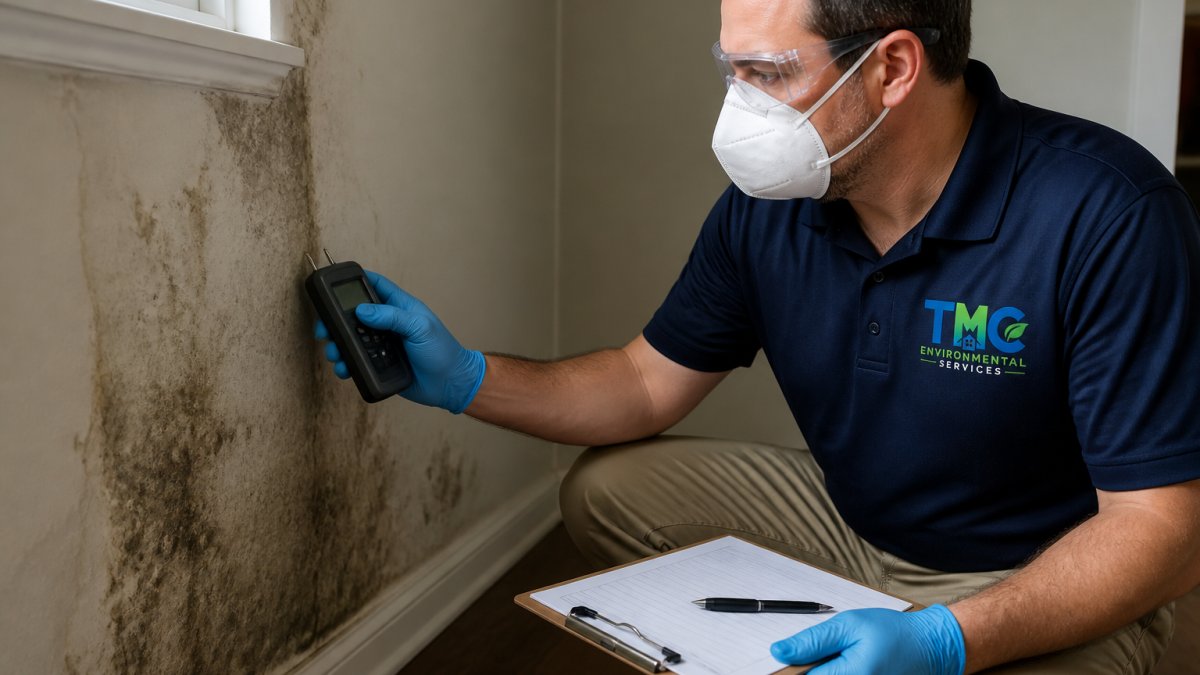
A moisture meter for mold inspection measures water content in building materials, the fastest way to find elevated moisture that can feed mold growth before anything is visible.
Two types are common:
- Pin-type meters push small pins into the material for a direct reading at that spot, making them the better choice for confirming a suspicious area.
- Pinless meters scan the surface without damage over a wider area. They are faster for scanning a whole wall, but read only the outer layer and are easily thrown off by metal lath, foil-faced insulation, or dense plaster.
What the Numbers Actually Mean
Most inspectors report readings as a percentage of moisture content or as a wood moisture equivalent (WME), which normalizes the reading to what wood would show at that moisture level. The scale is not universal, so the number only means something in context:
- Wood framing and sheathing: readings in the low teens are generally considered dry. Readings that climb into the high teens and above suggest the wood is holding enough water to support mold growth.
- Drywall and plaster: these materials do not have a clean percentage scale. A meter reading on drywall is best used as a relative comparison, dry area versus suspect area, rather than an absolute number.
- Concrete and masonry: these stay naturally damp and read high even without a leak. A high reading on a basement slab is not automatically a mold problem; it is a reason to check the surrounding framing and finishes.
Because scales differ by material and meter, the useful comparison is almost always one spot against another in the same material, not one number against a chart.
Where to Take Readings
A reading is only as good as its location. The spots that matter most are where water collects or travels:
- The base of walls, where water wicks down and pools
- Under and around sinks, dishwashers, and refrigerators
- Around windows and exterior doors, especially below the sill
Take a baseline reading in a known-dry area of the same material first. Then compare. A single spike in an otherwise consistent wall is a stronger signal than a high reading everywhere, which usually points to ambient humidity rather than a leak.
The Limits You Should Know
A moisture meter tells you where water is, not whether mold is growing there, moisture is a precondition for mold, not proof of it. It also cannot read through some materials, and metal or dense surfaces can throw off pinless readings. Use the meter to map the problem area, then confirm with thermal imaging, a pin-type reading, or a lab sample before treating it as a confirmed mold site.
Write down every reading and the spot it came from. A moisture map, even a rough one sketched on a floor plan, is what turns a handful of numbers into a story about where water is entering and how far it has spread.
Thermal Imaging for Moisture Detection: Seeing What’s Hidden
Thermal imaging for moisture detection uses an infrared camera to show temperature differences across a surface.
The camera does not see mold, it sees temperature, a clue, not proof. An inspector confirms each suspicious spot with a moisture meter before calling it a problem.
Where thermal imaging helps most:
- Scanning large wall areas quickly
- Finding hidden moisture after a leak
- Checking ceilings below bathrooms or roofs
The limits are real: a thermal camera can miss moisture if temperatures are even and can flag harmless temperature changes as false alarms.
When to Call a Professional Mold Inspector
Call a professional mold inspector when you have musty odors, a known water event, visible mold, or unexplained health concerns. A trained inspector has the tools and experience to find what a visual check misses.
Reach out if any of these apply:
- You had water damage in the last year, even if it looks dry now
- You smell a musty odor but see no mold
- You see visible mold larger than a small patch
The Scenario Changes the Scope
The right inspection depends on why you are asking.
Buying a home. A general home inspection is not a mold inspection.
Renting. Tenants usually cannot authorize invasive work, so start with documentation.
Owning after a leak. The most common mistake is stopping when the surface looks dry.
Recurring symptoms. If mold keeps coming back after cleaning or remediation, the moisture source was never fixed.
What a Useful Report Should Contain
An inspection is only as valuable as its documentation. A report that says “mold found” without detail is hard to act on, insure, or defend in a dispute. A useful report should include:
- A moisture map showing where readings were taken and what they were
- Photographs of visible growth, staining, and the moisture sources identified
- A plain-language statement of the suspected water source and how it is entering
- The areas that could not be assessed without invasive work, and why
That last point matters. A spore count with no outdoor baseline is nearly meaningless, because indoor and outdoor mold levels are always compared, not judged in isolation.
At The Mold Consultant, LLC, we use non-destructive tools like moisture meters and thermal imaging to find hidden moisture intrusion points without tearing your home apart. Our reports give you clear, actionable next steps.
Do not treat a clean visual walkthrough as a clearance. If a known leak was never opened up and dried, or if the moisture source was never corrected, the absence of visible mold is not evidence that the problem is gone.
Frequently Asked Questions
How accurate are mold testers?
Accuracy depends on the type of test and how samples are collected. Air sampling can identify airborne mold spores but cannot confirm whether hidden mold is actively growing or if it is a health hazard. Surface sampling only shows what is on the surface tested. No test can determine the extent of hidden mold behind walls. A professional inspector uses multiple tools, moisture meters, thermal imaging, and laboratory analysis, to build a complete picture. Results must be interpreted in context with the inspection findings.
Can moisture meters or thermal cameras detect hidden mold?
Moisture meters and thermal cameras detect moisture, not mold itself. A moisture meter measures water content in building materials, indicating conditions that support mold growth. Thermal imaging reveals temperature differences caused by moisture behind walls. Both tools help identify areas where mold may be growing, but confirmation often requires further investigation. A professional mold inspection combines these readings with visual clues and, when needed, laboratory testing to determine if mold is present.
What should you do if you suspect mold but see none?
If you smell a musty odor or have had water damage, a visual inspection alone may not be enough. Start by checking for moisture sources: leaks, high humidity, or recent water intrusion. Use a moisture meter to scan walls, floors, and ceilings for elevated readings. If moisture is detected, call a professional mold inspector who can use thermal imaging and air sampling to assess hidden mold. The Mold Consultant, LLC offers non-destructive inspections to locate moisture and mold without unnecessary demolition.
Does a musty smell mean there is mold?
A musty odor is a common sign of mold growth, but it does not confirm mold. The smell comes from microbial volatile organic compounds (MVOCs) produced by mold and bacteria. It can also come from damp building materials or other sources. If you notice a musty smell, it is worth investigating. A professional inspector can use moisture readings and air sampling to determine if mold is present and identify the source of the odor.
Mold hides. A visual inspection is a strong first step, but it cannot see inside your walls or measure what is in your air. If you have had water damage, smell something musty, or need real answers before you buy or remediate, The Mold Consultant, LLC can help. Our team combines over a decade of experience, non-destructive testing, and neutral, documented findings you can act on. Call now to schedule your inspection and find the root cause instead of treating the symptom.