

Table of Contents
- Step 1: Extract Standing Water and Remove Saturated Materials
- Step 2: How to Dry Out a House After Flooding
- Step 3: Best Mold Killers for Water Damage and Surface Disinfection
- Step 4: Personal Protective Equipment (PPE) and Safety Precautions
- Step 5: Asbestos Testing After Water Damage
- Step 6: HVAC System Contamination and Air Quality Testing
- Step 7: Mold Remediation Timeline and When to Hire a Professional
- Frequently Asked Questions
Last Updated: September 25, 2026
Step 1: Extract Standing Water and Remove Saturated Materials
The clock starts the moment floodwater enters your home. According to the CDC’s guidance on floodwater cleanup, mold can begin growing on wet surfaces within 24 to 48 hours. That window is your entire battle plan.
How to prevent mold after flooding starts with speed, not products.
Here’s the order that works:
- Pump or shop-vac standing water first. Move fast.
- Pull up soaked carpet, padding, and rugs. They rarely dry fully.
- Remove wet drywall at least 12 inches above the water line.
- Toss saturated insulation. It holds water like a sponge.
- Bag and remove debris before it starts to smell.
Floodwater comes in three grades. Clean water from a burst pipe is easy to manage. Gray water from appliances carries bacteria. Black water from outdoor flooding contains sewage and pathogens, everything it touched has to go.
That distinction matters for your insurance claim. Document everything with photos before you haul it out.
Step 2: How to Dry Out a House After Flooding
Drying is where most people quit too early, a house that feels dry can still hold moisture deep in the framing. How to dry out a house after flooding comes down to air movement, dehumidification, time, and measurement.
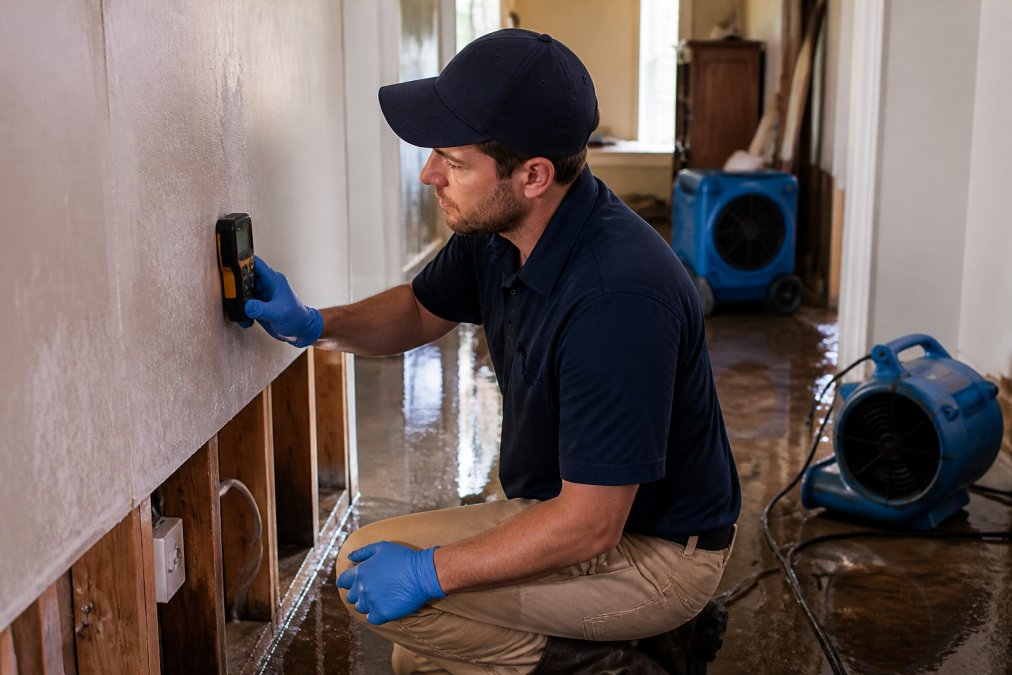
Dehumidification and Ventilation for Structural Drying
Structural drying removes moisture from building materials, not just the air. Run dehumidifiers around the clock with windows closed, and add air movers along walls, under cabinets, and across floors.
A hygrometer tells you the relative humidity in each room, keep it under 50 percent.
Point air movers at a 45-degree angle toward walls, not straight down at the floor. This pushes air along the surface where water actually sits. Rotate the angle every 24 hours so you’re not just drying one strip of wall.
Material-Specific Drying: Drywall, Insulation, and Subfloor
Not every material dries the same way, this is where the decision to save or replace gets made.
The single most common mistake is turning off the dehumidifier too soon because the room “feels dry.” The air dries first; the framing and subfloor dry last. Keep the equipment running until your moisture meter readings hold steady for two consecutive days.
How Long Drying Actually Takes
A small area with one air mover and one dehumidifier might dry in two to three days; a whole floor with wet drywall, subfloor, and framing typically takes one to two weeks of continuous drying before repairs. If moisture readings don’t drop after 72 hours, something is still feeding the moisture, a hidden leak, a wet cavity, or a saturated slab.
Step 3: Best Mold Killers for Water Damage and Surface Disinfection
The best mold killers for water damage are the ones that actually reach the mold. Bleach kills only surface mold and doesn’t penetrate wood or drywall, so the roots survive.
What works better:
- Concrobium or similar encapsulants that dry and trap spores
- Hydrogen peroxide for non-porous surfaces like tile and countertops
- Commercial disinfectants labeled for mold and mildew
- Vinegar as a mild option for small, non-porous areas
Cleaning Porous vs. Non-Porous Materials
Non-porous materials are the easy win. Scrub with disinfectant, rinse, and dry fully. Tile, glass, metal, and sealed concrete fall in this group.
Painting over moldy drywall traps moisture behind the paint. The mold keeps growing underneath and comes back worse within months.
Step 4: Personal Protective Equipment (PPE) and Safety Precautions
PPE is not optional when dealing with floodwater and mold. Floodwater carries bacteria, sewage, and chemicals; mold releases spores that trigger allergies and breathing problems.
Gear up before you start:
- N95 or P100 respirator to block spores
- Goggles to keep contaminated water out of your eyes
- Gloves, ideally rubber or nitrile, not thin latex
- Rubber boots for standing water
- Long sleeves and pants you can wash or throw away
The two fastest ways to get hurt during flood cleanup are electrical shock and breathing mold spores. Cut the power and mask up before anything else.
Step 5: Asbestos Testing After Water Damage
Older homes hide a serious risk. Asbestos testing after water damage matters because cleanup often means cutting into walls, floors, and ceilings, disturbing asbestos-containing materials releases fibers that cause lung disease.
- Floor tiles and the adhesive under them
- Pipe and furnace insulation
- Popcorn ceilings and joint compound
- Roofing and siding shingles
Step 6: HVAC System Contamination and Air Quality Testing
Your HVAC system can spread mold through the entire house. When floodwater or high humidity reaches the ducts, spores get pulled in and blown into every room, the angle most cleanup guides skip, and the one that determines whether your home is actually safe to live in.
How Mold Gets Into Your HVAC System
Your air handler pulls return air across the evaporator coil and pushes it out through the supply ducts. If any part of that loop is wet, a flooded basement, a saturated return duct, a coil that stayed damp, spores colonize the wet surface and get distributed to every room each time the system runs.
Three places to check first:
- The air handler and evaporator coil. The coil is wet by design during normal operation. After a flood, it stays wet longer and becomes a mold surface.
- Ductwork in a flooded basement or crawlspace. Flex duct is porous and nearly impossible to clean, if it was submerged, it should be replaced, not cleaned.
- Return air plenums and filter slots. These are often built from duct board or lined with insulation, both of which absorb water.
Signs your HVAC is contaminated:
- Musty smell when the system runs
- Visible mildew around vents or the air handler
- Water staining in ductwork or near the unit
- Allergy symptoms that worsen indoors
- A filter that keeps loading up faster than normal
What to Do Before You Run the System Again
Do not just turn the system back on. The order matters:
- Shut the system off at the thermostat and the breaker.
- Inspect the air handler, coil, and any ductwork that was submerged or in a flooded space.
- Replace the filter, a wet filter is a mold reservoir.
- If flex duct was submerged, replace it. Cleaning submerged flex duct is not reliable.
- If hard duct (sheet metal) was wet, it can sometimes be cleaned and disinfected by a duct cleaning professional, but only after the moisture source is fixed and the duct is fully dry.
- Have the coil and drain pan cleaned if there’s any visible growth.
Running your HVAC after a flood without inspecting it first is one of the fastest ways to re-contaminate a home you just finished cleaning. If you smell musty air when the system kicks on, shut it off and get the ducts inspected.
Post-Flood Air Quality Testing: When and How
Post-flood air quality testing measures spore levels inside versus outside and checks for hidden contamination. It matters if you have health concerns, anyone in the home has asthma or allergies, or you need proof for an insurance claim.
How testing typically works:
- Air sampling (spore trap): A pump pulls a known volume of air across a slide, and a lab counts spores by type. You take one sample indoors and one outdoors as a baseline.
- Surface sampling (tape lift or swab): Used when you can see something and want to confirm whether it’s mold.
- Moisture mapping: Thermal imaging and penetrating meters find wet cavities that air sampling can’t see.
Step 7: Mold Remediation Timeline and When to Hire a Professional
A realistic mold remediation timeline depends on how much water got in and how fast you acted. Small areas dried within 48 hours often need no remediation; larger floods can take one to two weeks of drying before repairs.
Here’s a simple way to decide:
| Situation | Action | Timeline |
|---|---|---|
| Small leak, dried in 24-48 hours | DIY cleanup and monitoring | 2-3 days |
| Wet drywall, carpet, or insulation | Remove materials, dry, disinfect | 1-2 weeks |
| Black water or sewage backup | Call a professional | Immediately |
| Mold visible over 10 square feet | Professional remediation | As soon as possible |
| Health symptoms or HVAC involvement | Testing and remediation | Immediately |
Hiring a remediation company that also does the testing is a conflict of interest. Get an independent inspection first so you know the real scope before anyone quotes you a price.
Frequently Asked Questions
How long does it take for mold to start growing after a flood?
Mold spores can begin to grow within 24 to 48 hours after water damage occurs. The key to prevention is rapid response. If you can start water extraction and drying within the first day, you significantly reduce the risk of fungal growth. If the area remains wet for longer than 48 hours, mold growth is highly likely, and you may need professional remediation services.
What should I use to disinfect my home after a flood?
For non-porous surfaces, a diluted bleach solution or a commercial disinfectant labeled for mold can be effective. However, bleach is not ideal for porous materials like drywall or wood because it cannot penetrate deeply. Always wear a respirator, gloves, and goggles during application. Ensure the area is well-ventilated to avoid inhaling fumes. For extensive contamination, professional sanitization is recommended.
Do I need asbestos testing after water damage?
Yes, if your home was built before the 1980s, water damage can disturb asbestos-containing materials in insulation, drywall, or flooring. Disturbing these materials releases fibers that pose serious health risks. Before starting any demolition or cleanup, have a certified inspector conduct asbestos testing. This is especially important for landlords and property managers who need to ensure tenant safety and regulatory compliance.
When should I call a professional for mold prevention?
Call a professional if the flooded area exceeds 10 square feet, if water has been standing for more than 48 hours, or if you suspect hidden moisture behind walls or under floors. Professionals use moisture meters and thermal imaging to find hidden water. They also have industrial-grade dehumidifiers and air scrubbers to dry the structure quickly and prevent mold growth.