
Table of Contents
- Why Mold Returns After Remediation: The Short Answer
- The Difference Between Mold Removal and Mold Killing
- Hidden Moisture Sources That Keep Feeding Mold
- How Post-Remediation Verification Catches What Visual Inspections Miss
- Why Independent Mold Testing Matters for Confirming Success
- Common Remediation Mistakes That Lead to Re-Infestation
- Preventative Maintenance to Stop Mold From Coming Back
- Conclusion
- Frequently Asked Questions
Last Updated: October 2, 2026
Why Mold Returns After Remediation: The Short Answer
Mold returns after remediation when the moisture problem that caused it was never fixed. Remediation removes visible growth, but if a hidden leak, high humidity, or poor ventilation remains, spores settle and grow again within weeks.
This article breaks down:
- Why cleanup alone fails
- The difference between removal and killing
- Hidden moisture sources most people miss
- How verification testing catches what your eyes cannot
- Steps to keep mold from coming back
The Difference Between Mold Removal and Mold Killing
Mold removal means physically taking mold out of a building. Mold killing means applying a chemical that destroys living mold cells. Mixing them up causes most repeat problems.
Proper remediation follows a sequence:
- Find and fix the water source
- Remove porous materials that cannot be cleaned
- Clean hard surfaces with the right products
- Dry the area completely
- Verify with testing
Hidden Moisture Sources That Keep Feeding Mold
Hidden moisture is the number one reason mold comes back. You cannot see, smell, or feel it, but it feeds fungal colonization around the clock. What separates a job that holds from one that fails is whether anyone traced the water to its source.
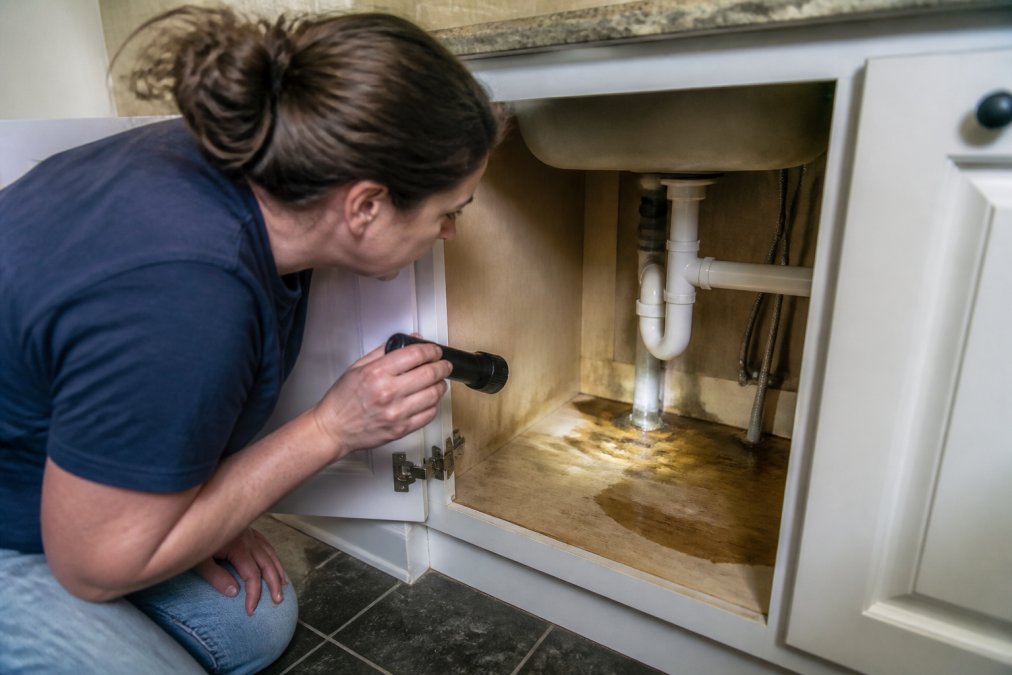
Common sources we find during inspections:
- Plumbing leaks behind walls or under sinks that drip slowly for months
- Leaky roofs where water enters the attic and travels down framing
- Condensation on cold pipes, windows, or AC ducts
- Crawl space moisture with no vapor barrier to block ground water
- Poor attic ventilation that traps humid air
- Basement waterproofing failures that let water seep through foundation walls
- HVAC system contamination where spores trapped in ductwork re-seed clean rooms
Why hidden moisture is so hard to catch
Water does not stay where it lands. It wicks through drywall, travels along framing, and pools at the lowest point in a cavity, often ten or fifteen feet from the leak. By the time you see a ceiling stain, the source may be in the attic.
Three mechanisms drive most hidden growth:
- Capillary action. Water climbs through porous materials like drywall and insulation, feeding mold above the visible water line.
- Stack effect. Warm air rises and escapes through the attic, pulling humid air up from crawl spaces and basements into living areas.
- Vapor diffusion. Moisture moves through solid materials as a gas, so a wall can be damp inside even when the surface feels dry.
The HVAC re-seeding problem most guides skip
Your ductwork is a closed loop touching every room. If spores settled in the air handler, evaporator coil, or duct liner, they stay there after surface remediation, and every time the system runs it blows them back into rooms you just cleaned.
Signs your HVAC system may be re-seeding mold:
- A musty smell that gets stronger when the AC or heat kicks on
- Visible growth around supply or return vents
- Dust or debris buildup on the evaporator coil
- Condensation on duct surfaces in humid months
- Allergy symptoms that flare in specific rooms
Material matters: porous vs. non-porous
Where mold lands determines whether it can be cleaned or must be removed.
| Material type | Examples | Typical approach |
|---|---|---|
| Porous | Drywall, insulation, carpet, ceiling tile, upholstery | Usually must be removed and replaced, cleaning rarely reaches growth inside |
| Semi-porous | Wood framing, plywood, concrete | Can sometimes be cleaned and sealed if growth is surface-level and drying is verified |
| Non-porous | Tile, metal, glass, sealed countertops | Can usually be cleaned and disinfected |
Never trust a visual inspection alone. Water travels along framing and pools far from where the leak starts. If you see mold on a ceiling, the source is often ten feet away in the attic, and the HVAC system may be spreading spores to rooms that look clean.
How Post-Remediation Verification Catches What Visual Inspections Miss
Post-remediation verification is an independent check that confirms mold cleanup actually worked, using air and surface samples rather than eyesight to measure spore count and air quality. Visual inspections only confirm what is visible; they cannot tell you if spores are still floating in the air or hiding in a wall cavity.
The process usually includes:
- Air sampling to measure airborne mold spores
- Surface sampling on cleaned materials
- Moisture readings to confirm structural drying
- Comparison of indoor vs. outdoor spore levels
Why Independent Mold Testing Matters for Confirming Success
Independent mold testing matters because the company that cleaned the mold should not be the only one grading its own work. A remediation company testing its own job has every reason to say the work passed, while an independent inspector has no stake in that outcome.
What independent testing gives you:
- A written report you can share with insurers or lawyers
- Lab-verified spore counts, not guesses
- A clear pass or fail on remediation quality
- Evidence if you need to hold a contractor accountable
Ask for the lab report, not just a summary. A real report shows raw spore counts by type and location. If a company only gives you a one-page “all clear,” ask why.
Common Remediation Mistakes That Lead to Re-Infestation
Most remediation failures trace back to a handful of avoidable mistakes:
- Skipping the moisture fix. Cleaning mold without repairing the leak is the fastest path to re-infestation.
- Not drying fully. Damp drywall and framing grow new mold in days.
- Missing HVAC contamination. Spores circulate through ducts and re-seed clean rooms.
- Using the wrong products. Some cleaners kill surface mold but leave spores in porous materials.
- No containment. Without plastic barriers, spores spread to other rooms during cleanup.
- Skipping HEPA vacuuming. Fine spores stay in carpet and dust until vacuumed with HEPA filtration.
- No verification. Going straight from cleanup to “done” with no testing.
Preventative Maintenance to Stop Mold From Coming Back
Preventative maintenance keeps moisture under control so mold never gets a foothold again: keep indoor humidity low, fix water problems fast, and know what your remediation warranty covers.
A practical routine looks like this:
| Task | How Often | Why It Matters |
|---|---|---|
| Check under sinks and around appliances | Monthly | Catches slow plumbing leaks early |
| Test indoor humidity with a hygrometer | Weekly | Keeps relative humidity below 60% |
| Run exhaust fans in baths and kitchen | Every use | Removes condensation at the source |
| Inspect attic and crawl space | Seasonally | Spots roof leaks and trapped moisture |
| Clean gutters and check grading | Twice a year | Stops water from pooling near the foundation |
| Replace HVAC filters (HVAC Proper Installation of Filters) | Every 1-3 months | Keeps air quality and airflow strong |
| Inspect ductwork and air handler | Annually | Catches spores that re-seed clean rooms |
| Schedule a professional mold inspection | Annually | Finds hidden issues before they spread |
What your remediation warranty should, and should not, cover
A remediation warranty is a written promise about the work, but scope varies wildly between companies. Before you sign, get it in writing and read three things:
- What is covered. Most warranties cover re-treatment of the same area if mold returns, but only if the original moisture source was fixed and stayed fixed. If a new leak appears, that is usually on you.
- How long it lasts. Common terms range from 30 days to a few years. Longer is not automatically better if the exclusions are broad.
- What voids it. Failing to run a dehumidifier, ignoring a new leak, or doing your own cleanup in the treated area can void coverage.
Who is liable when mold comes back
Liability usually splits along one question: was the recurrence caused by the original problem or something new?
- Contractor liability typically applies if the moisture source was not fixed, drying was not verified, or containment was inadequate during the original job.
- Homeowner liability typically applies if a new leak, plumbing failure, or humidity problem developed after the job, or if recommended preventative steps were skipped.
- Landlord liability in rental properties often hinges on whether the tenant reported moisture issues and whether the landlord responded in a reasonable time.
What to do if mold comes back anyway
If you see new growth after remediation, do not start spraying bleach. Follow this order:
- Stop the moisture. Find and fix whatever is wet, a new leak, a failed dehumidifier, a clogged condensate line.
- Document everything. Photos, dates, and the location of the new growth.
- Call for independent testing. A neutral inspector can tell you whether this is leftover contamination from the original job or a brand-new problem.
- Contact the original remediator. With a lab report in hand, you have leverage. Without one, you have a conversation.
- Escalate if needed. State licensing boards, consumer protection agencies, and in some cases small claims court are options when a contractor will not honor a warranty.
Before you hire any remediator, ask two questions in writing: “What does your warranty cover, and what voids it?” and “Will you provide post-remediation verification from a third party?” The answers tell you more than any review.
The single rule that prevents most repeat mold: fix the water, dry the space, prove it with testing, and know your warranty before you need it. Skip any of these and you will likely see mold again.
Conclusion
Mold keeps coming back for one reason: the moisture that feeds it never went away. Killing surface mold, skipping verification, or ignoring a hidden leak all lead to the same result. Break the cycle by fixing the water source, drying completely, and confirming success with independent testing.
Frequently Asked Questions
Can mold come back after remediation?
Yes, mold can return if the underlying moisture problem is not fully resolved. Remediation removes visible mold and spores, but if hidden moisture sources like plumbing leaks, high humidity, or condensation remain, mold will regrow. Post-remediation verification and independent mold testing help confirm that moisture levels are back to normal and that no spores remain. Without addressing the water source, re-infestation is likely within weeks or months.
What does it mean when mold keeps coming back?
Recurring mold usually means there is an unresolved moisture issue, such as a slow leak behind walls, a clogged HVAC drain, or inadequate ventilation. It can also indicate that the remediation process missed hidden mold in porous materials or that structural drying was incomplete. A thorough mold inspection with moisture meters and thermal imaging can identify the source. Independent mold testing after remediation provides objective evidence of whether the problem was truly fixed.
How can I tell if mold remediation was successful?
Success is confirmed through post-remediation verification, which includes visual inspection, moisture readings, and air quality testing. A certified inspector will check that moisture levels are normal (typically below 15% in wood) and that spore counts indoors are at or below outdoor levels. Without independent mold testing, you cannot be sure that hidden mold or moisture remains. Clearance testing by a third party ensures the remediation achieved its goal.
Does insurance cover mold if it returns after remediation?
Insurance coverage for mold that returns depends on your policy and the cause. Most policies cover mold remediation if it resulted from a sudden, accidental water damage event, but they may not cover recurrence if the underlying issue was not fixed or was due to neglect. Some insurers require proof of proper remediation and post-remediation verification. Review your policy and consult your adjuster; independent mold testing can provide documentation to support your claim.