
Last Updated: October 26, 2026
Quick Summary
The long term health effects of mold for first responders are mainly respiratory: asthma exacerbation, allergic rhinitis, chronic sinusitis, and hypersensitivity pneumonitis, driven by repeated unprotected exposure to high spore counts in water-damaged buildings. The mechanism is airway inflammation and sensitization rather than infection, so smaller exposures can trigger larger reactions over a career. Claims of generalized mold toxicity are not well supported.
- Responders face repeated, unprotected exposure to high spore counts in confined spaces, not one bad exposure.
- Symptoms that fade after leaving a building point to an irritant or allergic trigger; those lasting weeks need a medical look.
- A fitted N95 or P100 respirator worn correctly sharply cuts spore inhalation, and fit matters more than filter rating.
- Track symptoms against your call log to bring a clear pattern to an occupational health visit.
- A professional assessment should include air sampling, moisture mapping, a written lab report, and next steps.
Table of Contents
- Why Repeated Mold Exposure Hits First Responders Harder
- Mold Exposure Symptoms That Show Up First
- How Mold Exposure Duration Changes the Picture
- Respiratory and Chronic Health Effects That Can Last
- Mold Exposure Risk Factors That Raise Your Odds
- First Responder Respiratory Protection and Workplace Controls
- Telling Mold Effects Apart From Other Occupational Exposures
- Book an Indoor Air Quality Test Before Your Next Shift
- Frequently Asked Questions
Why Repeated Mold Exposure Hits First Responders Harder
First responders face a heavier mold burden than the general public because they enter water-damaged buildings on every shift, often within hours of a flood or fire, which is why the long term health effects of mold for first responders deserve close attention. The long term health effects of mold for first responders come from that pattern: repeated, unprotected exposure to high spore counts in confined spaces.
Most people get one bad exposure. Responders get dozens.
Where Responders Meet Mold on the Job
Firefighters pull ceilings and open walls, releasing spores into the air. EMS crews enter damp apartments. Police serve warrants in vacant buildings with leaking roofs. Flood crews wade through standing water for days.
Each of those scenes carries a common trigger: moisture that never dried.
- Water-damaged drywall and ceiling tile
- Carpet soaked for more than 24 to 48 hours
- Crawl spaces and basements with no ventilation
Veterans and responders with service-related exposure can find focused testing guidance through mold testing for veterans and first responders.
Mold Exposure Symptoms That Show Up First
The earliest mold exposure symptoms are usually irritation, not infection. Most responders notice them within hours to days of a call in a contaminated building.
Watch for these:
- Nasal congestion and sneezing
- Dry cough or throat clearing
- Itchy, watery eyes
Symptoms that fade after you leave the building point to an irritant or allergic trigger. Symptoms that persist for weeks deserve a medical look. A common mistake is writing off a recurring cough as “just the job.”
How Mold Exposure Duration Changes the Picture
Mold exposure duration matters more than any single event. One hour in a wet basement is different from ten years of calls in flooded buildings.
Short-term exposure tends to produce irritation and allergy-type reactions. Long-term or chronic exposure is where the conversation shifts toward airway inflammation and chronic respiratory symptoms.
Here is the practical split:
| Exposure Pattern | Typical Response | What to Watch |
|---|---|---|
| Single short call | Eye, nose, throat irritation | Clears within days |
| Repeated calls, no protection | Recurring cough, congestion | Symptoms return each shift |
| Years of chronic exposure | Chronic cough, wheezing, fatigue | Needs medical evaluation |
Duration is one variable. The building itself is the other.
Respiratory and Chronic Health Effects That Can Last
The most documented long-term concerns are respiratory. Mold spores, hyphae fragments, and the volatile and particulate byproducts of mold growth trigger an immune response in the airways, and repeated exposure can keep that response switched on long after the building is left. The key mechanism is not infection, it is inflammation and sensitization. Once the immune system is primed, smaller exposures can produce larger reactions, which is why a responder’s tenth flooded basement can hit harder than the first.
Asthma and Asthma Control
Responders with existing asthma often report more frequent attacks, more rescue-inhaler use, and worse control after repeated exposure to water-damaged buildings. For responders without prior asthma, new-onset wheezing and exercise intolerance are the patterns occupational health clinicians watch for. The practical point: a change in asthma control after a run of moldy calls is a clinical signal, not a coincidence to push through.
Allergic Rhinitis and Chronic Sinusitis
Allergic rhinitis, congestion, sneezing, runny nose, itchy eyes, is the most common complaint. When nasal inflammation recurs shift after shift, it can settle into chronic sinusitis with facial pressure, post-nasal drip, and reduced smell. Responders often mistake this for a perpetual cold. The tell is timing: symptoms that track with certain buildings and ease on days off point to an environmental trigger.
Hypersensitivity Pneumonitis and Inflammatory Lung Disease
Hypersensitivity pneumonitis is a rarer immune-mediated reaction to inhaled organic dust, and it can progress to inflammatory lung disease and scarring if exposure continues. It is not the same as an allergy, and it is not diagnosed by a home test kit. Evaluation typically involves a detailed exposure history, chest imaging, and pulmonary function testing, sometimes with input from an occupational medicine specialist.
Other Conditions Worth Knowing
- Allergic bronchopulmonary aspergillosis (ABPA): an immune reaction to Aspergillus species that can complicate asthma or cystic fibrosis; it requires clinical and laboratory evaluation.
- Organic dust toxic syndrome (ODTS): a flu-like illness after heavy organic dust exposure, more common during demolition and cleanup than during routine calls.
- Irritant-induced airway symptoms: cough, chest tightness, and throat irritation from the irritant compounds mold produces, which can persist after exposure ends.
What the Evidence Does and Does Not Support
Established associations include respiratory irritation, asthma exacerbation, allergic rhinitis, and hypersensitivity pneumonitis in susceptible people. Claims of generalized “mold toxicity” causing broad systemic disease are not well supported and should not be treated as a diagnosis. Responders are better served by documenting specific symptoms and getting a clinical evaluation than by self-diagnosing a syndrome.
Track your symptoms against your call log. A pattern tied to specific buildings, easing with time away, is the strongest signal you can bring to an occupational health visit.
For a deeper look at symptom patterns, read health symptoms linked to toxic mold.
Mold Exposure Risk Factors That Raise Your Odds
Not every responder reacts the same way. Individual risk factors explain part of the difference, but for responders the bigger variables are the exposure scenarios themselves, how, where, and how often the exposure happens. Most general guides stop at the personal list. The responder-specific picture is more useful.
Personal Risk Factors
- Pre-existing asthma, allergies, or chronic sinusitis
- A weakened immune system or immunosuppressive medication
- Smoking or vaping, which impair airway clearance
Two responders on the same call can walk out with very different symptoms. That is normal, and it is why blanket advice fails.
First-Responder Exposure Scenarios That Raise Risk
Household exposure is usually steady and low-level. Responder exposure is the opposite: unpredictable concentrations, repeated incidents, and confined spaces.
- Fire overhaul and demolition: pulling ceilings and opening walls releases concentrated spores and organic dust into a confined space, often before ventilation is established.
- Flood and water-damage response: wading through standing water, moving soaked materials, and working in buildings that have been wet for days, the window when mold growth accelerates.
- Building searches and vacant-structure entries: leaking roofs, blocked ventilation, and long-shift occupancy in spaces no one has maintained.
- Cleanup and remediation support: the highest spore loads often occur during disturbance, not during the initial entry.
Monitoring Your Own Symptoms
A simple symptom log, date, building or incident, symptoms, and whether respiratory protection was worn, gives an occupational health clinician something to work with. Bring it to periodic health evaluations. If you develop persistent cough, wheezing, exertional shortness of breath, or recurrent sinus symptoms, request a pulmonary or allergy evaluation rather than waiting for an annual physical.
Telling Mold Apart From Other Occupational Exposures
Responders are exposed to smoke, diesel exhaust, asbestos, chemicals, and infectious agents, often on the same call. Mold effects tend to track with specific buildings, worsen indoors, and ease with time away. Smoke and chemical exposure often hit immediately and affect the whole crew. Asbestos-related disease has a long latency and does not present as next-week irritation. Sorting these apart is genuinely hard, which is why documentation and clinical evaluation matter more than self-diagnosis.
A mask pulled down to talk defeats the seal. That single habit is behind a lot of recurring symptoms, and it is the easiest risk factor to control.
If you want to connect symptoms to indoor air rather than other exposures, indoor air quality testing and its health benefits explains what testing can and cannot show.
First Responder Respiratory Protection and Workplace Controls
First responder respiratory protection is the single most controllable variable. A fitted N95 or P100 respirator, worn correctly, cuts spore inhalation sharply.
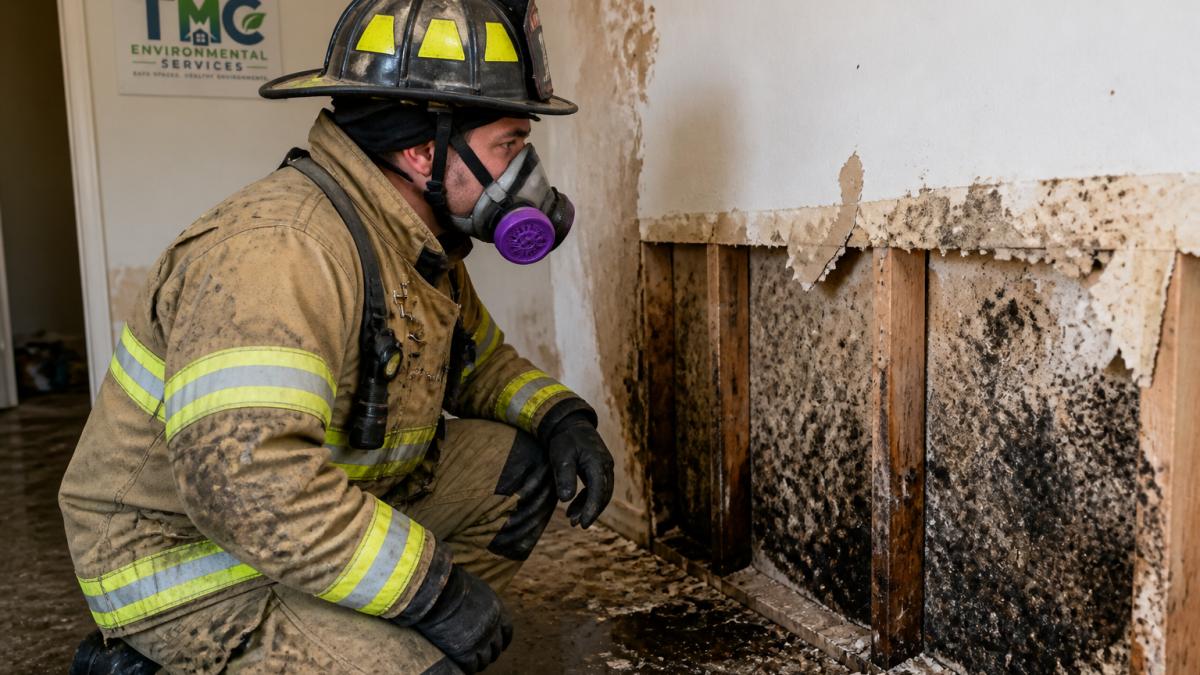
Workplace controls to push for:
- Respiratory protection issued and fit-tested
- Moisture assessment before crews enter
- Ventilation or negative air pressure during demolition
- Gloves and eye protection for contact work
Watch out: a mask pulled down to talk defeats the seal. That single habit is behind a lot of recurring symptoms.
Telling Mold Effects Apart From Other Occupational Exposures
This is the part most guides skip. Responders are exposed to smoke, diesel exhaust, asbestos, chemicals, and mold, often on the same call.
Mold effects tend to follow a pattern: symptoms tied to specific buildings, worse indoors, easing with time away.
If you want to connect symptoms to indoor air rather than other exposures, indoor air quality testing and its health benefits explains what testing can and cannot show.
Book an Indoor Air Quality Test Before Your Next Shift
Testing turns a guess into data. A professional assessment measures spore levels, finds hidden moisture, and gives you a written record you can take to a doctor or a supervisor.
Here is what a proper assessment should cover:
- Air sampling in the areas you actually work
- Moisture mapping to find the source
- A written report with lab results
- Clear next steps for remediation
Watch out: a test with no moisture investigation just confirms spores exist. It will not tell you why, and the problem returns.
If you are deciding whether it is worth it, is air quality testing worth it walks through the reasoning. To see what a professional analysis involves, read the benefits of professional indoor air quality analysis.
Responders spend careers entering buildings most people avoid. The exposure adds up, and the health effects tend to follow the same pattern: irritation first, then respiratory problems that linger.
Frequently Asked Questions
Are first responders at higher risk from mold exposure?
Yes, in practice. Firefighters, EMTs and police officers routinely enter flooded, water-damaged buildings where mold spores are already airborne, often before the structure is dried out. Repeated call-outs mean repeated inhalation, and that adds up over a career. Risk climbs further when responders skip respiratory protection, work in confined spaces, or return to the same chronically damp property multiple times. A baseline indoor air quality test at home also matters, since gear and clothing can carry spores back to living spaces.
How long can symptoms from mold exposure last?
It depends on mold exposure duration and the person. Short, one-off exposures often clear within days to a few weeks once the source is removed. Repeated occupational exposure can keep symptoms going for months, especially where chronic cough, nasal congestion or skin irritation are involved. Some responders develop longer-lasting allergic rhinitis or asthma that needs ongoing management. If symptoms persist past a few weeks after you leave the environment, a medical evaluation is the right next step.
When should a first responder seek medical care after mold exposure?
Get evaluated if you notice wheezing, shortness of breath, chest tightness, a cough that will not quit, or flu-like symptoms after working in a moldy structure. Seek care sooner if you have asthma, a known allergy, or an immune condition. Bring details of the exposure, including how long you were inside and whether you wore respiratory protection. Documenting the exposure helps your doctor distinguish mold-related effects from other occupational causes and supports any workers’ compensation claim.
How can first responders reduce mold exposure during a call?
Wear a fitted N95 or P100 respirator in any water-damaged building, and upgrade to a full-face respirator with cartridges for heavy growth or confined spaces. Ventilate when possible, limit time inside, and bag contaminated gear before it goes into a vehicle or locker. Change out of work clothing before entering your home, and shower after shift. If you suspect mold in your own home, schedule an air quality test so you know what you are breathing between calls.
