
Table of Contents
- Why Indoor Air Quality Testing Matters for Your Health
- Health Effects of Poor Indoor Air Quality
- When to Test Indoor Air Quality
- Indoor Air Quality Test for Mold and Contaminant Detection
- Professional Indoor Air Quality Testing vs. DIY Approaches
- What to Do After Testing Identifies a Problem
- Frequently Asked Questions
Last Updated: October 11, 2026
Why Indoor Air Quality Testing Matters for Your Health
Indoor air quality testing is one of the most overlooked investments a homeowner can make. The EPA reports that indoor air can be 2-5 times more polluted than outdoor air (the EPA).
You can’t see most indoor air pollutants, mold spores, carbon monoxide, radon, and VOCs are invisible. Without testing, families live with poor indoor air quality for months or years, experiencing unexplained health symptoms.
Professional indoor air quality testing identifies invisible contaminants before they cause serious health problems. Early detection protects your family’s respiratory health, cognitive function, and overall well-being.
Health Effects of Poor Indoor Air Quality
Poor indoor air quality triggers real, measurable health problems. Mold, radon, carbon monoxide, and particulates cause immediate physical responses you may not connect to your home’s air.
Respiratory Issues and Asthma Symptoms
Mold spores and airborne contaminants inflame your respiratory system, triggering asthma attacks and causing persistent coughing, wheezing, shortness of breath, and chest tightness.
Children are especially vulnerable, their developing lungs can suffer long-term respiratory damage. Allergens like dust mites and pet dander accumulate in poorly ventilated homes, triggering allergic reactions and asthma flare-ups.
Headaches, Fatigue, and Cognitive Effects
Headaches are common in homes with poor indoor air quality. Carbon monoxide and radon exposure both cause headaches, dizziness, and confusion.
Fatigue and cognitive fog, waking exhausted despite adequate sleep, struggling to focus, reflect your brain’s response to oxygen deprivation and toxin exposure.
Children struggling in school and adults underperforming at work often have air quality problems, not motivation issues.
If your family experiences unexplained fatigue, headaches, or difficulty concentrating, indoor air quality testing should be your first step before pursuing other medical investigations. Many families discover the culprit is their home environment, not a health condition.
When to Test Indoor Air Quality
Not every home needs testing immediately. But certain situations make it essential.
After Water Damage or Visible Moisture
Water damage creates ideal conditions for mold growth. Even after drying and cleaning visible mold, hidden moisture and mold can remain inside walls, under flooring, and in HVAC systems.
Professional indoor air quality testing is critical here. Visible cleanup isn’t enough, mold spores spread through your home’s air. Testing reveals whether mold is still actively growing and releasing spores.
After water events, burst pipes, roof leaks, or flooding, schedule testing to prevent mold colonies from establishing in hidden areas.
If You Suspect Hidden Contaminants
Sometimes you sense something’s wrong: your family gets sick more often, the house smells off, or unusual odors persist despite cleaning. These signal hidden contaminants.
Indoor air quality testing pinpoints the problem, mold in the attic, carbon monoxide from a faulty furnace, radon from the foundation, or VOCs from new materials, with certainty.
| Symptom | Possible Contaminant | Testing Method |
|---|---|---|
| Musty odors | Mold | Air quality test for mold |
| Headaches, dizziness | Carbon monoxide | CO detector + professional assessment |
| Radon exposure risk | Radon | Radon-specific air quality test |
| Chemical smells | VOCs | VOC air quality testing |
Indoor Air Quality Test for Mold and Contaminant Detection
Indoor air quality testing measures what’s actually in your air. Different tests target different contaminants, helping you choose the right assessment.
What Tests Measure and How to Interpret Results
Professional indoor air quality testing uses specialized equipment to collect and analyze air samples, providing specific measurements: spore counts, chemical concentrations, and contamination levels.
Mold testing measures spore counts and compares indoor levels to outdoor baselines. If indoor counts exceed outdoor counts, mold is actively growing inside your home.
Carbon monoxide testing detects CO levels in real time.
Radon testing runs 2-7 days, measuring gas accumulation.
Never ignore test results showing elevated contaminants. Continued exposure causes cumulative health damage. Even “slightly elevated” levels add up over months and years. Address findings immediately with professional remediation.
Identifying Radon, Carbon Monoxide, and VOCs
Radon is an odorless, invisible radioactive gas that seeps from soil beneath your home. Long-term exposure increases lung cancer risk; testing is the only way to detect it.
Carbon monoxide from furnaces, water heaters, fireplaces, and car exhaust binds to hemoglobin, preventing oxygen transport. Exposure causes headaches, nausea, and confusion; high exposure is fatal.
VOCs from paint, adhesives, cleaning products, and new furniture off-gas into the air, especially in new homes or after renovations, causing respiratory irritation, headaches, and allergic reactions.
Professional indoor air quality testing identifies all three, clarifying remediation strategies: radon mitigation systems, furnace repairs, ventilation improvements, or source removal.
Professional Indoor Air Quality Testing vs. DIY Approaches
DIY air quality testing kits are widely available and inexpensive. Understanding their limitations and when professional assessment is necessary helps you make the right choice.
What DIY Kits Actually Measure
Radon test kits are the most reliable DIY option. EPA-approved charcoal canisters or electret detectors cost $15-$40 per kit. Place the device in your lowest lived-in level for 48 hours to 7 days, then mail it for lab analysis. Results are directly comparable to EPA action levels. Many homeowners use DIY kits as initial screening; borderline or elevated results warrant professional follow-up testing.
Carbon monoxide detectors differ from professional CO testing. Consumer detectors alert you at dangerous levels (typically 70 ppm or higher) but don’t provide precise measurements or exposure records. They’re useful for safety but not for diagnosing low-level leaks from furnaces or water heaters.
Mold test kits are widely marketed but problematic. Most use petri dishes exposed to air for 24-48 hours, then mailed for analysis. Results show whether mold spores are present, which they always are, but without a professional outdoor baseline collected the same day, you cannot determine if indoor levels are elevated.
Why Professional Testing Provides Answers DIY Kits Cannot
Professional indoor air quality testing differs from DIY kits in scope, accuracy, and interpretation.
Comprehensive assessment. A professional technician inspects your home for moisture intrusion, visible mold, HVAC condition, ventilation patterns, and contamination sources. They identify where moisture accumulates, where air leaks occur, and where contaminants hide.
Calibrated equipment and proper methodology. Professional air sampling pumps are calibrated annually and certified for accuracy, following EPA and AIHA protocols. DIY kits lack calibration requirements and are sensitive to placement and air movement.
Baseline comparison and context. Professional mold testing includes an outdoor baseline sample collected the same day, allowing direct comparison.
Written documentation and expert interpretation. A professional report explains results, identifies sources, and recommends remediation. This documentation is essential for insurance claims, landlord proof, or real estate transactions.
Moisture mapping and source identification. Professional technicians use moisture meters, thermal imaging, and visual inspection to locate moisture intrusion and mold sources, identifying roof leaks, foundation cracks, or plumbing issues driving mold growth.
Cost and Timeline Comparison
DIY radon kit: $25-$65 total. Timeline: 2-7 days testing, 1-2 weeks for results.
Professional radon test: $150-$500. Timeline: 2-7 days testing, 3-5 business days for results.
DIY mold kit: $40-$80 per room. Timeline: 24-48 hours testing, 1-2 weeks for results (often inconclusive without professional interpretation).
Professional mold and moisture assessment: $300-$800, including air sampling, surface swabs, moisture mapping, and report. Timeline: 2-4 hours on-site, 3-5 business days for results.
Elevated DIY results typically require professional follow-up, negating initial savings. Many homeowners find professional testing more cost-effective from the start, especially when mold, radon, or CO is suspected.
When DIY Testing Makes Sense
- Radon screening in low-risk areas as an inexpensive initial check before deciding on professional testing.
- Ongoing radon monitoring after mitigation using annual DIY kits, supplemented by professional testing every 2 years.
- CO detector verification after alarm and furnace/water heater inspection to confirm CO is no longer present.
When Professional Testing Is Essential
Professional assessment is necessary when:
- You suspect mold. Visible mold, musty odors, water damage, or respiratory symptoms warrant professional inspection and air sampling. DIY kits cannot reliably confirm whether mold is actively growing or identify the source.
- Radon results are borderline (2-4 pCi/L). A DIY test showing levels near the EPA action level should be followed by a professional multi-day test to confirm the finding before investing in mitigation.
- You have unexplained health symptoms. If your family experiences respiratory issues, headaches, or fatigue that might be air-quality related, a professional assessment can evaluate multiple contaminants and identify sources. A single DIY test won’t provide enough information.
- You’re buying or selling a home. Real estate transactions require professional radon testing (typically 48 hours minimum) and written documentation. DIY results are not accepted by lenders or title companies.
- You have combustion appliances and suspect CO. A professional CO assessment includes inspection of furnaces, water heaters, and fireplaces to identify leaks and ensure safe operation.
- You need insurance or legal documentation. Professional reports with detailed methodology, results, and recommendations are admissible in insurance claims and legal disputes. DIY results are not.
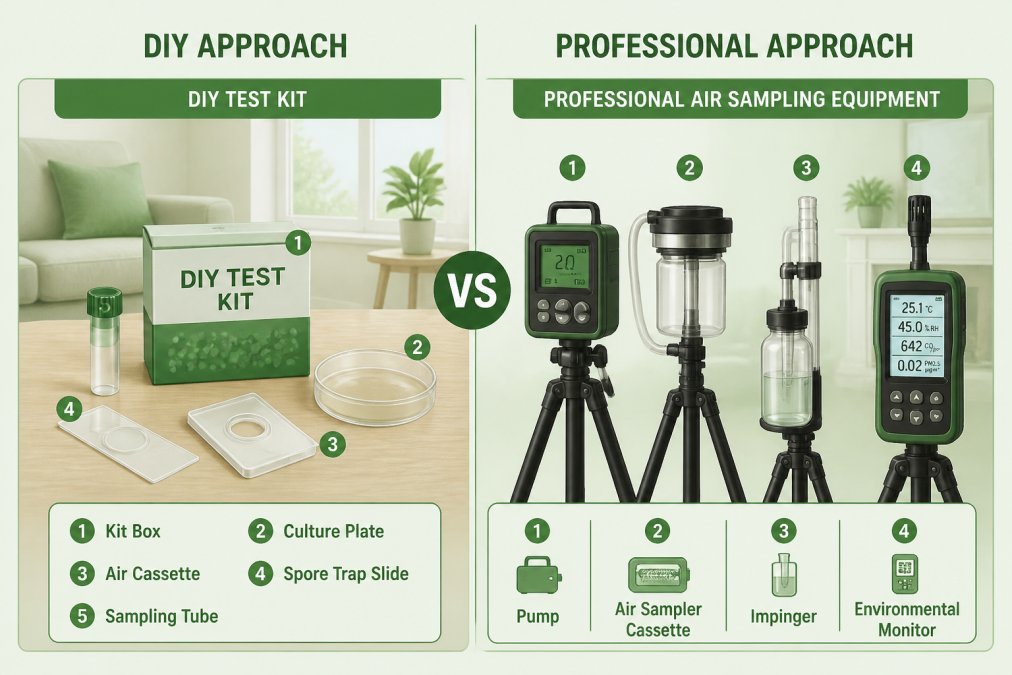
DIY radon kits can serve as an initial screening tool, but mold, CO, and VOC assessment require professional expertise, calibrated equipment, and source identification. If you suspect a serious air quality problem or need documentation for insurance or real estate purposes, professional testing is the only reliable choice.
What to Do After Testing Identifies a Problem
Test results showing elevated contaminants aren’t the end of the process. They’re the beginning of remediation.
If mold is present, source removal comes first. Find where moisture is entering and stop it. Then remove contaminated materials and remediate affected areas. Post-remediation testing confirms that mold levels have returned to normal.
Carbon monoxide requires immediate action. Shut down the contamination source, repair or replace the furnace, water heater, or fireplace. Have a professional inspect the equipment. Retest after repairs to confirm CO levels are safe.
Radon mitigation involves installing a radon reduction system. These systems vent radon gas from beneath your home to the atmosphere above the roof. Testing 2-4 weeks after installation confirms the system is working.
VOC exposure decreases through ventilation. Open windows, improve HVAC filtration, and remove off-gassing sources. Retest after 30 days to track improvement.
Testing identifies the problem. Professional remediation fixes it. Follow-up testing proves success. This three-step process protects your family’s health and provides documentation for insurance, legal, or real estate purposes.
Testing your home’s indoor air quality gives you answers. You stop guessing about unexplained health symptoms. You identify hidden mold, radon, carbon monoxide, and other contaminants before they cause serious damage.
Frequently Asked Questions
What does bad indoor air quality do to your health?
Poor indoor air quality exposes you to airborne contaminants including mold spores, allergens, carbon monoxide, radon, and volatile organic compounds (VOCs). Short-term exposure can cause headaches, eye irritation, throat discomfort, and fatigue. Long-term exposure increases respiratory issues, asthma attacks, and allergy symptoms. People with existing health conditions, children, and elderly residents face higher risks. Indoor air quality testing identifies these hidden threats before they cause lasting damage to your health and well-being.
When should you consider professional indoor air quality testing?
Test after water damage, visible moisture, or unusual odors appear. Also test if household members experience unexplained respiratory symptoms, persistent headaches, or sleep quality decline. Real estate agents recommend testing during pre-purchase inspections. Landlords should test to verify tenant safety and property compliance. If you suspect mold growth or have experienced previous mold issues, professional testing identifies whether the problem has returned or if hidden moisture intrusion exists. Testing provides documented evidence for insurance claims and remediation decisions.
Can indoor air quality testing identify the cause of my symptoms?
Indoor air quality testing detects specific contaminants like mold, allergens, radon, and VOCs that contribute to health symptoms. However, testing alone does not diagnose medical conditions. If you experience respiratory issues, headaches, or fatigue, consult your healthcare provider. Testing results show what pollutants exist in your home, which helps your doctor understand potential environmental factors. Professional testing combined with medical evaluation provides the clearest picture of whether indoor air quality is affecting your health and what remediation steps are needed.
What’s the difference between DIY air quality testing and professional assessment?
DIY kits measure basic parameters like particulate matter but cannot detect hidden contaminants in walls, crawlspaces, or HVAC systems. Professional testing uses advanced technology to identify moisture intrusion points, mold in non-visible areas, radon levels, carbon monoxide exposure, and specific VOCs. Professionals interpret results in context of your home’s ventilation, HVAC performance, and health risks. Professional findings are documented and defensible for insurance claims, real estate transactions, and remediation decisions. For homes with water damage history or suspected mold, professional assessment provides the certainty DIY testing cannot.