
Table of Contents
- Start With the Signs of Hidden Mold in a House
- Where Mold Hides in a Home: A Room-by-Room Checklist
- How to Check for Moisture in Walls Without Cutting Them Open
- How to Tell Mold Clues From Other Causes
- When to Test for Mold (and When to Skip It)
- When Not to Investigate or Disturb Materials Yourself
- Find and Fix the Moisture Source Before Remediation
- Frequently Asked Questions
Last Updated: October 17, 2026
Start With the Signs of Hidden Mold in a House
Hidden mold is fungal growth that develops inside wall cavities, under flooring, or behind ceilings where you cannot see it, usually fed by a slow leak or trapped dampness. Learning how to identify hidden mold growth starts with clues your nose and eyes can pick up before any growth becomes visible. At The Mold Consultant, LLC, we have spent over a decade tracing those clues back to their source in homes and commercial buildings.
Mold needs three things: moisture, organic material like drywall paper or wood, and time. Remove the moisture and growth stalls. That is why every sign below points to the same question: where is the water coming from?
Musty, Earthy, or Sour Odors
A musty odor is the single most reliable early signal. Mold releases gases as it breaks down damp materials, and that earthy, basement-like smell often shows up weeks before a stain appears. If one room smells off and the rest of the house does not, treat that room as the starting point.
Water Stains, Discoloration, and Bubbling Paint
Discoloration on a ceiling or wall, especially rings of brown or yellow, means water has been moving through the material. Bubbling paint and peeling wallpaper are the same story told differently: moisture is pushing from behind. Cracking or dripping sounds inside a wall round out the picture.
Where Mold Hides in a Home: A Room-by-Room Checklist
Most hidden mold growth clusters in the rooms with the most water and the least airflow. Walk your home in this order and note anything damp, stained, or smelly.
- Basements and crawl spaces: check the rim joist, sill plate, and any cardboard or stored boxes.
- Closets: smell the back wall and the floor near exterior walls.
- Bathrooms: look under the sink, behind the toilet tank, and around the tub caulk.
- Kitchens: pull the fridge out and check the cabinet under the sink.
- Laundry areas: inspect behind the washer and the dryer vent connection.
- Attics: check roof sheathing for dark streaks.
Basements, Crawl Spaces, and Closets
These spaces hold damp air with nowhere to go. A crawl space with no vapor barrier lets ground moisture rise straight into the floor structure above. In closets, exterior-wall condensation is the usual culprit.
Bathrooms, Kitchens, and Laundry Areas
Supply-line leaks and worn caulk drive most growth here. Run the exhaust fan during and after showers, and check under sinks every few months.
How to Check for Moisture in Walls Without Cutting Them Open
Non-destructive moisture checks can tell you whether a wall is wet without opening it up, and that is exactly how we approach inspections. But the tools are easy to misread, so it helps to know what each one actually measures before you trust a number.
What a Pin-Type Moisture Meter Tells You, and What It Doesn’t
A pin-type meter drives two small electrodes into the drywall paper or wood and measures electrical resistance between them. Water conducts electricity better than dry material, so lower resistance reads as higher moisture. That is a relative signal, not a percentage of water in the wall.
The practical move is to compare readings across the same material in the same room. Take a baseline in a dry area, then read near the baseboard, under a window, and around any stain. Pin meters also leave tiny holes, so avoid finished surfaces you cannot touch up, and never push pins into suspected asbestos-containing material.
Pinless Meters and Thermal Imaging
A pinless (capacitive) meter scans through the surface without holes, which makes it useful for a first pass over large areas. It is more sensitive to what is just beneath the surface and to metal or wiring inside the wall, so it is a screening tool, not a confirmation. Thermal imaging shows temperature differences; wet framing and insulation often read cooler than dry material, and evaporating moisture can create a visible pattern. Our team uses thermal imaging to find the likely zone, then confirms with a pin meter. Neither tool detects mold, they detect moisture, and moisture is the condition mold needs.
Reading the Results Without Overclaiming
Treat every reading as a clue, not a verdict. A high reading means “investigate here,” not “mold is present.” A low reading does not rule out mold in a wall that has since dried. Pair the meter with your senses: run a hand along the wall for cool spots, look for paint that feels soft or blistered, and note any musty odor that gets stronger near an outlet or baseboard.
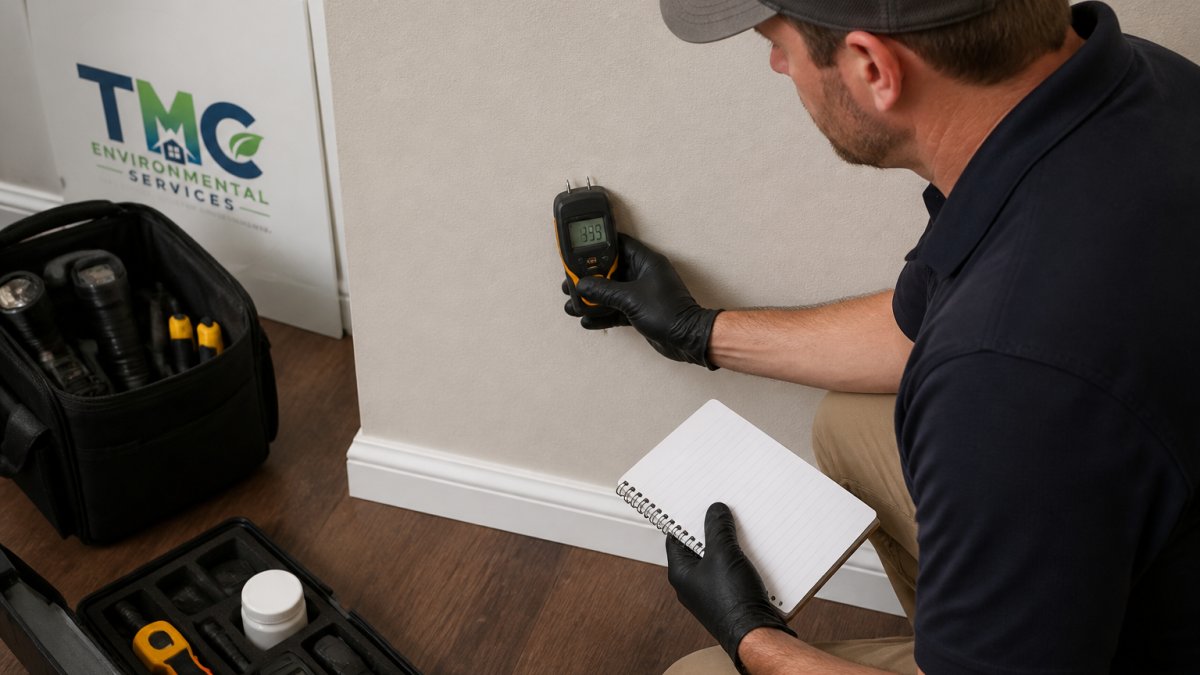
Photograph the meter screen next to the spot you tested, with a date visible. A before-and-after record of readings is far more useful to an adjuster or contractor than a single number written on a notepad.
How to Tell Mold Clues From Other Causes
Not every dark spot is mold, and not every smell is fungal. Mildew from a shower stays on the surface and wipes away. Dirt streaks near vents come from airflow, not water. Old water stains can stay brown long after the material dried out.
The tiebreaker is moisture. If a stain is dry and stable, it may be historical. If a meter reads high or the smell returns after cleaning, you likely have an active source. According to the EPA’s guide to mold and moisture control, fixing the water problem is the core of any mold strategy.
When to Test for Mold (and When to Skip It)
Testing is one of the most misunderstood steps in the whole process. A mold test does not tell you whether your home is “safe”, it tells you what types and how much mold material showed up in one sample at one moment. That can be useful evidence, but it is rarely the first thing you need.
What Mold Tests Can and Cannot Establish
Air sampling draws a known volume of air through a cassette and later analyzes the spores caught on the medium. Surface sampling (tape lifts or swabs) tells you what is growing on a specific spot. Both are snapshots. Spore counts shift with weather, HVAC operation, foot traffic, and the season, so a single air sample is hard to compare against a single outdoor baseline. Labs report results in spores per cubic meter or as a relative index, and interpretation depends on the lab’s method and the sampler’s technique.
When Testing Is Worth the Cost
Testing makes sense when you need documentation for another party: a real estate transaction, an insurance claim, a landlord-tenant dispute, or a health concern your doctor raised. In those cases, use an accredited laboratory and a sampler who documents conditions, because the chain of custody and the report matter as much as the result. Skip testing when growth is visible and the source is obvious, you already know what to do: dry it out and fix the leak. A test adds cost without changing the plan.
A Decision Path for the In-Between Cases
Most homes fall between “obvious visible mold” and “no idea.” Use this sequence:
- Monitor: A faint musty odor or a single old stain with dry meter readings and no recurrence after cleaning. Note it, recheck in a few weeks, and keep the area ventilated.
- Investigate further: A smell that returns, a meter reading that stays high, or a stain that grows. Do a non-destructive check with a moisture meter and thermal imaging before considering any opening.
- Arrange professional assessment: Growth larger than a few square feet, growth inside a wall or HVAC system, or a moisture source you cannot trace. A professional inspection with moisture mapping and, if warranted, sampling gives you a defensible picture.
- Address a known moisture problem now: An active leak, flooding, or condensation you have already identified. Fix the water first; testing can wait until the source is controlled.
The EPA’s guide to mold and moisture control is clear that controlling moisture is the core of any mold strategy, and the CDC’s page on mold and health is a useful starting point for exposure concerns. Neither replaces a site-specific inspection when the clues point inside a wall.
Test for evidence, not for peace of mind. If you already know where the water is coming from, spend the money on fixing it, not on a sample that will only confirm what your nose already told you.
When Not to Investigate or Disturb Materials Yourself
Stop and call a professional if disturbing the area could release spores or hazardous fibers into your air. Do not cut into walls with heavy growth, sand stained drywall, or rip up flooring on your own. In older homes, disturbed materials can also contain asbestos or lead, which require separate testing.
Sanding or cutting moldy drywall without containment spreads spores through the house and can turn a small cleanup into a full remediation. If the area is larger than a few square feet, leave it sealed and get an inspection.
Find and Fix the Moisture Source Before Remediation
Remediation without source control fails. We see it often: growth cleaned up, then back within months because the slow leak behind the shower valve was never fixed. Trace the water first.
- Check supply lines, shutoff valves, and appliance hoses.
- Inspect the roof and flashing after heavy rain.
- Confirm gutters carry water away from the foundation.
- Look for condensation on cold pipes and windows.
- Grade soil so it slopes away from the house.
Once the source is fixed, materials can dry and remediation can hold. Our post-remediation verification confirms the work actually solved the problem.
Photograph every moisture reading and stain with a date before any repair work starts. That record is what insurance adjusters and lawyers ask for first.
Frequently Asked Questions
Can you have hidden mold behind walls without seeing it?
Yes. Mold behind drywall, under flooring, or inside wall cavities often shows no visible growth on the surface. The clues are indirect: a musty or earthy smell that returns after cleaning, water stains or bubbling paint, condensation on walls, or a history of leaks and flooding. A moisture meter can flag damp materials inside a wall, and air or dust sampling can confirm whether elevated mold spores are present. If the smell persists after you ventilate and clean, treat it as a signal to inspect further rather than ignore.
What does hidden mold smell like?
Hidden mold usually produces a musty, earthy, or sour odor, sometimes described as damp basement smell. It tends to be strongest in closets, basements, crawl spaces, and rooms with poor ventilation, and it often returns within days of cleaning. A smell alone does not prove mold, but a persistent odor paired with dampness, water stains, or a past leak is a strong reason to check for moisture in walls and consider a professional mold inspection.
Can a moisture meter detect mold behind a wall?
A moisture meter detects moisture, not mold directly. Pin-type meters measure dampness at the surface and shallow depth; pinless meters scan through drywall and can reveal wet spots inside a wall cavity. Elevated moisture readings point to conditions where hidden mold growth is likely, especially near leaks, windows, and plumbing. Meters have limits: metal, wiring, and density changes can cause false readings, so confirm any anomaly with a second method or a professional inspection before assuming mold.
Should you test for mold if you cannot see it?
Testing makes sense when you have symptoms, a dispute, or a real estate transaction that needs documentation. If you can see or smell mold and the moisture source is obvious, skip testing and fix the moisture first. Air sampling, surface testing, and dust testing can confirm elevated spores, but results must be paired with a visual inspection and moisture readings to be meaningful. A certified mold inspector can tell you which test fits your situation and what the results actually mean.
Hidden mold rarely announces itself. It shows up as a smell, a stain, or a reading on a meter, and it stays until the water source is fixed. If you are unsure what you are seeing, The Mold Consultant, LLC offers non-destructive mold inspection, air quality testing, and moisture mapping to find the source and give you a clear plan. Our team brings certified inspectors and over a decade of experience to every job. Call now to schedule an inspection and protect your home and your health.