
Table of Contents
- When Professional Mold Testing Is Worth the Money
- When You Can Skip Testing and Act Instead
- DIY Mold Test vs. Professional Testing: What Each One Proves
- What Professional Mold Testing Costs and What Drives the Price
- Hidden Mold in Walls: How Inspectors Find What You Can’t See
- How to Read a Mold Inspection Report
- Independent Inspection vs. Remediation Conflicts of Interest
- The Bottom Line on Whether Mold Testing Is Worth It
- Frequently Asked Questions
Last Updated: October 19, 2026
When Professional Mold Testing Is Worth the Money
Professional mold testing is worth it when the result changes a decision you are about to make. At The Mold Consultant, LLC, we put it to clients this way: if a lab report will alter what you do next, pay for it. If it won’t, spend the money fixing the moisture instead.
The cases where a professional mold test earns its cost are narrower than most people expect:
- You are in a real estate transaction. A pre-purchase inspection with documentation protects your deposit and your negotiating position.
- You need proof for an insurance claim or a legal dispute. A written report from a neutral third party carries weight that a home test kit never will.
- Someone in the home has symptoms a doctor has linked to indoor air quality. Air sampling gives you a baseline to act on and to re-test against later.
Notice what is missing from that list: “I think I smell something.” A musty odor is a reason to investigate moisture, not automatically a reason to order lab work. The EPA’s guidance on mold and moisture control makes the same point plainly: fix the water problem first, and you often do not need to identify the species at all.
A Decision Framework You Can Apply in Five Minutes
Run your situation through four questions.
- Can you see the mold? If yes, and you know where the water came from, you do not need a lab to confirm mold exists. Fix the moisture and clean up; testing adds cost without changing your next step.
- Is there a musty odor but no visible growth? This is the classic hidden-mold scenario. An inspection with moisture metering and thermal imaging is usually the higher-value first spend; sampling without an inspection is a guess.
- Is there known water damage, a recent leak, or a flooded area? Document the extent with moisture readings and photos, then dry it out and remove what cannot be saved. Testing matters mainly if you need a record for insurance or a sale.
- Is a third party waiting on an answer? A buyer, lender, insurer, tenant, attorney, or physician is a strong reason to get a written report. When someone else needs proof, a documented sample plus inspection is what they will accept.
Visible mold, a known moisture source, and no third party means testing rarely changes the outcome. Hidden moisture, a health concern, or a transaction usually justifies testing, an inspection, or both.
What a Sample Can and Cannot Establish
A mold sample is a snapshot of one location at one moment. It can show which spore types are present and, against an outdoor control, whether indoor levels look elevated.
That limitation cuts both ways:
- A positive result confirms mold is present in the sampled area. It does not by itself prove the home is unsafe or that remediation is required.
- A negative result does not rule out hidden mold. Spores settle, air moves, and a sample taken in the wrong room or on the wrong day can miss growth elsewhere.
- Results vary with conditions. Weather, HVAC operation, recent cleaning, and activity all shift spore counts. Two samples from the same room on different days can differ.
This is why a sample without an inspection is weak evidence. The inspection supplies the context, where the moisture is, how long it has been there, what materials are affected, that makes a lab result actionable.
Testing answers “what is this and how much of it is there.” An inspection answers “where is the water coming from.” Most homes need the second answer. When you do pay for testing, pay because a decision depends on the result, not because you want certainty, which a single sample cannot provide.
When You Can Skip Testing and Act Instead
Visible mold on a bathroom wall or windowsill does not need a lab to confirm it is mold. If you can see it and know where the water came from, skip the test and start cleanup.
The EPA’s mold cleanup guidelines are blunt about this: if the moldy area is smaller than roughly 10 square feet, most people can handle it themselves with detergent and water, provided they fix the moisture source. Paying for a professional mold test on a patch behind a leaking vanity is money spent confirming what your eyes already told you.
Three situations where acting beats testing:
- The water damage is recent and obvious. A burst pipe soaked the drywall last week. Dry it out, remove what cannot be saved, and monitor.
- The mold is on a hard, non-porous surface. Tile, glass, and painted trim clean up well. No species ID needed.
- You already know the moisture source and can fix it. A failed supply line, a clogged condensate drain, a missing downspout. Fix it, clean up, move on.
What you should never skip is the moisture fix. Mold returns in months if the water source stays. That is the single most common callback we see, and it is almost never a testing problem.
DIY Mold Test vs. Professional Testing: What Each One Proves
DIY mold tests and professional testing prove different things, and conflating them wastes money. A store-bought kit or mailed-in swab tells you mold is present. It rarely tells you whether that matters.
DIY mold test kits generally fall into two types: petri dish settle plates that collect spores falling out of the air, and swab kits you wipe across a surface. Neither gives a defensible answer about your home’s air quality, because:
- Settle plates capture whatever drifts in over the exposure window, including outdoor spores that entered through a door.
- A swab confirms something is growing on the surface you swabbed, which you probably already suspected.
- Neither includes an outdoor control sample, so there is no baseline to compare against.
Professional mold testing pairs sampling with an inspection. A trained inspector takes indoor air samples plus an outdoor control, documents the moisture readings that explain the result, and writes a report you can hand to a buyer, insurer, or contractor.
| What you want to know | DIY kit | Professional testing |
|---|---|---|
| Is mold present on this surface? | Yes, roughly | Yes, documented |
| Are indoor spore levels elevated vs. outside? | No | Yes, with control sample |
| Where is the moisture coming from? | No | Yes, via inspection |
| Usable for insurance or real estate? | Rarely | Yes |
| Identifies species and concentration? | Sometimes | Yes |
A DIY kit that comes back “positive” tells you mold exists somewhere in the sample area. It does not tell you whether the level is elevated, whether the species is a concern, or where the water is. Acting on a positive kit result without an inspection often means treating a symptom.
What Professional Mold Testing Costs and What Drives the Price
Professional mold testing costs vary widely by scope, and any provider quoting a flat number before seeing your property is guessing. Pricing depends on sample count, home size, and whether the inspection includes air quality, asbestos, or post-remediation verification.
You are paying for three separate things: the inspection (time and tools on site), the sampling (lab fees per sample), and the report (documentation depth). Each moves the price independently.
What the Components Typically Cost
Exact prices vary by market and provider, but the structure is consistent across the industry:
- Inspection and moisture assessment. The on-site work: walking the property, using moisture meters and thermal imaging, and identifying suspect areas. Usually the largest single line item.
- Air sampling. Each air sample carries a lab fee, and a standard assessment usually pairs at least one indoor sample per suspect area with an outdoor control. More suspect areas mean more samples.
- Surface or swab sampling. Used when visible growth or a suspect surface needs identification. Often cheaper per sample than air sampling, but it documents only the spot swabbed.
Because lab fees are per sample, sample count is the biggest lever on the final bill. A small condo with one suspect bathroom needs far fewer samples than a 4,000-square-foot home with moisture in a crawlspace, attic, and two exterior walls.
Factors That Move the Price Up or Down
- Number of samples. Each air or surface sample carries a lab fee.
- Home size and accessibility. Crawlspaces, attics, and finished basements take longer and sometimes need different equipment.
- Report depth. A written report suitable for a transaction or insurance claim takes more time than a verbal summary.
Our pricing is published on our website so you can see the structure before you call.
How to Compare Quotes Without Getting Burned
Two quotes for “mold testing” can differ by hundreds of dollars and still not cover the same work. Ask each provider to break the quote into inspection, sampling, lab fees, and report, then compare on four points:
- How many samples are included, and what does each additional sample cost? A quote that excludes lab fees is not a quote, it is a starting point that grows.
- Is an outdoor control sample included? Without it, indoor numbers are hard to interpret.
- Is the inspection included, or is this sampling only? Sampling without an inspection gives you a lab result with no context.
- What does the written report contain, and will it be usable for a buyer, insurer, or contractor? Ask to see a sample report.
Ask any inspector how many samples are included and what each additional sample costs before you book. A quote that excludes lab fees is not a quote. It is a starting point that grows. The cheapest headline number is often the one with the most add-ons behind it.
Hidden Mold in Walls: How Inspectors Find What You Can’t See
Hidden mold in walls is found by following moisture, not hunting for mold. An inspector looks for where water has been, because mold needs sustained moisture and grows wherever it settled.
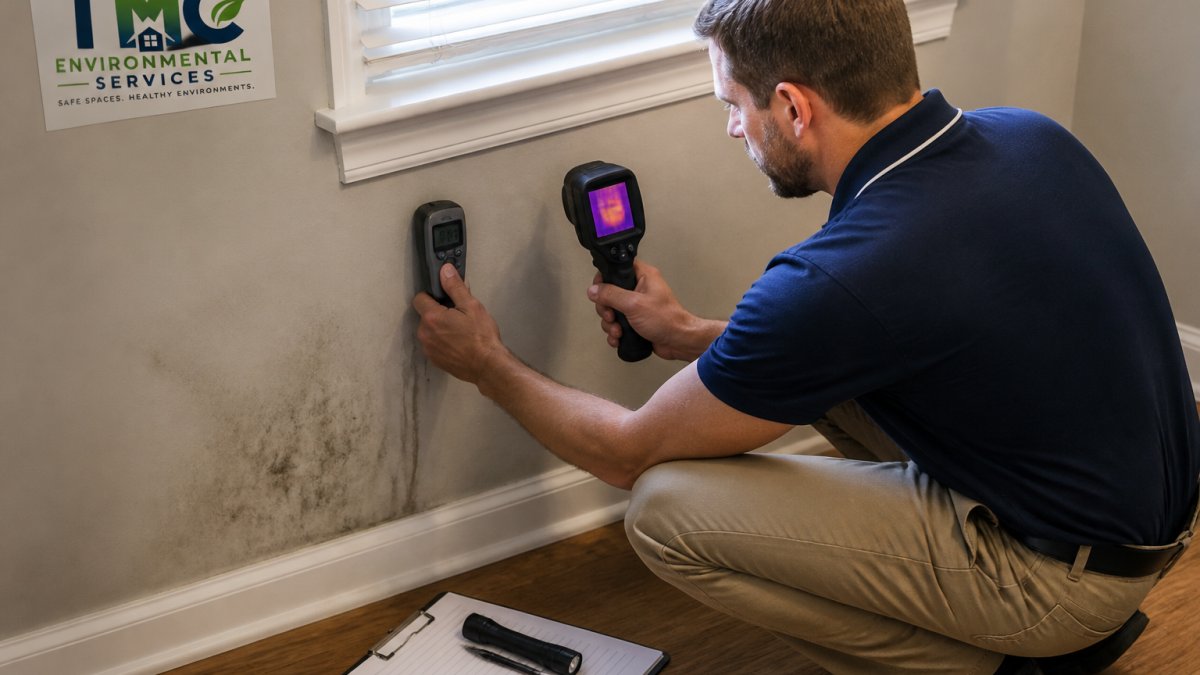
The tools are non-destructive, which matters if you are not ready to open walls:
- Moisture meters read water content through drywall and framing without cutting.
- Thermal imaging cameras show temperature differences that suggest trapped moisture or missing insulation.
- Humidity and dew point readings explain condensation problems in humid climates.
Once a suspect area is identified, the inspector samples there, not randomly. That is the difference between a test that means something and a swab taken from a wall that was never wet.
How to Read a Mold Inspection Report
A mold inspection report should tell you three things: what was found, where the moisture is coming from, and what to do next.
What to look for in the report:
- Sample locations and the outdoor control result. Without the control, indoor numbers mean little.
- Moisture readings and the suspected source. The report should name the water problem, not just the mold.
- Spore types and relative levels. Elevated levels of a type also present outdoors at low levels tells a different story than an indoor-only species.
That last point is where reports earn trust. Mold sampling is a snapshot, not a diagnosis; spore counts shift with weather, HVAC operation, and activity. A report presenting a single sample as definitive is overselling its certainty.
Be wary of any report that declares your home “toxic” based on a single air sample. Mold sampling shows relative levels and species presence. It does not measure your exposure or your health risk.
Independent Inspection vs. Remediation Conflicts of Interest
The biggest conflict of interest in this industry is an inspector who also sells remediation.
That is why we keep inspection and remediation advice separate. Our job is to find the moisture, document what is growing, and hand you a scope you can take to any contractor.
Questions that reveal whether a provider is independent:
- Does the inspector’s company also perform the remediation?
- Will you get a written report you can shop to other contractors?
- Are findings documented in writing for a tenant dispute or insurance claim?
If the answer to the first question is yes, treat the inspection with appropriate skepticism. A neutral inspection is worth more than a cheap one attached to a sales pitch.
The Bottom Line on Whether Mold Testing Is Worth It
Mold testing is worth it when it changes a decision, documents a problem for someone who needs proof, or verifies a fix worked.
Our rule of thumb: if the answer to “what will I do differently based on this result?” is “nothing,” skip the test and fix the moisture.
The Mold Consultant, LLC has spent over a decade inspecting homes and commercial properties, using non-destructive tools to find hidden moisture before it becomes a bigger problem.
Frequently Asked Questions
How much does professional mold testing cost?
Mold testing cost depends on the number of samples, the size of the property, and how much of the building the inspector needs to examine. Air sampling, surface sampling, and lab analysis are usually priced separately. The Mold Consultant, LLC lists current pricing on its website, so you can see the breakdown before you book. Ask for a written scope that names how many samples are included and what the lab fees cover, because a low headline price with add-on sample charges is where estimates drift.
Can you test for mold yourself, and is a DIY mold test vs. professional testing really different?
Store-bought kits let you collect a sample, but they rarely tell you whether spore levels in your home are elevated compared with normal outdoor air. A professional inspection pairs lab analysis with an outdoor control sample, moisture readings, and a walkthrough that locates the water source feeding the growth. The DIY mold test vs. professional testing gap is context: a lab result without sample location data and a moisture source rarely changes what you should do next.
Can you have hidden mold in walls without seeing it?
Yes. Mold behind drywall, under flooring, or inside wall cavities often shows no visible growth. Look for clues instead: a musty odor, unexplained allergic or respiratory symptoms that ease when you leave the house, bubbling paint, warped baseboards, or a past water damage event that was dried without verification. An inspector uses moisture meters and thermal imaging to map wet areas without cutting into walls, then samples where readings suggest growth.
Does a mold inspection report tell you what type of mold is in your home?
A lab-backed report identifies mold species or groups in each sample and gives spore counts, which you can compare against the outdoor control sample. It should also list sample locations, moisture readings, and the source the inspector believes is feeding the growth. Use the report to decide on remediation scope and to document conditions for a landlord, insurer, or real estate transaction. It is not a medical diagnosis, and no inspection can prove a specific health outcome.
If you are facing a water leak, a musty smell, or a real estate deadline and you are not sure whether testing is the right next step, talk to a neutral inspector before you spend money on samples. The Mold Consultant, LLC offers mold inspection, air quality testing, and post-remediation verification with written reports built for real decisions. Call now to walk through your situation and get a clear answer on whether testing is worth it for your home.