
Quick Summary
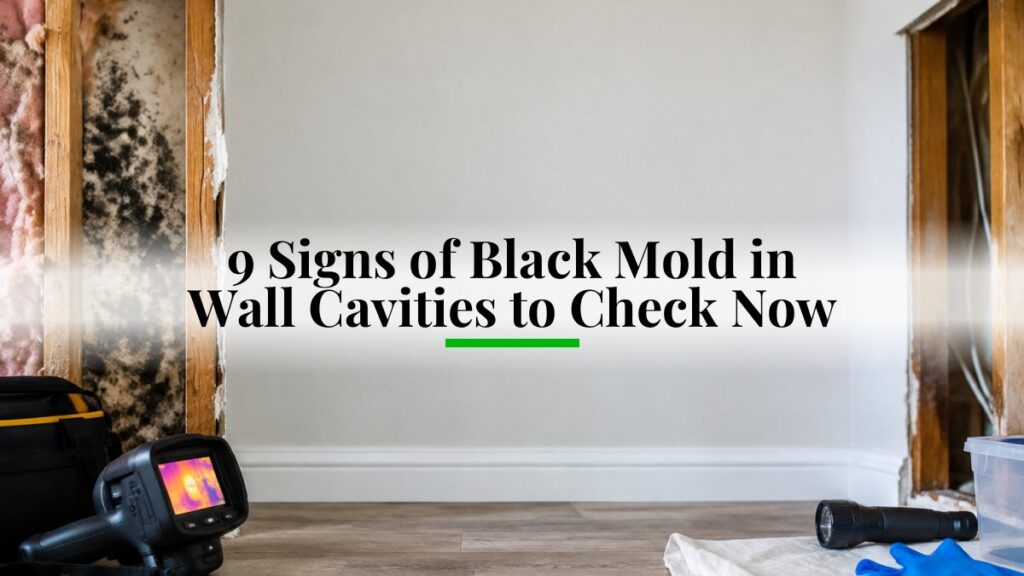
Black mold in wall cavities often shows up as a musty or earthy odor, especially near one wall or after humid weather. Surface signs like bubbling paint, peeling wallpaper, dark patches, and lifting drywall tape can also point to growth behind the wall. Finding the moisture source is the key clue, since mold needs water to grow.
- A musty or earthy smell concentrated near one wall is often the first sign.
- Moisture sources like roof leaks, plumbing leaks, and condensation point to hidden growth.
- Surface clues include bubbling paint, peeling wallpaper, and lifting drywall tape.
- Moisture readings consistently above the dry baseline justify further investigation.
- Call a qualified professional if the suspected area is larger than about 10 square feet.
Table of Contents
- Why Black Mold Inside Walls Is Hard to Spot
- Musty and Earthy Odors Coming From Walls
- Moisture Sources That Point to Hidden Growth
- Visible Discoloration and Other Clues Behind Drywall
- How to Detect Mold Inside Walls Without Tearing Them Open
- Can Mold Inside Walls Make You Sick?
- Risk Assessment Checklist and When to Call a Professional
- Next Steps for Treating Mold in a Wall Cavity
- Frequently Asked Questions
Why Black Mold Inside Walls Is Hard to Spot
Black mold inside walls often goes unnoticed for months. Most of the growth sits behind drywall, in the dark wall cavities where nobody looks. By the time signs show up on the surface, the problem has usually been building for a while.
This guide covers the signs homeowners and property owners can check for, along with what to do next. Mold is a fungus that grows where moisture sits (the EPA). Hidden growth in a wall cavity is a fungal colony that feeds on paper facing, wood framing, and dust trapped inside the wall.
Wall cavities make mold hard to find for a few reasons:
- The space is sealed. Drywall, insulation, and trim hide the growth completely.
- Moisture stays trapped. Water moves through the wall and stays there, feeding growth without drying out.
- Surface cleaning does nothing. Wiping the visible area never reaches the source inside the wall.
Some of the best clues are sensory, not visual. Keep reading to learn the warning signs and a safe way to check.
Musty and Earthy Odors Coming From Walls
A musty or earthy smell is often the first sign of mold inside a wall. The odor comes from microbial compounds released as the fungus grows. Many people describe it as damp basement air or wet socks.
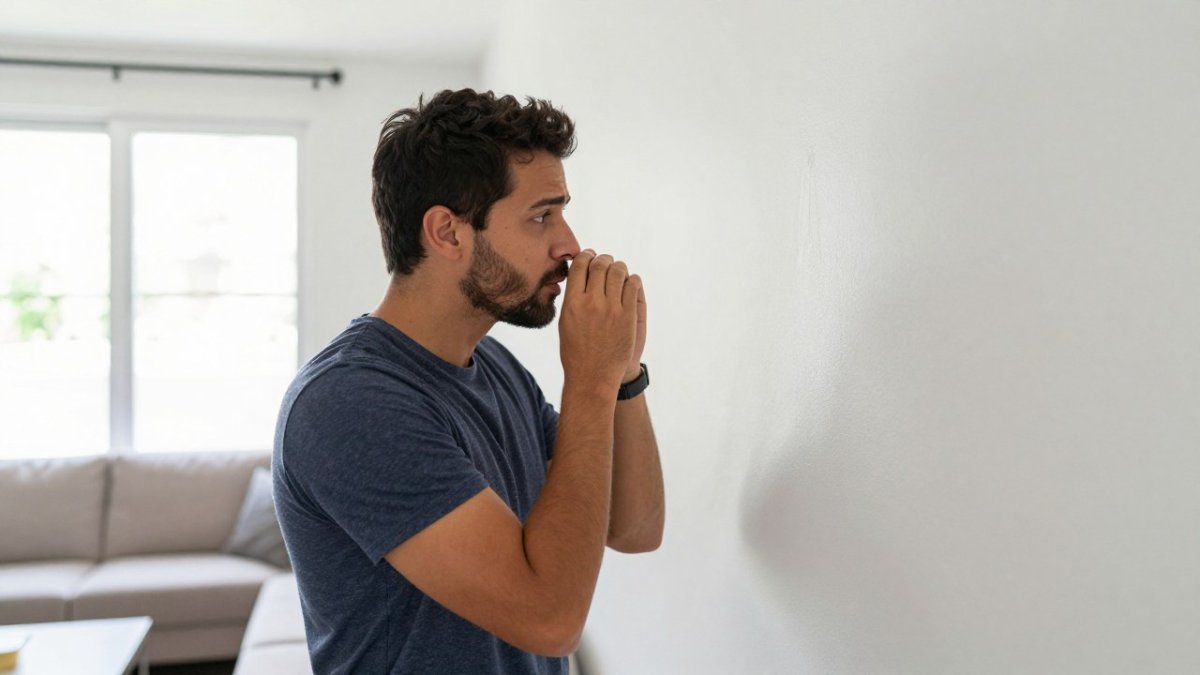
The smell often gets stronger in these situations:
- Right after rain or humid weather, when moisture levels rise
- Near a specific wall, not the whole room
- When the HVAC system runs, pushing air through gaps in the wall
Watch out: A smell that comes and goes is still a warning sign. Do not wait for the odor to get worse before acting.
Moisture Sources That Point to Hidden Growth
Mold needs water to grow, so moisture problems are the strongest clue. Look for these common sources:
- Roof leaks that show up after storms
- Plumbing leaks behind sinks, tubs, or toilets
- Condensation on cold exterior walls
- Poor ventilation in bathrooms and kitchens
- Water intrusion around windows or doors
If a moisture source was never fixed, mold can grow inside the wall even when the room looks dry. Finding and fixing the water source is a key step. Learn practical ways to stop moisture for good so mold does not return. Otherwise, mold will keep coming back.
Visible Discoloration and Other Clues Behind Drywall
Sometimes mold shows up on the surface of a wall. Watch for these signs:
- Dark spots or patches, often black, green, or gray
- Bubbling, soft, or sagging paint or drywall
- Peeling wallpaper or trim
- Stains that grow or change color over time
- Cracks along a wall where moisture collects
Surface staining does not always show how big the problem is. Growth inside the wall can be far larger than the visible patch.
How to Detect Mold Inside Walls Without Tearing Them Open
A wall cavity is a closed space, so the goal of a non-destructive inspection is to gather converging clues before you cut anything. Work through the checks below in order.
Step 1: Map the odor. Walk the room slowly and note where the musty or earthy smell is strongest. Pay attention to corners, baseboards, outlet covers, and the seams where ceiling meets wall.
Step 2: Inspect the wall surface. Look for clues that track with moisture: paint that bubbles or blisters, drywall tape that lifts, baseboards that swell or separate, wallpaper that peels, and stains that have a tide-line edge.
Step 3: Check adjacent plumbing and building assemblies. Trace the walls that back up to bathrooms, kitchens, laundry rooms, and exterior hose bibs. Look under sinks for active drips, check supply-line fittings, and note any prior repair patches.
Step 4: Take moisture readings. A pin-type or pinless moisture meter gives a relative reading, not a mold verdict.
Step 5: Use a borescope only when the clues justify it. A borescope lets you see inside a cavity through a hole roughly the diameter of a pencil. For checking behind cabinets, find mold behind cabinets without tearing out the wall.
Step 6: Consider sampling last, not first. Air or surface samples can identify mold types, but they cannot tell you where growth is located or how far it extends. A Mold Inspection and an Air Quality Test can provide this kind of professional evaluation.
Watch out: A moisture meter that reads high, or a borescope image that looks clean, is not proof either way. Treat each tool as one line of evidence and let the pattern across odor, surface condition, plumbing history, and readings drive the decision.
If the clues converge on one wall and you cannot identify a safe access point, stop and bring in a qualified inspector. When a cavity may contain hidden mold or other hazards, professional mold remediation services can help address the contamination without turning an uncertain inspection into a risky DIY project.
Can Mold Inside Walls Make You Sick?
Mold can affect health, especially for people who are sensitive to it (the EPA). Common reported symptoms include:
- Nasal congestion or a runny nose
- Sneezing, coughing, or a sore throat
- Eye irritation
- Skin rash
- Wheezing or trouble breathing for people with asthma
Some groups are more sensitive to mold. These include infants, older adults, people with asthma or allergies, and people with weakened immune systems (the CDC).
If symptoms improve when you leave the home and return when you come back, mold may be a factor. Speak with a doctor for any health concern. Mold can cause symptoms, but it can also be confused with other conditions, so a medical evaluation matters.
Risk Assessment Checklist and When to Call a Professional
Use this checklist to decide whether a wall cavity needs further investigation, and whether you can safely proceed or should bring in a qualified professional. Check every item that applies.
- Musty or earthy odor concentrated near one wall
- Visible discoloration, bubbling paint, or lifting drywall tape
- A past or active water leak, flooding, or roof intrusion near the wall
- Moisture readings consistently above the dry baseline in the same room
- Plumbing, HVAC, or exterior penetrations on or behind the suspect wall
- Household members with symptoms that improve when they leave the home
- Suspected growth larger than a small patch, or growth that has returned after cleaning
- The wall is on an exterior face, below grade, or shares a plane with a bathroom or kitchen
Decision criteria for opening a wall. An inspection opening is reasonable when the clues point to one location, the moisture source is understood or strongly suspected, and the opening can be made without cutting into concealed wiring, plumbing, or structural members.
When to call a professional instead. Bring in a qualified mold inspector or remediator if any of the following apply: the suspect area is larger than about 10 square feet; sewage or flood water is involved; the wall contains concealed electrical or plumbing hazards; anyone in the home has asthma, allergies, or a weakened immune system; or the moisture source cannot be found. A professional inspection can locate hidden growth, identify the moisture source, and provide a written scope of work. See what a mold inspection report contains before you hire someone. Lead or asbestos concerns in older walls may also call for Lead Testing or Asbestos Testing before any opening.
Containment and occupant safety during investigation. Mold spores and dust become airborne when a cavity is disturbed. Before any opening, seal doorways and HVAC returns with plastic sheeting, run a HEPA air scrubber if one is available, and keep children, older adults, and anyone with respiratory sensitivity out of the work area. Wear an N95 or P100 respirator, eye protection, and gloves.
A clear response plan after finding mold. Once growth is confirmed, the order matters: stop the water source first, then assess which materials are affected, document the damage with photos and moisture readings, remove and bag porous materials that cannot be dried, clean and dry the framing, and verify drying before closing the wall.
Watch out: A checklist score is a guide, not a clearance. If the clues point to a hidden leak, a hazardous wall assembly, or a sensitive occupant, treat the situation as a professional matter even if only one or two boxes are checked.
The table below summarises when a wall cavity needs professional help, using the thresholds and criteria covered above.
| Situation | Threshold or criterion | Action |
|---|---|---|
| Suspected growth size | Larger than about 10 square feet | Call a professional |
| Sewage or flood water | Involved in the area | Call a professional |
| Sensitive occupants | Asthma, allergies, or weakened immune system | Call a professional |
| Concealed hazards | Electrical or plumbing inside the wall | Do not open it yourself |
| Moisture source | Cannot be found | Call a professional |
| Load-bearing or panelboard wall | Structural or electrical hazard | Do not open it yourself |
| Moisture readings | Consistently above dry baseline | Investigate further |
| Checklist score | Any boxes checked | Treat as a guide, not clearance |
Next Steps for Treating Mold in a Wall Cavity
Treatment works best when it follows a clear order:
- Stop the moisture source. Fix the leak, improve ventilation, or correct drainage first.
- Contain the area. Limit airflow and keep the space closed off during work.
- Remove affected materials. Drywall, insulation, or wood that holds mold often needs replacing.
- Clean and dry the framing. Surfaces must be fully dry before rebuilding.
- Verify the result. A post-remediation check confirms the work is done.
Trying to remove mold without fixing the water problem usually fails. Once the source is fixed, Mold Remediation and Post Remediation verification can help confirm the work is complete. Contact The Mold Consultant, LLC to schedule an inspection, or call for guidance on a safe plan for your home.
Frequently Asked Questions
How do I know if I have black mold inside my walls?
The most common clues are a persistent musty or earthy odor that does not go away after cleaning, discoloration or staining on drywall or baseboards, peeling paint or bubbling wallpaper, and a history of water intrusion from a roof leak, plumbing leak, or condensation. Because black mold often grows out of sight, these signs are usually the first indication. A visual check alone rarely confirms growth inside a wall cavity, so a professional inspection that uses moisture readings and controlled sampling is the reliable next step when several clues appear together.
Can mold inside walls make you sick?
Mold exposure can trigger symptoms in some people, including nasal congestion, sore throat, coughing, wheezing, eye irritation, and skin rashes. People with asthma, allergies, weakened immune systems, young children, and older adults are generally more sensitive. Symptoms that improve when a person leaves the home and return when they come back are a common pattern worth noting. Anyone with ongoing symptoms should talk with a physician, and the home should be inspected to identify the moisture source and any hidden growth.
How can I detect mold inside a wall without opening it?
Non-destructive methods include checking for moisture with a moisture meter, looking for staining or soft drywall, and using a borescope through a small inspection hole in a location chosen by a professional. Each tool has limits: moisture meters show dampness but not mold itself, and borescopes only see what is directly in view. Air and surface sampling can support findings but cannot prove the full extent of growth. Combining several methods gives a more reliable picture than any single test.
What should I do if I find mold in a wall cavity?
First, stop the moisture source, such as a leak or condensation problem, because mold will return if water keeps getting in. Limit access to the affected area and avoid disturbing the growth, since disturbing it can spread spores. Then arrange a professional inspection to determine the extent of growth and whether removal is needed. Remediation typically involves containment, removal of affected materials, and post-remediation verification to confirm the area is clear before rebuilding.
