
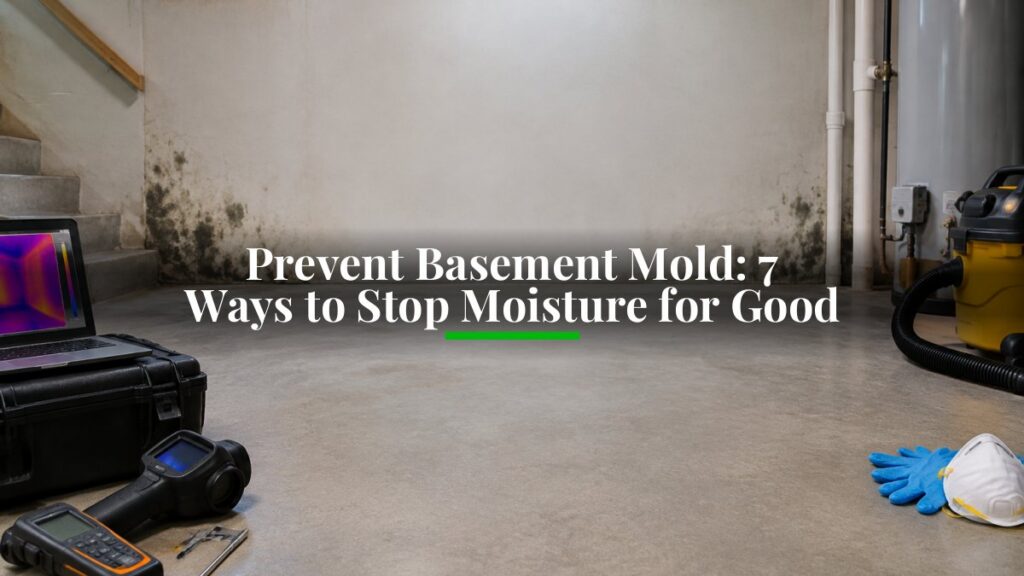
Last Updated: November 12, 2026
Quick Summary
To prevent basement mold, stop the water source first, then keep the air dry. Keep relative humidity between 30% and 50%, run a properly sized dehumidifier during humid months, and fix gutters, grading, and foundation cracks so water never reaches the basement.
- Mold needs moisture, organic food, and still air, so cutting off water beats scrubbing harder.
- Gutters and downspouts should carry roof water at least six feet away from the foundation.
- A moisture meter reads water content in walls without cutting into drywall or concrete.
- Ventilate only when outdoor humidity is lower than basement humidity, or you import moisture.
- You can clean small patches under about ten square feet yourself once the moisture source is fixed.
Table of Contents
- Why Basement Mold Keeps Coming Back
- 1. Control Indoor Humidity Before Mold Spores Settle
- 2. Use a Dehumidifier for Basement Air That Stays Dry
- 3. How to Identify Hidden Moisture in Walls Before It Spreads
- 5. Improve Ventilation and Air Circulation
- 6. How to Get Rid of Mold on Basement Walls
- 7. Can I Get Rid of Basement Mold Myself, or Do I Need a Pro?
- What Matters Most for Long-Term Prevention
- Frequently Asked Questions
Why Basement Mold Keeps Coming Back
Basement mold keeps returning because the moisture source was never fixed. Cleaning the mold kills what you can see, but spores stay dormant until water returns.
The reason is simple. Mold needs three things: moisture, organic food (dust, wood, drywall paper), and still air. Basement mold prevention means cutting off the water supply, not scrubbing harder.
Below, this guide covers seven methods for preventing basement mold. We’ll also cover how to identify hidden moisture in walls and when to call in a professional. If you’re tracing a recurring problem, our guide on finding the source of mold in your house walks through the diagnostic steps.
U.S. Environmental Protection Agency mold guidance notes that controlling moisture is the key to controlling mold, and no amount of cleaning fixes a wet foundation.
1. Control Indoor Humidity Before Mold Spores Settle
Keeping basement relative humidity between 30% and 50% is a commonly recommended target, since mold spores need elevated humidity to colonize.
A hygrometer is the cheapest tool you’ll buy for this job. Place one in the basement and check it weekly. Humidity often climbs after rain or in summer even without any visible leak.
Practical steps:
- Run a dehumidifier when readings pass 50%
- Fix dryer vents that dump warm, damp air indoors
- Avoid storing cardboard and paper in damp corners
- Seal the basement from humid outdoor air where possible
Watch out: a single humid summer month is enough for spores to settle. Check the gauge after storms, not just in winter.
2. Use a Dehumidifier for Basement Air That Stays Dry
A dehumidifier for basement use is the workhorse of moisture control. It pulls water from the air before condensation forms on cool walls and floors. But most basement dehumidifiers are undersized for the space they serve, run in the wrong spot, or quit on a full tank, and any one of those turns a working unit into an expensive fan.
Size the unit to the space, not the room label
Dehumidifier capacity is rated in pints of water removed per 24 hours, and the rating is measured under specific conditions (commonly 80°F and 60% relative humidity). A cool basement in the 60s runs well below those conditions, so real-world output is lower than the box number. Dehumidifier capacity needs vary with basement size and dampness, and sizing guidance from manufacturers should be checked against the specific space.
Match the unit type to the basement
- Portable refrigerant units are the common choice for finished and semi-finished basements. They work best when the space stays above roughly 60°F; in cold basements the coil ices and output drops.
- Desiccant units cost more to run but keep removing water at low temperatures, which suits unheated crawl spaces and cold cellars.
- Whole-home or ducted units tie into the HVAC system and handle a full basement without a floor unit in the way, at higher install cost.
Placement and drainage decide whether it actually works
Put the unit in the dampest, most open part of the basement, not tucked into a corner behind storage. Keep it a few inches off exterior walls and clear of furniture so air moves through the coil.
Drainage is the failure point. A unit on tank mode shuts off the moment it fills, often overnight or during a storm when you need it most.
Set the target and let automation do the monitoring
Set the target around 45% to 50% and run continuously during humid months rather than cycling it on and off by hand.
Watch out: running a dehumidifier in a room with open windows, or ignoring the drain line so the unit shuts off when the tank fills, are common setup mistakes that can make a unit appear to have stopped working.
If you’re drying out after a flood, our roundup of the best dehumidifiers for drying out flooded basements covers capacity and drain options.
3. How to Identify Hidden Moisture in Walls Before It Spreads
Hidden moisture can sit behind paint, drywall, and baseboards, and by the time a stain is visible, the wall cavity may already be wet.
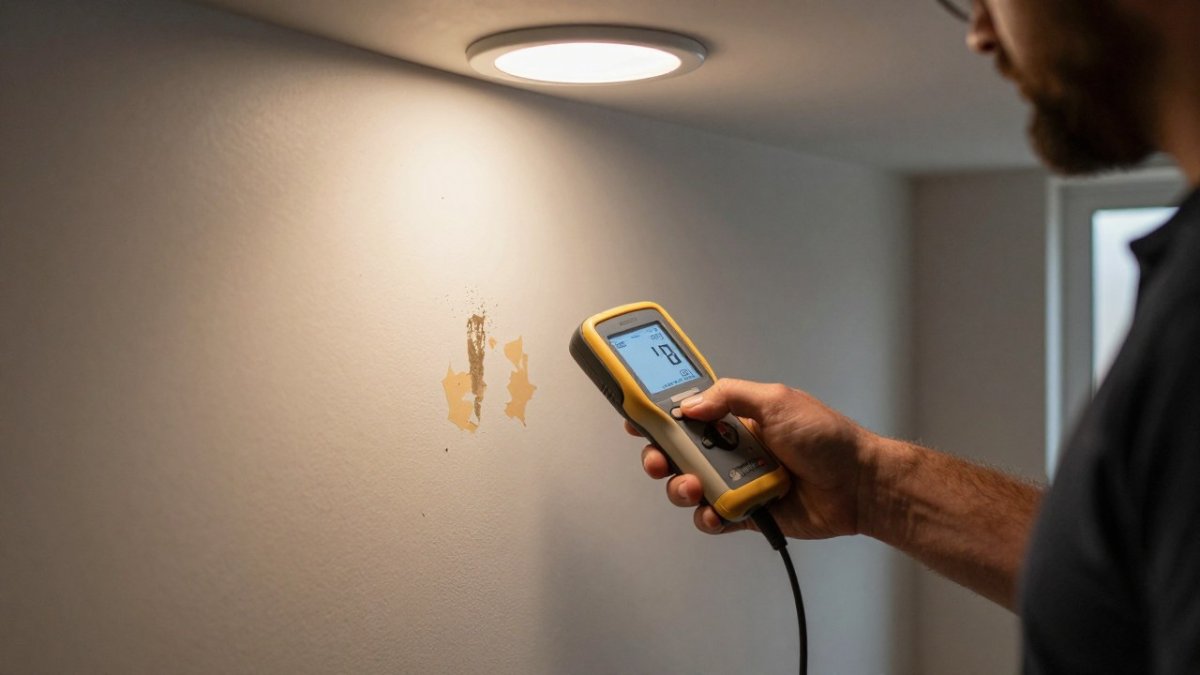
Signs to check:
- Peeling or bubbling paint near the floor line
- A musty odor that lingers after cleaning
- White chalky stains (efflorescence) on concrete
- Baseboards that feel soft or pull away from the wall
- Condensation on window glass in the basement
A moisture meter pressed against the wall reads water content without cutting into it. For a full walkthrough, see our guide on how to identify hidden moisture in walls before it spreads.
(/musty-smell-why-house-smells-musty-after-heavy-rain/) connects that odor to drainage and intrusion points.
5. Improve Ventilation and Air Circulation
Still air lets moisture settle on cold surfaces. Air circulation moves damp air out and keeps walls drier. But ventilation in a basement is not one thing, it is two different jobs, and confusing them is why so many homeowners open a window, feel a breeze, and still get mold.
Circulation vs. exchange: two jobs, two fixes
Circulation moves air around inside the basement so it doesn’t stratify into a cold, damp layer at the floor. Exchange replaces basement air with outdoor air. Circulation is cheap and always useful; exchange is only useful when the outdoor air is drier than the basement air. On a humid summer day, opening windows is exchange in the wrong direction, you are importing moisture.
Circulation fixes that cost almost nothing
- Keep furniture, boxes, and shelving at least a few inches off exterior walls so air can move behind them.
- Run a box fan or air circulator on low continuously in the dampest corner rather than blasting it intermittently.
- Leave interior doors open or undercut them so the basement isn’t divided into dead-air rooms.
- In finished basements, run the HVAC fan in ‘on’ or ‘circulate’ mode to keep air moving through the whole space.
Exchange: when to ventilate and when not to
Open windows and doors only when outdoor humidity is lower than basement humidity, typically cool, dry days and much of the heating season.
For steady exchange without opening windows, a basement exhaust fan or an energy recovery ventilator (ERV) does the job. An ERV exchanges heat and some moisture between incoming and outgoing air, which makes it a better fit for humid climates than a plain exhaust fan that pulls in unconditioned outdoor air.
The interaction most guides miss
Ventilation and dehumidification pull against each other. Every cubic foot of humid outdoor air you bring in is water the dehumidifier has to remove.
Watch out: an exhaust fan strong enough to clear a basement can backdraft a gas water heater or furnace flue if the basement is tight, have the setup checked before you run a large fan continuously.
An HVAC system with a dehumidifier setting helps in finished basements. The goal is steady air exchange, not a blast of cold air that raises condensation risk.
6. How to Get Rid of Mold on Basement Walls
How to get rid of mold on basement walls starts with protective gear and ends with fixing the water source. Wear an N95 mask, gloves, and eye protection.
For small patches on hard surfaces:
- Mix a mild detergent with water
- Scrub the area and dry it fully
- Discard porous materials like drywall or carpet that stayed wet
For larger growth, a professional inspection confirms the extent. Our article on how to identify hidden mold growth lists seven warning signs worth checking before you clean.
U.S. EPA mold cleanup guidance recommends fixing the water problem first, since cleanup alone won’t stop mold from returning.
7. Can I Get Rid of Basement Mold Myself, or Do I Need a Pro?
Can I get rid of basement mold myself? Yes, for small patches on hard surfaces under about ten square feet, once the moisture source is fixed.
Call a pro when you see:
- Mold covering more than a small patch
- Growth inside walls or under flooring
- Mold that returns after cleaning
- Anyone in the home with health concerns
- A need for documentation for a landlord, insurer, or real estate deal
At The Mold Consultant, LLC, our certified inspectors use non-destructive tools to find moisture intrusion without tearing into walls.
Centers for Disease Control and Prevention mold resources advises that people with health conditions consult a doctor about mold exposure concerns.
What Matters Most for Long-Term Prevention
| Method | What It Fixes | How Often |
|---|---|---|
| Humidity control | Airborne moisture | Weekly checks |
| Dehumidifier | Damp air, condensation | Continuous in humid months |
| Moisture detection | Hidden wall water | Seasonal inspection |
| Drainage and crack repair | Water intrusion | After storms, yearly |
| Ventilation | Still, damp air | Ongoing |
| Mold cleanup | Visible growth | As needed |
| Professional inspection | Root cause, documentation | When mold returns |
Preventing basement mold comes down to one rule: stop the water, then keep the air dry. The seven methods above work best together, and the order matters. Fix drainage and humidity first, then clean, then monitor.
If mold keeps coming back, the moisture source is likely still active. The Mold Consultant, LLC offers mold inspection, air quality testing, and post-remediation verification with over a decade of experience and a commitment to neutral, documented findings.
Frequently Asked Questions
Does a dehumidifier prevent basement mold on its own?
A dehumidifier removes moisture from the air, which is the main fuel for mold growth, but it will not fix a leak or seepage problem. Run it to keep relative humidity between 30 and 50 percent, check the tank or drain line regularly, and pair it with drainage and ventilation fixes. If the basement smells musty even with the unit running, the moisture source is likely behind a wall or under the slab and needs a professional inspection.
How do I know if my basement has hidden moisture?
Watch for a musty odor, condensation on pipes or windows, bubbling or peeling paint, and white chalky stains on concrete. A hygrometer reading above 50 percent relative humidity is a red flag, and a moisture meter pressed against walls and floors can confirm dampness that looks dry. If you had water damage recently, an inspection can trace the intrusion point before mold spores colonize the drywall or insulation.
Can I get rid of basement mold myself?
Small patches on hard surfaces like concrete or tile, roughly under 10 square feet, can often be cleaned with a detergent solution and dried thoroughly. Anything larger, or mold that has soaked into drywall, carpet, or insulation, should be handled by a professional because disturbing it releases spores into the air. People with health concerns or compromised immune systems should skip DIY cleanup entirely and get an air quality test first.
What time of year is worst for basement mold?
Late spring through early fall is when humidity climbs and heavy rain pushes water against foundations, so mold growth peaks in summer and early fall. Winter brings its own risk when warm indoor air meets cold foundation walls and condenses. Checking relative humidity with a hygrometer year-round, and keeping gutters clear before spring rains, prevents the seasonal spikes that catch most homeowners off guard.
