

Last Updated: November 11, 2026
Quick Summary
Asbestos retesting after abatement is the air sampling step that checks whether a removal job cleared fibers from the space. An independent professional collects air samples after cleaning and sends them to a lab, and the results decide whether the area is safe to reoccupy.
- Retesting only means something when an independent professional, not the removal crew, runs it.
- Testing should happen only after cleaning and any required drying are complete.
- Compare work-area samples against outdoor reference samples and the clearance criterion.
- Lab reports should show sample volume and detection limits, not just pass or fail.
- A failed test calls for a written corrective scope, targeted re-cleaning, and retesting with the same plan.
Table of Contents
- What Asbestos Retesting After Abatement Involves
- Asbestos Clearance Testing: Purpose and Timing
- Asbestos Air Testing After Removal: How Sampling Works
- PCM Asbestos Air Sampling and Lab Results
- Choosing an Independent Clearance Professional
- What to Do After a Failed Asbestos Clearance Test
- Scheduling Your Retest and Keeping Records
- Frequently Asked Questions
What Asbestos Retesting After Abatement Involves
Asbestos retesting after abatement is the air sampling step that checks whether a removal job actually cleared the fibers out of the space. Once contractors finish removing asbestos-containing material, an independent professional collects air samples and sends them to a lab. The results decide whether the area is safe to reoccupy.
Retesting only tells you something useful when someone outside the removal crew runs it. That independence is what makes the result trustworthy to a homeowner, landlord, or insurance adjuster.
Here is what the process usually covers:
- Visual inspection: Checking that the work area is free of visible debris and damaged material
- Air sampling: Pumping air through filter cassettes placed inside the work area and at outside reference points
- Lab analysis: Counting fibers under a microscope and comparing the results to clearance criteria
- Written report: Documenting pass or fail results so the record is clear for future buyers, tenants, or insurers
Asbestos retesting after abatement is not the same as a general mold inspection. It targets airborne asbestos fibers only, and it follows a specific sampling protocol. Learn more about the health stakes in why residual asbestos matters in homes.
Asbestos Clearance Testing: Purpose and Timing
Clearance testing is the formal name for the post-removal air test. It happens after the abatement contractor has finished cleaning and before the space is reopened for occupancy or further construction.
The goal is simple. Confirm that airborne fiber levels inside the work area have dropped to an acceptable level. Timing matters. Testing too early, while dust is still settling or wet materials are drying, can produce misleading results. Testing should happen only after cleaning and any required drying are complete.
Clearance testing usually takes place at these points:
- After all asbestos-containing material has been removed and the area has been cleaned
- Before containment barriers are taken down
- Before the space is reoccupied, reopened, or handed back to the property owner
Requirements vary by project type and location, so confirm what applies to your job with the appropriate state or local authority. The U.S. Environmental Protection Agency explains the federal framework for asbestos work at EPA asbestos regulations overview.
Asbestos Air Testing After Removal: How Sampling Works
Air sampling is the core of the clearance process. A technician sets up pumps and cassettes at fixed points, runs the pumps for a set volume of air, and then seals the cassettes for lab analysis.
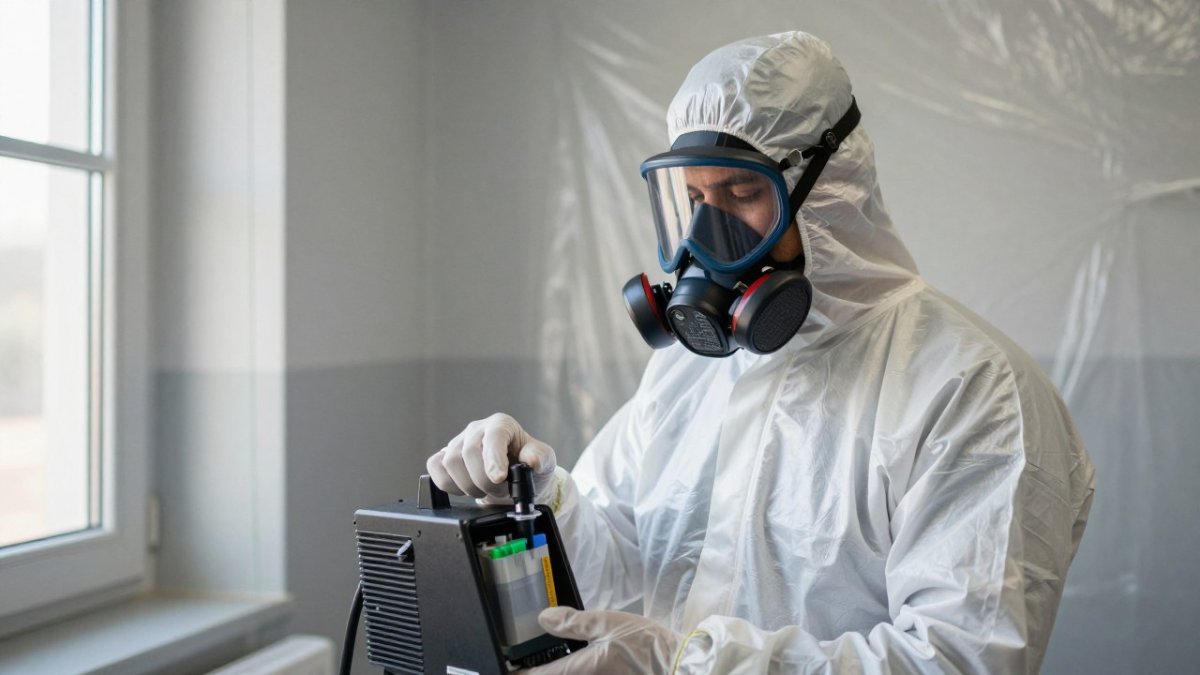
The sampling plan usually includes several locations:
- Samples inside the work area, placed where air circulates and dust tends to settle
- Outside or background samples, taken from clean air to act as a control
- Enough samples to represent the whole space, not just one corner
Comparing inside and outside results shows whether the work area is clean relative to ambient air. A common approach is to collect several samples inside and several outside, though the exact count depends on the size of the project.
A technician in a half-face respirator and disposable coveralls holding an air sampling pump with a cassette inside a cleared room with plastic sheeting still on the walls. The woman is American.
PCM Asbestos Air Sampling and Lab Results
Phase Contrast Microscopy (PCM) is the lab method most often used for clearance air samples. The analyst counts fibers that meet a length and shape definition under a phase contrast microscope, then reports the count as fibers per cubic centimeter of air, usually written f/cc. PCM does not identify the mineral type, so it answers “how many fiber-like structures are in this air” rather than “is this specific mineral asbestos.” That distinction matters when you read the report.
Reading a result takes three numbers, and they should always appear together on the lab report:
- Sample volume: The number of liters of air pumped through the cassette. Because the count is divided by volume, a larger air volume gives a more precise reading. A short sample run on a dusty or fast-moving space can produce a result that looks clean but rests on very little air.
- Analytical sensitivity: The lowest fiber concentration the lab can report for that sample volume. Labs express this as a detection limit. When a sample shows no countable fibers, the lab reports the result as below that limit, often written as “non-detect” or “< [limit] f/cc.” A non-detect means the count was below what the method can reliably measure for that volume. It does not prove the air contains zero fibers.
- Clearance criterion: The threshold the project is being judged against. Compare each sample to this number, not to a general sense of “low.” Confirm which criterion applies to your project with the authority having jurisdiction, since requirements differ by project type and location.
Background or outdoor samples give context. A work-area result that sits near the outdoor reference level suggests the space is about as clean as ambient air. A work-area result far above the reference level suggests residual fibers, even if it falls under the numeric criterion. Read the two sets of results side by side rather than in isolation.
Watch out: a lab report that lists only a pass or fail column, without sample volumes and detection limits, leaves you unable to judge how much confidence the result deserves. Request the full laboratory data sheet before accepting the conclusion.
Ask the laboratory for the complete report, including the sample volume, analytical method, analytical sensitivity, and the individual sample results. Those figures explain most confusing outcomes and let you check whether the clearance conclusion follows from the data. Verifying that the abatement contractor held the proper credentials throughout the Mission Demolition process remains the final safeguard for ensuring that your clearance results are both accurate and legally sound.
The lab report carries three numbers that determine how much confidence a clearance result deserves.
| Term | What it means | Why it matters |
|---|---|---|
| Sample volume | Liters of air pumped through the cassette | Larger volume gives a more precise reading |
| Analytical sensitivity | Lowest concentration the lab can report | Sets the detection limit for that sample |
| Non-detect | Count below the method’s measurable limit | Does not prove zero fibers in the air |
| Clearance criterion | Threshold each sample is judged against | Confirm which criterion applies to your project |
Choosing an Independent Clearance Professional
The person who collects the clearance samples should not be the same company that performed the removal. Independence protects the integrity of the result. When the same contractor both removes the material and certifies the space as clean, there is an obvious conflict of interest.
When you look for a clearance professional, ask about:
- Independence: Confirm the firm does not perform the abatement on that same project
- Credentials: Look for proper certification in asbestos inspection and sampling
- Accredited lab: Confirm the samples go to a lab accredited for the method being used
- Written reporting: Expect a clear report with sample locations, results, and a pass or fail conclusion
A clearance test is a measurement, not a promise.
What to Do After a Failed Asbestos Clearance Test
A failed clearance test means at least one sample exceeded the clearance criterion. It is a finding about the space, not a verdict on the job as a whole. The useful question is which samples failed, where they were taken, and how far above the criterion they sit.
Work through the following sequence in order, because each step narrows what comes next:
- Read the full report, not just the summary. Note each failed sample’s location, its result, and its sample volume. Check whether the failures cluster in one area or appear scattered.
- Compare failures to likely sources. Clustered failures near a ceiling void, wall cavity, duct opening, or a doorway that was not sealed usually point to a specific source. Scattered low-level failures often point to dust that was disturbed during cleaning or to incomplete containment.
- Ask the clearance professional for a written corrective scope. The scope should name the areas to re-clean and the method to use, such as HEPA vacuuming followed by wet wiping. A vague instruction to “clean again” makes it hard to verify the work.
- Have the abatement contractor perform the targeted re-clean. Keep the re-clean limited to flagged areas where the evidence supports it, and document the date and scope.
- Allow the area to dry completely before retesting. Wet surfaces and settling dust can skew results, so confirm dryness before scheduling air samples.
- Retest with the same sampling plan. Using the same locations and the same method lets you compare the new results directly to the original failures.
Borderline results need separate handling. A sample that is just over the criterion, when the other samples are well below it, is often a sign of localized residue rather than a space-wide problem. In that case, a targeted re-clean and a retest is usually the proportionate response. A sample that is far over the criterion, or many samples that fail, points to a broader cleaning gap and may justify a more thorough review of containment and cleaning procedures.
Inconsistent results need care too. Sometimes two reports from the same job disagree, for example because one used a different sample volume or was collected on a different day. Before accepting either conclusion, compare sample volumes, detection limits, sample locations, and collection dates. If the disagreement remains unexplained, ask the two parties to reconcile the data in writing, or have an independent professional review both reports.
Avoid repeating a large amount of work when the evidence points to a small one. Equally, do not accept a pass from a single low-volume sample when the failure pattern suggests a larger problem. The goal is to match the scope of corrective work to what the data actually shows, and to document each decision so the final file explains why the space was judged safe to reoccupy.
Scheduling Your Retest and Keeping Records
If you need a retest, schedule it only after all corrective cleaning is complete and the area is dry. Scheduling too early wastes money and produces another likely failure.
Keep a complete file for the project:
- The original clearance report and lab results
- Notes on any corrective cleaning and the date it was done
- The retest report and its pass or fail result
- Photos of the work area before and after cleaning, if available
This file matters for future buyers, tenants, insurers, and inspectors. It shows that the space was tested, what the results were, and what was done about any problems.
The Mold Consultant, LLC offers asbestos testing and air quality analysis for clients in the Oklahoma City metro area. Pricing details are available on our website. Call now to talk through your project and schedule your clearance sampling.
Frequently Asked Questions
What is the 3-5-7 rule for asbestos testing?
The 3-5-7 rule is a common clearance protocol that describes how many air samples are collected after removal and how they are compared. Clearance sampling plans and fiber thresholds vary by project scope and jurisdiction. Confirm the protocol your jurisdiction and the abatement contract require before sampling begins.
Who should conduct asbestos air testing after removal?
Clearance air testing should be performed by an independent, accredited professional rather than the abatement contractor who did the removal. Independence matters because the people who performed the work should not also certify its success. Look for an inspector who is properly certified for asbestos work and a laboratory accredited for the analytical method used. Ask for a written scope, sample locations, and the lab report with chain of custody documentation.
What happens if asbestos clearance testing fails?
A failed clearance result means airborne fiber levels exceed the clearance criterion, so the area is not yet safe to reoccupy. The usual response is additional cleaning of the containment area, followed by a repeat HEPA vacuum and wet wipe cycle, then a new set of air samples. Retesting should not begin until the contractor has completed corrective cleaning and documented it. Keep the failed report and the retest report together, since both may be needed for property records or disputes.
