

Table of Contents
- Why Mold Grows in New Construction Homes
- Mold on New Construction Framing: Lumber, Rain, and Storage
- How to Prevent Mold in New Construction at Every Stage
- Hidden Moisture in Walls: How to Verify It With Measurements
- Construction Defects, Workmanship, and Who Is Responsible
- Mold Inspection in a New Home: Distinguishing Mold From Staining and Residue
- Schedule a New Construction Mold Inspection Before You Close
- Frequently Asked Questions
Last Updated: November 10, 2026
Why Mold Grows in New Construction Homes
Mold needs one thing above all: moisture. A new build is not a sealed, dry box the day the keys are handed over. It is a structure that has spent months exposed to rain, humidity, and wet materials.
New builds often show the same pattern. The mold is rarely random. It traces back to a specific wet event or a construction shortcut.
Below, we break down the real causes, the stages where prevention works, and how to verify a problem before you close.
Moisture Is the Only Condition That Matters
No moisture, no mold. That single rule explains almost every case we see.
Mold spores are everywhere in the air, on lumber, and in dust. They stay dormant until water gives them a reason to grow. The EPA’s guide to mold and moisture control puts it plainly: control the moisture and you control the mold.
So when a new home grows mold, the question is never “how did spores get in?” They were always there. The question is “where did the water come from?” If you notice a musty smell after storms, our article on why your house smells musty after heavy rain helps you trace hidden moisture.
Why New Builds Are More Vulnerable Than You Think
A finished home hides its history. A new build has a short but intense one.
Framing sits in the rain. Lumber arrives wet. Concrete cures and releases water vapor. Drywall goes up before the structure is fully dry. Each step stacks risk.
Many buyers assume “new” means “clean.” In practice, a home that was never properly dried can carry more hidden moisture than an older house that stayed sealed for decades.
Mold on New Construction Framing: Lumber, Rain, and Storage
Wet lumber is the most common starting point for mold on new construction framing. Wood framing absorbs water fast and dries slowly, especially in a closed-up shell.
Rain exposure during construction is the usual culprit. Framing that sits uncovered through a wet week soaks up water.
Material storage matters just as much. Lumber stacked on bare ground, or drywall leaned against a damp slab, wicks up moisture from below. Poor site drainage makes it worse by pooling water where materials sit.
Here is what we look for on framing:
- Dark staining or fuzz on studs and sheathing
- Musty odor in closed rooms
- Lumber with high readings on a moisture meter
- Materials stored flat on soil or concrete
How to Prevent Mold in New Construction at Every Stage
Prevention is a schedule, not a single step. The builders who avoid mold treat drying as part of the build, not an afterthought.
The most effective approach is to control water at each stage: keep it out, let wet materials dry, and verify before you close up walls. That is the core of how to prevent mold in new construction.
Site Drainage, Flashing, and Vapor Barriers
Water management starts outside the walls. Good site drainage moves rain away from the foundation instead of letting it pool against it.
Flashing around windows, doors, and roof lines directs water out, not in. A missed or badly lapped piece of flashing is a slow leak waiting to happen.
Vapor barriers and retarders control moisture movement through the building envelope. Installed wrong, they trap water inside the wall cavity instead of keeping it out. That single mistake causes a large share of the wall mold we find.
Drying Schedules and Material Storage
Wet materials need time and airflow to dry. A real drying schedule tracks that.
Store lumber and drywall off the ground and under cover. Keep the site graded so water runs away. Run fans and dehumidifiers after any wet event, and do not hang drywall over damp framing.
A simple stage-by-stage checklist keeps this on track:
| Stage | Key Action | What to Verify |
|---|---|---|
| Foundation | Grade site, check drainage | Water flows away from slab |
| Framing | Cover lumber, allow drying | Wood reads dry on meter |
| Envelope | Install flashing and vapor barrier | Laps correct, no gaps |
| Pre-drywall | Run dehumidifiers after rain | Wall cavities dry before closing |
| Pre-close | Full moisture check | No hidden wet spots remain |
Hidden Moisture in Walls: How to Verify It With Measurements
Hidden moisture in walls is invisible, so you measure it. A visual walk-through misses water trapped behind drywall. Instruments do not.
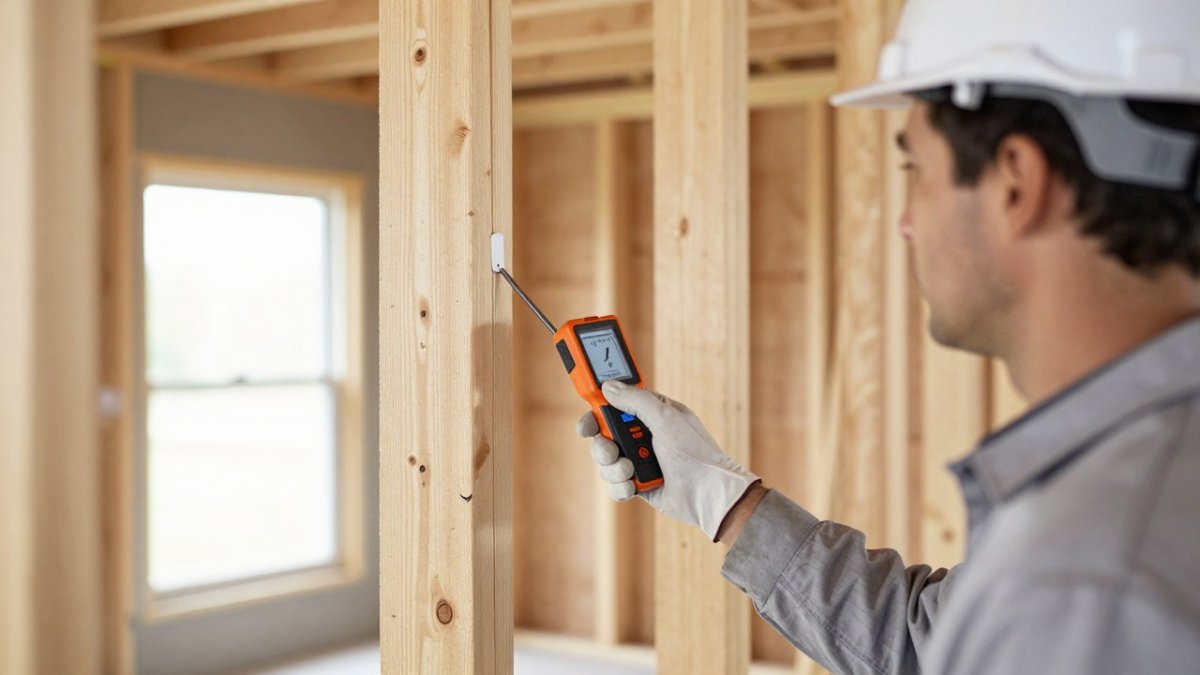
The three tools that matter
A pin-type moisture meter drives two pins into wood and reads water content as a percentage, reading inside the material rather than just at the surface. A pinless meter scans through drywall and tile without leaving holes, which makes it useful for finished walls but less precise on thick or uneven assemblies. A thermal imaging camera shows temperature differences that often reveal cold, damp spots behind surfaces, but it does not measure moisture directly, so it points you to where to confirm with a meter.
Where to take readings
Measurements are only as good as their placement. Check the bottom plate of framing, the lower third of studs, sheathing near window and door openings, subfloor around plumbing penetrations, and any area that was exposed to rain before the shell was closed. In finished homes, scan exterior walls, ceilings below attics, and the corners of rooms where air movement is poor. Take several readings per assembly and record the location, because a single dry reading next to a wet one tells you the moisture is localized, not gone.
What the numbers mean
Moisture readings on framing should be interpreted by a qualified inspector, since acceptable levels depend on the wood species and the local climate. For a pinless meter, a reading that is consistently higher than surrounding dry areas is a flag even if the absolute number looks modest.
Watch out: a meter reading taken on a cold morning or right after a rain can be misleading, so take readings under stable conditions and compare multiple spots rather than trusting one number.
When to call a professional
If readings stay elevated across a wall cavity, if you find moisture behind finished drywall, or if you smell a musty odor without a visible source, a professional assessment is warranted. A qualified inspector can map moisture with multiple tools, check humidity with a hygrometer, and determine whether the source is a one-time wet event or an ongoing leak. For a deeper walkthrough of the technique, see our guide on how to identify hidden moisture in walls.
Construction Defects, Workmanship, and Who Is Responsible
Poor workmanship turns a small oversight into a mold problem. A reversed vapor barrier, a skipped flashing detail, or a roof penetration left unsealed all let water in. These are construction defects, and they matter for responsibility. Documenting these structural failures remains essential before any remediation efforts by Eco Friendly Steemers can effectively restore the integrity of your home after water damage.
Common defects that lead to mold
The defects that show up most often in new-build mold cases are predictable. Vapor retarders installed on the wrong side of the wall or with tears and gaps let moisture migrate into the cavity. Flashing that is lapped backward or missing at window heads and sills directs water into the wall instead of out. Roof and plumbing penetrations that are not sealed allow slow leaks that soak framing for months. Grading that slopes toward the foundation pools water against the slab.
Warranties: what they actually cover
Most builders provide a warranty, but the terms and the claim window vary widely. Warranty terms are set by the builder, and they vary widely in length and coverage. Read the warranty before you close, and note specifically what it says about water intrusion, mold, and consequential damage. Many warranties exclude mold itself but cover the defect that caused it, which means your claim has to be framed around the defect, not the mold.
Documentation: build the record before you need it
Documentation is your leverage. Photograph wet materials when you see them, keep every inspection report, and save emails and text messages about water issues. Date your photos and note the location. If a third-party inspector finds elevated moisture, get the report in writing with the readings and the locations. A neutral third-party inspection report can provide written evidence if a dispute arises.
How to notify the builder and escalate
Notify the builder in writing as soon as you find a moisture problem, even if you are not yet sure it is mold. Describe what you found, where, and when, and attach your photos and readings. Ask for a written response and a proposed remedy. If the builder does not respond or disputes the finding, request an independent inspection and put the request in writing.
Watch out: verbal promises from a builder’s superintendent are hard to enforce, so confirm every commitment in an email or letter the same day.
Mold Inspection in a New Home: Distinguishing Mold From Staining and Residue
Not every dark mark is mold. New builds carry staining from tannins in wood, drywall dust, and construction residue that can look alarming.
Real mold usually shows as fuzzy or speckled growth in patches.
For a visual walkthrough of the warning signs, our article on how to identify hidden mold growth breaks down what genuine growth looks like.
A professional mold inspection in a new home confirms what you are actually seeing. Testing tells you whether growth is active and whether the indoor air quality is affected.
Schedule a New Construction Mold Inspection Before You Close
Closing is the last easy moment to catch a problem. After closing, the burden of proof shifts toward you.
An inspection before you close gives you written findings while the builder is still on the hook. If you are weighing the cost, read whether a mold inspection is worth it before you decide.
Buyers who want a full walkthrough of the process can review our pre-purchase mold inspection guide. It explains what we check and how findings are documented.
The Mold Consultant, LLC provides mold inspection, air quality testing, and post-remediation verification for new builds.
A new home should not come with a hidden moisture problem.
Frequently Asked Questions
Is it normal to get mold in a new build?
It is common but not normal. New construction mold usually traces back to rain exposure, wet lumber, or a vapor barrier installed incorrectly during the build. Because the home has not had years of leaks, the mold is often caught early, which makes cleanup easier. If you see discoloration or smell a musty odor in a new-build home, treat it as a moisture problem first and a mold problem second. A mold inspection in a new home can confirm whether growth is active and where the water is coming from.
How can you tell whether a new home has hidden mold?
Hidden moisture in walls rarely shows visible mold at first. Watch for a musty odor, warped or bubbling drywall, peeling paint, and baseboards that feel soft. A moisture meter reading above the dry standard on framing or drywall is a stronger signal than any visual clue. Ask your inspector to check wall cavities, the attic, and around plumbing penetrations. If readings are elevated, air quality testing can confirm whether spores are circulating indoors.
Who is responsible for mold in a new house?
Responsibility depends on the cause and your contract. If mold traces to a construction defect, a poorly installed vapor barrier, or materials left wet on site, the builder’s warranty and state law may apply. Document everything in writing: photos, moisture readings, and inspection reports. In Oklahoma and Missouri, warranty terms vary by builder, so read the exclusions carefully before assuming coverage. A neutral inspection report gives you documentation you can bring to a builder, insurer, or attorney.
What should you do if you find mold on new construction framing?
Do not paint over it or cover it with drywall. First, find the moisture source and fix it, because mold returns wherever water stays. Surface mold on framing can often be cleaned and the wood dried, but the structure needs to reach a safe moisture level before it is closed in. Have an independent inspector verify readings before and after. If the affected area is large or the wood is soft, remediation may be needed before construction continues.
