
Table of Contents
- What a Pre-Purchase Mold Inspection Covers
- Why a Standard Home Inspection Misses Mold
- Signs of Moisture Intrusion in Residential Properties
- Mold Inspection Cost for Homebuyers: What Drives the Price
- What to Do If Mold Is Found During Home Inspection
- Pre-Purchase Mold Inspection vs. Mold Testing: What’s the Difference?
- Frequently Asked Questions
Last Updated: September 27, 2026
What a Pre-Purchase Mold Inspection Covers
A pre-purchase mold inspection is a non-invasive evaluation of a home’s moisture conditions and fungal growth before you close on the property. At The Mold Consultant, LLC, we’ve performed these assessments for over a decade.
A thorough inspection covers four areas:
- Moisture mapping: A professional inspector uses a moisture meter and thermal imaging to trace water intrusion behind walls, under floors, and around fixtures.
- Visual assessment: The inspector documents visible growth, water staining, and deteriorated materials in accessible areas, including the attic, crawl space, and basement.
- HVAC evaluation: Supply and return lines, drain pans, and ductwork are checked for condensation and microbial growth.
- Air and surface sampling: When warranted, the inspector collects air quality testing samples or surface sampling swabs for laboratory analysis.
The goal is not just to find mold. It is to identify the moisture source feeding it. According to the EPA’s guidance on mold and moisture control, controlling indoor moisture is the single most effective way to prevent mold problems. Skip that step, and remediation becomes a recurring expense.
Why a Standard Home Inspection Misses Mold
A standard home inspection is not designed to detect mold. That is the gap most buyers discover too late.
A general home inspector evaluates the home’s systems and structure: roof, foundation, electrical, plumbing, HVAC function.
Signs of Moisture Intrusion in Residential Properties
The most reliable signs of moisture intrusion are musty odor, visible water staining, warped or bubbling surfaces, and elevated relative humidity readings. Any one of these warrants a closer look.
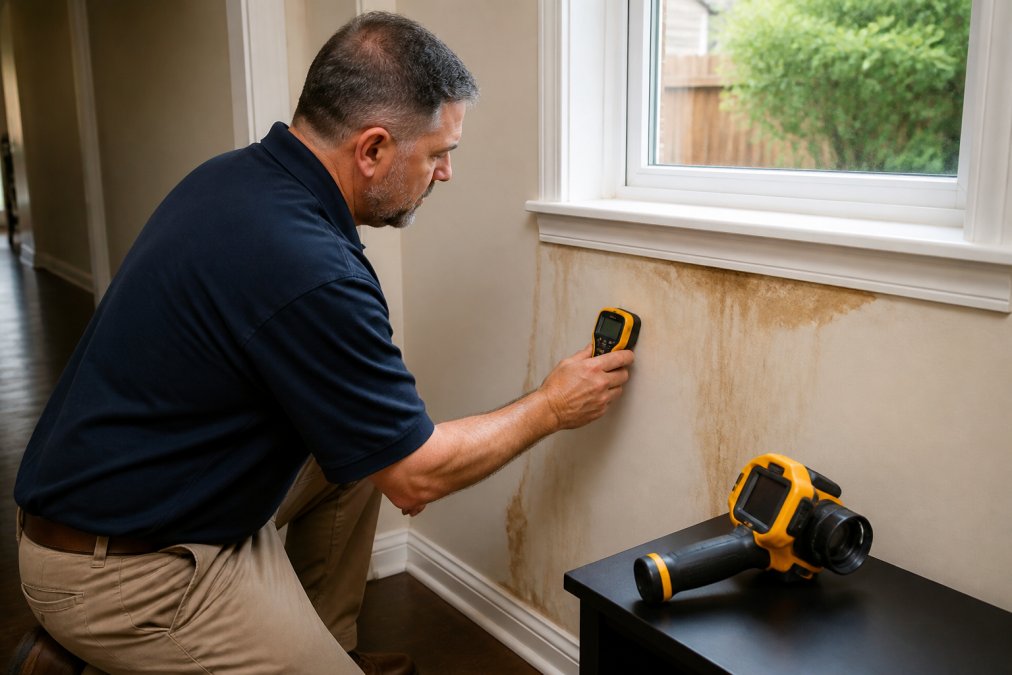
During a walkthrough, check for:
- Musty odor in basements, closets, or crawl spaces, which often signals hidden growth.
- Water staining on ceilings, around windows, and beneath plumbing fixtures.
- Warped flooring or bubbling paint, both signs of prolonged moisture exposure.
- Condensation on windows or cold pipes, which raises indoor humidity.
- A hygrometer reading above 60% relative humidity in living spaces.
Mold Inspection Cost for Homebuyers: What Drives the Price
Mold inspection cost for homebuyers depends on the size of the home, the number of samples collected, and whether the property has suspected hidden growth. There is no flat national rate, and any guide that quotes a single number is guessing.
| Factor | Lower Cost | Higher Cost |
|---|---|---|
| Home size | Under 1,500 sq ft | Over 3,000 sq ft |
| Sampling | Air samples only | Air plus surface and bulk sampling |
| Access | Open, unfinished areas | Sealed walls, crawl spaces, finished basements |
| Scope | Single concern (one room or area) | Whole-home assessment with moisture mapping |
| Reporting | Summary letter | Full lab report with genus-level spore counts and a moisture-source map |
Estimating Remediation Cost Before You Negotiate
This is the number that actually drives your decision, and it is the one most buyers never estimate before making an offer. Remediation pricing is driven by three variables: the square footage of affected material, the type of material, and whether the moisture source requires a structural repair.
A rough framework remediation contractors may use:
- Small, contained area (roughly under 10 square feet of affected drywall or trim, source already corrected): often handled as a minor repair rather than a full containment project.
- Moderate area (a single room, or a section of a basement or attic): typically requires containment, negative air pressure, HEPA filtration, and removal of affected porous materials. This is the most common pre-purchase scenario.
- Large or structural (multiple rooms, crawl space with widespread growth, or growth inside wall cavities and framing): requires full containment, possible structural repair, and often a separate contractor for the moisture source.
Ask every inspector and remediator for a written scope of work, not just a price. Two quotes at the same dollar figure can cover very different amounts of work, and the scope is what you negotiate with.
What a Standard Home Inspection Does Not Cover
A standard home inspection does not include mold assessment, and it does not include the moisture mapping that would reveal a hidden source. The InterNACHI standards of practice for home inspectors confirm that mold inspection is a separate, specialized service. Budget for it as a line item alongside your general inspection, radon test, and sewer scope, not as a replacement for any of them.
What to Do If Mold Is Found During Home Inspection
If mold is found during a home inspection, do not panic and do not immediately walk away. Mold findings are negotiable, and the right response protects both your health and your wallet. The problem is that most buyers treat a mold finding as a yes-or-no decision when it is really a scoping and documentation exercise.
Work through these steps in order:
- Get a professional assessment. A certified inspector confirms whether the growth is active and identifies the moisture source. A general inspector’s note that says “possible microbial growth” is not enough to negotiate with.
- Request lab documentation. Laboratory analysis distinguishes ordinary dust and pollen from active fungal growth and identifies genera such as stachybotrys, aspergillus, and penicillium. Spore counts by genus, compared against an outdoor control sample, are what give the report weight.
- Quantify the scope. Ask for a written report estimating the affected square footage, the materials involved (drywall, framing, insulation, subfloor), and the moisture source. Remediation pricing scales with all three.
- Negotiate the contingency. Use the report to request seller-funded remediation, a price reduction, or a repair credit. Get competing bids if the seller’s contractor quote looks low.
- Verify the fix. Insist on post-remediation verification, a clearance inspection with air sampling, before closing. A receipt from a remediation contractor is not the same thing as a clearance report.
Writing a Mold Contingency Into Your Offer
The legal and contractual side is where most buyers lose ground, and it is the piece almost no guide explains. A verbal promise to “take care of it” is worth nothing at closing. What you want is contract language, added as an addendum to your purchase agreement, that does four things:
- Defines the standard. Specify that remediation must follow a recognized industry standard, such as the IICRC S520 standard for mold remediation, and that clearance requires an independent third-party inspection, not the remediator inspecting their own work.
- Names who pays. State whether the seller funds remediation, credits the buyer at closing, or reduces the purchase price. Each has different tax and financing consequences, so confirm with your lender and closing agent before choosing.
- Sets a deadline. Remediation and clearance must be completed before a stated date, with the closing date tied to it. Open-ended timelines let a seller stall past your rate lock.
- Defines the walk-away trigger. Spell out the conditions under which you can terminate and recover your earnest money, for example, if clearance fails twice, or if the moisture source is structural and the seller refuses to repair it.
Do not accept a seller’s offer to “spray and paint” or apply an encapsulant coating over visible growth. That hides the symptom and leaves the moisture source intact. Insist on source correction plus removal of affected materials.
Deciding Whether to Walk Away
Not every mold finding is a dealbreaker, and not every dealbreaker is obvious. A useful rule of thumb: if the moisture source is a one-time event that has been corrected (a repaired supply line, a patched roof flashing) and the affected area is small and accessible, remediation is usually straightforward and negotiable. If the source is chronic or structural, a failing foundation drain, a crawl space with no vapor barrier and standing water, or long-term roof leakage into framing, the repair cost and the risk of recurrence rise sharply, and walking away is often the rational choice.
Pre-Purchase Mold Inspection vs. Mold Testing: What’s the Difference?
A pre-purchase mold inspection is a comprehensive assessment of moisture conditions and fungal growth, while mold testing is the narrower act of collecting and analyzing samples. They are related but not interchangeable.
Here is the practical difference:
- Inspection: Finds the source. Answers “why is there moisture here?”
- Testing: Confirms the presence. Answers “what is growing here?”
Frequently Asked Questions
Should I get a mold inspection before buying a house?
If the home has a history of water damage, musty odors, or visible staining, a pre-purchase mold inspection is worth the cost. Standard home inspections often miss hidden mold behind walls or under floors. An inspector uses moisture meters and thermal imaging to find problem areas before you close. This protects your investment and gives you leverage in negotiations.
How much does a mold inspection cost for homebuyers?
Mold inspection cost for homebuyers varies based on home size, number of samples, and whether lab analysis is included. Pricing depends on the scope of the inspection and any additional testing needed. Contact The Mold Consultant, LLC for a quote based on your specific property and concerns.
What happens if mold is found during a home inspection?
If mold is found, you have several options. You can request the seller pay for remediation, negotiate a lower price to cover costs, or walk away if the issue is severe. A professional inspector can provide a written report and remediation cost estimate. This documentation helps you make an informed decision during the contingency period.
Is a standard home inspection enough to detect mold?
No. Standard home inspectors check for visible issues but do not test for mold or use specialized equipment like moisture meters and thermal imaging. They may note water stains but cannot confirm mold growth or identify hidden spores. A certified mold inspector provides a deeper assessment, including air quality testing and surface sampling when needed.
Who pays for a mold inspection, buyer or seller?
Typically, the buyer pays for a pre-purchase mold inspection as part of due diligence. However, if the inspection reveals significant mold, you can negotiate with the seller to cover remediation or split costs. In some cases, sellers may agree to pay for the inspection upfront to speed up the transaction. It depends on your contract terms.
Can mold be hidden in a house?
Yes. Mold often grows behind drywall, under flooring, inside HVAC systems, and in crawl spaces where it is not visible. A musty odor or unexplained allergy symptoms can indicate hidden mold. A professional inspector uses moisture meters, thermal imaging, and air quality testing to find mold even when you cannot see it.