
Last Updated: November 12, 2026
Quick Summary
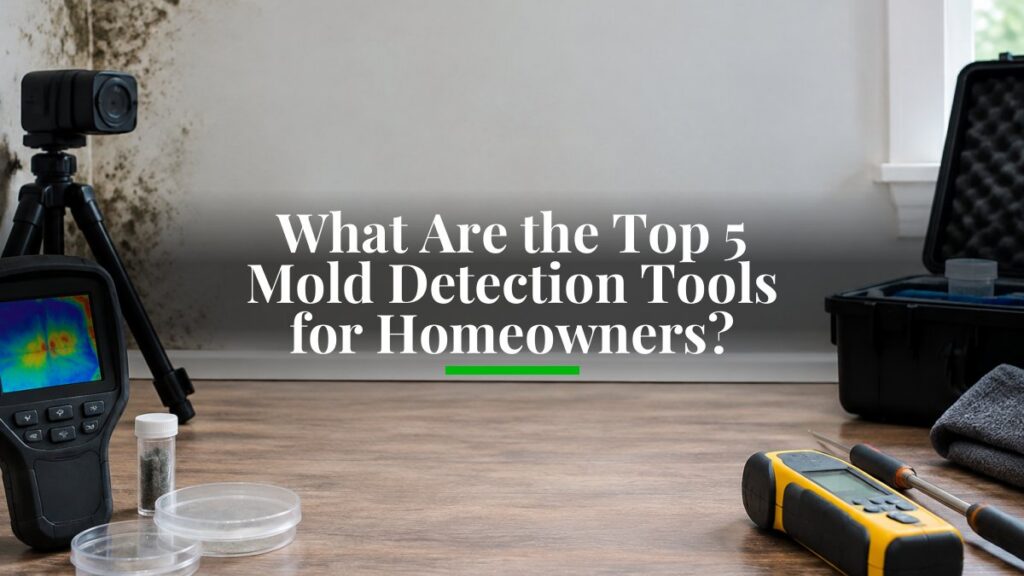
The top 5 mold detection tools for homeowners are a moisture meter, a thermal camera, a home mold test kit, an indoor humidity monitor, and professional air quality testing. Most homeowners get the best coverage from a moisture meter plus a humidity monitor, adding a thermal camera after water damage.
- Mold can begin colonizing within roughly 24 to 48 hours of water exposure, per EPA guidance.
- Test a known-dry wall section first, then compare meter readings against that baseline.
- Thermal cameras flag cold spots but cannot confirm what is growing there.
- Keep indoor relative humidity between 30 and 50 percent, and ideally below 60 percent.
- Wear an N95 respirator, goggles, and gloves before any mold cleanup.
Table of Contents
- Why Homeowners Need Mold Detection Tools
- 1. Moisture Meter for Mold Detection: Finding Hidden Water First
- 3. Home Mold Test Kit Accuracy: What These Kits Can and Cannot Prove
- 4. Indoor Humidity Monitor for Mold Prevention: Keeping Humidity Under Control
- 5. Professional Air Quality Testing: When a Tool Isn’t Enough
- Comparing the Top 5 Mold Detection Tools Side by Side
- Booking a Professional Mold Inspection
- Frequently Asked Questions
Why Homeowners Need Mold Detection Tools
Mold needs water, and it needs it for roughly 24 to 48 hours before colonization begins, according to EPA guidance on mold and moisture control. That short window is why the top 5 mold detection tools for homeowners matter: by the time you smell the musty odor, the problem has usually been growing behind drywall or under a baseboard for weeks. Homeowners who catch moisture early generally face smaller repair bills than those who catch mold late.
The tools below do different jobs. Some find water. Some find temperature anomalies. Some test the air. None of them replaces a trained eye, but each one shortens the gap between a hidden leak and a visible problem.
1. Moisture Meter for Mold Detection: Finding Hidden Water First
A moisture meter for mold detection is a handheld device that measures water content in building materials, expressed as a percentage of the material’s dry weight.
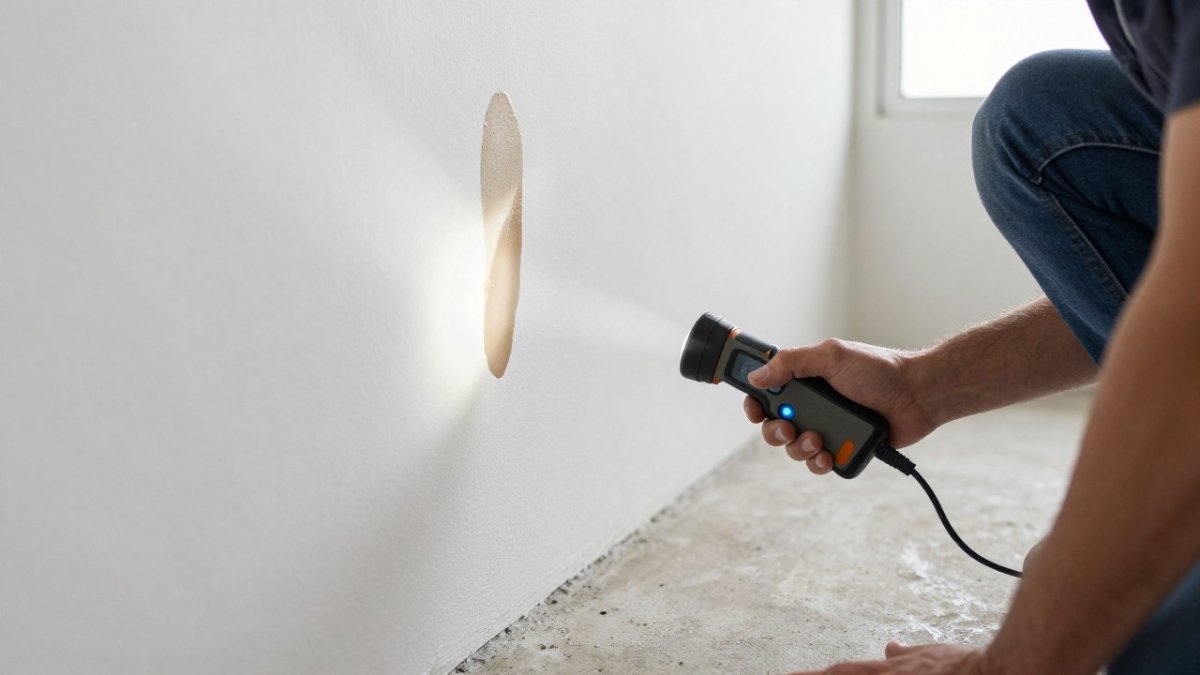
Pin-type meters drive two small probes into drywall or wood and read conductivity. Pinless meters scan a surface without leaving marks, which makes them better for finished walls. In practice, we reach for a pin-type meter on exposed framing and a pinless unit on painted drywall.
(/how-to-identify-hidden-moisture-in-walls/).
Treat a thermal camera as a screening tool rather than a final answer.
3. Home Mold Test Kit Accuracy: What These Kits Can and Cannot Prove
Home mold test kit accuracy is limited by design. Most kits fall into two types: settle plates that collect airborne spores over a set period, and swabs that sample a visible surface. Both can tell you that mold spores are present.
A common mistake is reading a positive result as proof of a problem. Mold spores exist in nearly every indoor environment.
Kits are cheap and easy, and that is their real value: they confirm suspicions and prompt action. If you are checking a crawlspace before mold takes hold, our article on detecting moisture in crawlspaces covers the sequence that actually matters.
4. Indoor Humidity Monitor for Mold Prevention: Keeping Humidity Under Control
An indoor humidity monitor for mold prevention tracks relative humidity, the percentage of moisture the air is holding compared with what it could hold at that temperature. This is the metric that predicts condensation, and condensation is where mold gets its start on cool surfaces.
The EPA recommends keeping indoor relative humidity between 30 and 50 percent, and ideally below 60 percent year-round, per EPA mold prevention guidance. Above that band, moisture condenses on window glass, exterior wall corners, and cold water pipes. Below roughly 30 percent, you trade mold risk for dry air complaints, so the target is a band, not a floor.
Where to Place Monitors
Place monitors in the rooms most likely to run humid: basements, bathrooms, laundry areas, and any room above a crawlspace. A monitor that logs readings over time beats a display-only unit, because mold problems build over weeks, not minutes. Logging matters most in a basement, where humidity swings between a cool night and a humid afternoon and a single glance at a display tells you almost nothing.
The Smart-Home Layer Most Guides Skip
The biggest upgrade in this category is not a better display; it is connectivity. Wi-Fi and Bluetooth hygrometers push readings to a phone app and trigger alerts when humidity crosses a threshold you set.
A common pattern is to pair a smart hygrometer with a smart plug on the dehumidifier. You set the hygrometer to alert or trigger above your chosen threshold, and the dehumidifier runs only when the space actually needs it.
Watch out: a smart plug rated for a small appliance may not be rated for the inrush current of a dehumidifier compressor. Check the plug’s amperage rating against the dehumidifier’s nameplate before you rely on automation, and keep the dehumidifier’s own humidistat as a backup.
Reading the Numbers Like an Inspector
Pair the monitor with a dehumidifier sized for the space, and watch the dew point during humid months. When the dew point climbs, so does your risk. A basement sitting at 55 percent relative humidity at 68°F is usually fine; the same 55 percent at 60°F is closer to condensation on cold surfaces, because cooler air holds less moisture.
Check the log weekly during humid months and after any rain event that wets the foundation. A slow upward drift in one corner of the basement points to a moisture path the gauge cannot see, and that is your cue to bring in the moisture meter from the first section.
5. Professional Air Quality Testing: When a Tool Isn’t Enough
Professional air quality testing is the point where homeowner tools stop and laboratory analysis begins. A trained inspector collects air and surface samples, documents moisture readings and thermal images, and sends samples to an accredited lab. The lab report gives you species identification and spore concentrations, compared against an outdoor control sample.
That comparison is what a home kit cannot deliver. It is also what you need if a landlord, insurer, or attorney will ask for documentation. If you have health concerns and your doctor raised mold as a possible factor, a lab-backed report gives you something concrete to work from rather than a guess.
The DIY vs. Hire Decision
The question homeowners actually ask is not whether lab testing exists; it is when to stop cleaning and call a professional. A small surface patch with a fixed moisture source may be manageable as a DIY job. Growth that spreads into wall cavities or HVAC ductwork, or that keeps returning after cleanup, calls for professional remediation.
The reason is containment, not scrubbing power. A small surface patch can be wiped and dried. A larger area releases spores into the air the moment it is disturbed, and a professional setup uses negative air pressure and HEPA filtration to keep those spores from spreading to the rest of the house.
Health and Safety Protocols Before You Touch Anything
The CDC’s information on mold and health is clear that mold exposure affects people differently, and testing tells you what is present, not what it means for your body. That distinction matters when you are deciding how far to take remediation.
Before any cleanup, treat the area as a contamination zone. Wear an N95 respirator, not a dust mask, along with goggles and gloves.
Watch out: if the musty odor is strong, if anyone in the home reports new respiratory symptoms, or if the growth sits near HVAC returns, skip the DIY phase and go straight to professional testing.
What the Report Actually Tells You
A lab report can compare indoor spore concentrations against an outdoor control sample, which helps show whether indoor growth may be present. Species identification matters because some molds are common outdoor colonizers and others are the water-damage indicators inspectors watch for.
Our team offers air quality testing as part of a full inspection, and the benefits of professional indoor air quality analysis go well beyond a single reading. If you are weighing whether to test at all, the deciding factor is usually documentation: a real estate transaction, an insurance claim, or a health concern is when a lab-backed report earns its cost.
Comparing the Top 5 Mold Detection Tools Side by Side
The right tool depends on what you are trying to answer. Use this table to match the tool to the question.
| Tool | What It Measures | Best For | Limitation |
|---|---|---|---|
| Moisture meter | Water content in materials | Confirming damp drywall or wood | Only reads at the probe |
| Thermal camera | Surface temperature differences | Locating hidden moisture areas | Flags cold spots, not mold |
| Mold test kit | Spore presence | Quick preliminary check | No baseline, no species ID |
| Humidity monitor | Relative humidity over time | Preventing condensation | Does not find existing growth |
| Professional testing | Lab-analyzed spore counts | Documentation and health concerns | Requires scheduling and cost |
Most homeowners get the best coverage from a moisture meter plus a humidity monitor. Add a thermal camera if you have had water damage. Skip straight to professional testing if you smell musty odor with no visible source, or if a real estate transaction or insurance claim is involved.
Booking a Professional Mold Inspection
A professional inspection is the right call when your tools point to a problem you cannot locate, when moisture keeps returning after cleanup, or when you need written findings that hold up. The Mold Consultant, LLC offers non-destructive testing solutions to help identify moisture intrusion points.
Before you book, it helps to know what an inspection costs and how to get ready. Our guide to the cost of a professional mold inspection breaks down pricing, and our checklist on how to prepare for a professional mold inspection covers what to clear and what to document.
The team holds the Certified Microbial Remediation Supervisor (CMRS) and Certified Residential Mold Inspector (CRMI) credentials, The Mold Consultant, LLC holds A+ accreditation from the BBB, and discounts are offered to veterans, teachers, and first responders.
Hidden moisture rarely announces itself. It shows up as a musty odor, a rising humidity reading, or a stain you notice months too late.
Frequently Asked Questions
Can a moisture meter detect mold behind walls?
A moisture meter detects elevated moisture content, not mold itself. Because mold needs sustained moisture to grow, a reading well above the dry baseline for that material signals a likely problem area. Pin-type meters measure at the surface, while pinless meters scan deeper without leaving holes. Use one to map wet zones, then confirm with a thermal camera or a professional inspection before assuming mold is present.
Are home mold test kits accurate?
Home mold test kit accuracy varies widely. Settling-plate and swab kits can confirm that mold spores exist, but they cannot tell you the source, the extent of growth, or whether the spore count is elevated compared with outdoor air. A lab report showing mold is common and rarely conclusive on its own. For a defensible answer, a professional air quality test with a control sample gives you comparable data.
What tools can homeowners use to detect mold?
Four tools cover most homeowner needs: a moisture meter to find wet materials, a thermal camera to spot temperature differences behind walls, a mold test kit for a basic presence check, and a hygrometer or humidity monitor to keep indoor relative humidity below 60%. Each answers a different question, so the strongest approach combines them. If two or more point to a problem, bring in a certified inspector.
When should I hire a professional mold inspector?
Call a professional when you smell a musty odor with no visible source, when a moisture meter or thermal camera flags a hidden area, or when you need documentation for a landlord, insurer, or real estate transaction.
