
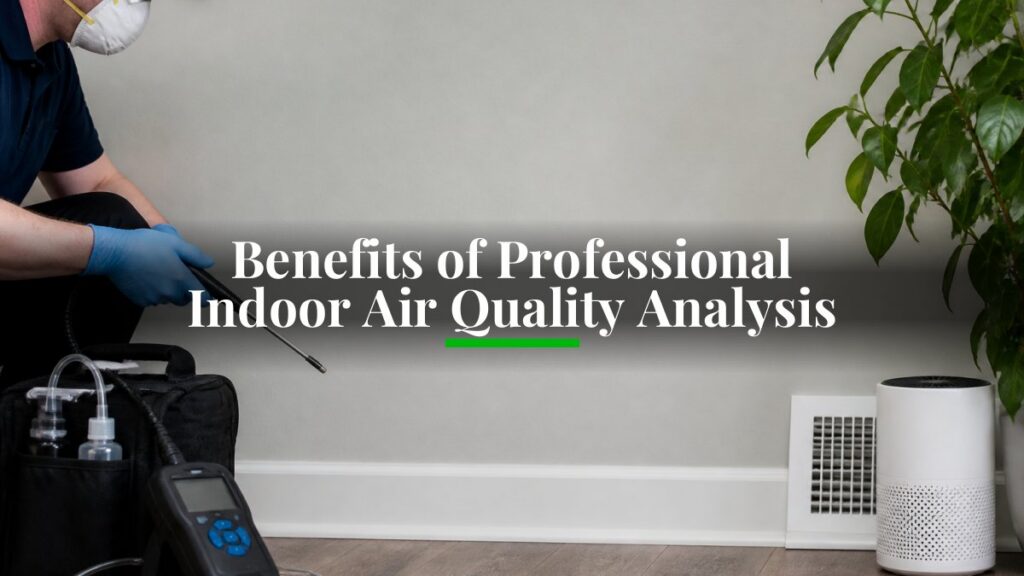
Last Updated: October 23, 2026
Quick Summary
Professional indoor air quality analysis measures particulate matter, volatile organic compounds, carbon monoxide, carbon dioxide, mold spores, allergens, and humidity together, then traces findings to their sources. It pairs calibrated sampling and accredited laboratory analysis with a walkthrough and moisture mapping, so you learn what is in the air and where it is coming from. The result is a written report with concentrations, outdoor control comparisons, and prioritized next steps.
- Consumer-grade sensors can flag some pollutants but cannot confirm what a particle actually is.
- Moisture mapping comes early because moisture is the strongest predictor of biological growth.
- Ask for outdoor control samples in every assessment so indoor levels are judged against a baseline.
- Choose an independent tester who does not sell remediation to avoid a conflict of interest.
- Confirm the lab holds accreditation such as AIHA-LAP, EMLAP, or NVLAP for the methods used.
Table of Contents
- Why Indoor Air Quality Analysis Matters More Than You Think
- What Professional Indoor Air Quality Analysis Detects
- The Indoor Air Quality Testing Process, Step by Step
- Indoor Air Quality Testing for Mold: Finding What You Can’t See
- Indoor Air Quality Monitor Accuracy: What Consumer Devices Miss
- Indoor Air Quality Report Interpretation and Next Steps
- How to Choose a Qualified, Independent IAQ Professional
- Frequently Asked Questions
Why Indoor Air Quality Analysis Matters More Than You Think
Most people assume the air inside their home is cleaner than the air outside. The opposite is often true. Indoor air quality is the measure of how clean or polluted the air inside a building is, based on the concentration of particles, gases, and biological contaminants circulating through it.
The stakes are practical, not abstract. The Environmental Protection Agency’s indoor air research consistently ranks indoor air among the top environmental risks to public health, largely because Americans spend the vast majority of their time indoors. Poor ventilation, trapped moisture, and everyday products all concentrate pollutants in enclosed spaces.
Here is what most guides get wrong: they treat air quality testing as a mold-only concern. It is not. A professional assessment measures particulate matter, volatile organic compounds, carbon monoxide, carbon dioxide, mold spores, allergens, and humidity together, because those factors interact. High humidity feeds mold. Poor airflow traps VOCs. One problem rarely travels alone.
If you are weighing whether testing is worthwhile, our guide on whether air quality testing is worth it walks through the value question from a homeowner’s perspective. For a deeper look at the health side, the health benefits of indoor air quality testing explain what cleaner air actually does for the people living in a space.
What Professional Indoor Air Quality Analysis Detects
A professional indoor air quality analysis identifies and measures airborne pollutants that you cannot see, smell, or feel until symptoms appear. The core targets are consistent across most assessments:
- Particulate matter from dust, pollen, and combustion
- Volatile organic compounds off-gassing from paints, adhesives, and furnishings
- Carbon monoxide and carbon dioxide tied to combustion and ventilation
- Mold spores and allergens suspended in the air
- Bacteria and biological contaminants in moisture-prone areas
- Humidity and moisture readings that predict future growth
Consumer-grade sensors can flag some of these. None of them can confirm what a particle actually is. That distinction matters, and we will come back to it.
The Indoor Air Quality Testing Process, Step by Step
A professional assessment follows a sequence designed to pair measurement with source identification. Here is how the indoor air quality testing process typically runs, and what each stage is actually for.
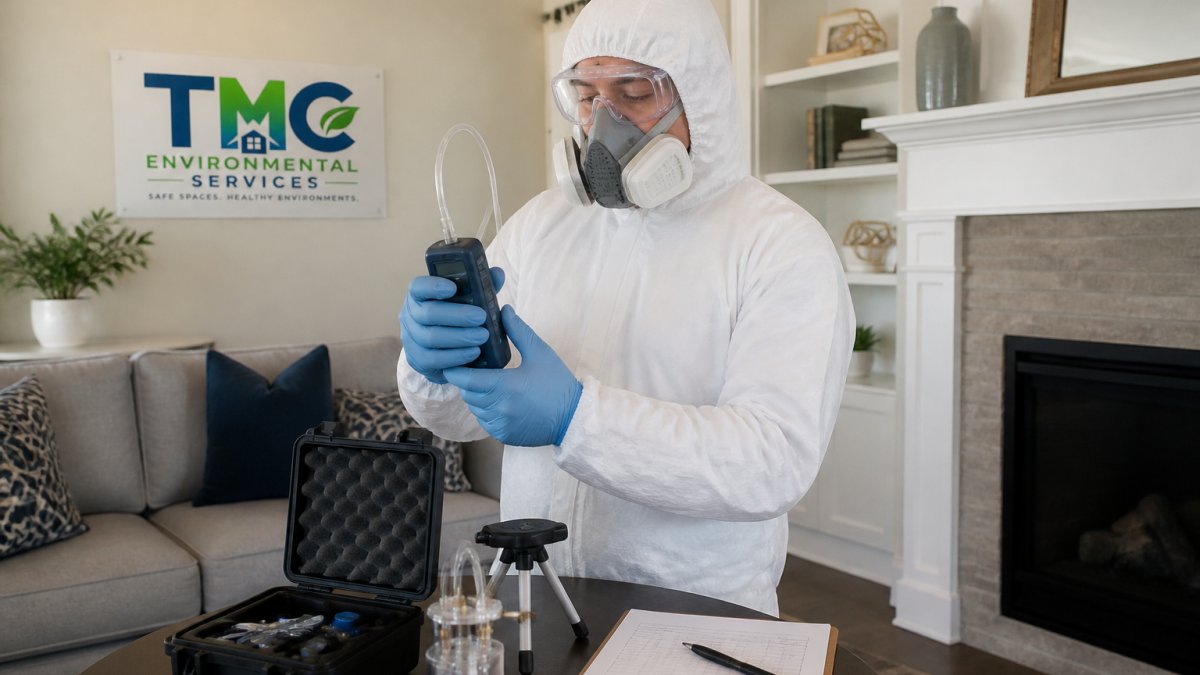
- Interview and walkthrough. We ask about water damage, renovations, HVAC history, occupant symptoms, pets, combustion appliances, and recent cleaning or painting. The answers determine which pollutants are plausible and which tests are worth paying for. A building with a gas range, an attached garage, and a recent bathroom remodel needs a different panel than a tight new-construction condo.
- Moisture mapping. Non-destructive pin meters, pinless meters, and thermal imaging locate hidden dampness behind walls, under flooring, and around window frames. Moisture is the single strongest predictor of biological growth, so this step often decides where air and surface samples get collected.
- Sampling plan. Rather than running every test available, a qualified professional selects targeted sampling based on the walkthrough: spore trap air samples in the breathing zone and in suspect rooms, outdoor control samples for baseline comparison, surface swabs or tape lifts where visible growth is suspected, and, when combustion or chemical sources are present, direct-reading instruments for carbon monoxide, carbon dioxide, and volatile organic compounds. A one-size-fits-all panel wastes money and can bury the real finding in irrelevant data.
- Air and surface sampling. Calibrated pumps draw a known volume of air through cassettes or spore traps over a set period, usually a few hours per sample. Flow rate and duration matter: an uncalibrated pump produces numbers that cannot be compared to reference limits. Surface samples are collected with swabs or tape lifts where growth is suspected but not confirmed.
- Laboratory analysis. Samples go to an accredited laboratory, look for accreditation such as AIHA-LAP, EMLAP, or NVLAP, that identifies and quantifies what was collected. Spore trap analysis typically reports genus and count per cubic meter; viable culture methods can take longer but identify living organisms. Lab choice affects turnaround: direct microscopy often returns in a few business days, while culture-based methods can take a week or more.
- Reporting. You receive findings with concentrations, source locations, outdoor control comparisons, and prioritized next steps. A useful report distinguishes detection from proof of a health risk and states the limitations of the sampling.
What affects cost and turnaround. Pricing varies by region, building size, and the number of samples, but the main cost drivers are the number of air and surface samples, whether outdoor controls are included, which laboratory methods are used, and whether the assessment covers one building or several units. Ask for a written scope that lists sample counts and lab methods before you approve work, that is what you are actually paying for.
The walkthrough is where most value sits. Labs tell you what is in the air. A trained inspector tells you where it is coming from, and a well-built sampling plan is what connects the two.
Indoor Air Quality Testing for Mold: Finding What You Can’t See
Indoor air quality testing for mold answers a question visual inspection cannot: is there growth you cannot see, and is it releasing spores into the breathing zone? Mold often hides behind drywall, under flooring, or inside HVAC ductwork after a slow leak. By the time it is visible, the source has usually been active for weeks.
Skipping air sampling after a leak because “everything looks dry now” is one of the most common mistakes we see. Moisture hides, and so does the growth it feeds. Visible dryness is not proof of a dry cavity.
Lab results distinguish mold spores from ordinary dust and identify genera, which helps tie findings to a moisture source rather than guesswork. That evidence also supports remediation decisions and, if needed, documentation for insurance or a tenant dispute. Beyond identifying airborne contaminants, addressing the settled particles trapped in fibers through professional carpet cleaning for asthma remains a critical step in maintaining a truly breathable environment.
Indoor Air Quality Monitor Accuracy: What Consumer Devices Miss
Indoor air quality monitor accuracy is the biggest reason store-bought sensors and professional analysis are not interchangeable. Consumer monitors estimate conditions using low-cost sensors. They are useful for spotting trends, like a humidity spike after a shower, but they cannot identify what a particle is or whether a spore is mold.
Professional analysis relies on calibrated sampling equipment and accredited laboratory methods. The difference is measurement versus estimation. A monitor might read “elevated particulates.” A lab report tells you those particulates include elevated mold spores traceable to a specific wall cavity.
Indoor Air Quality Report Interpretation and Next Steps
Indoor air quality report interpretation starts with three questions: what was found, at what concentration, and compared to what baseline. A good report gives you outdoor control samples, so indoor levels are judged against normal background rather than an arbitrary number.
Results typically lead to one of three paths:
| Finding | Typical Next Step | Urgency |
|---|---|---|
| Elevated mold spores tied to a moisture source | Source repair plus remediation | High |
| High humidity with no active growth | Ventilation and dehumidification fixes | Moderate |
| Normal readings with isolated dust | Routine filtration and cleaning | Low |
If you are staring at lab numbers and unsure what they mean, our guide on how to interpret mold lab results breaks down the report line by line before you commit to any next step.
Ask for outdoor control samples in every assessment. Without a baseline, an indoor spore count tells you almost nothing about whether your building has a problem.
How to Choose a Qualified, Independent IAQ Professional
Choosing the right professional comes down to independence and documentation. An inspector who also sells remediation has a financial incentive to find a problem. Independent testing keeps the diagnosis separate from the cure. That separation is the first filter, but it is not the only one.
Credentials that mean something. Look for training specific to the work being done. For broader indoor air quality work, board certifications and state licensure requirements vary, so confirm what applies in your area (the EPA).
Laboratory accreditation. The lab matters as much as the inspector. Ask whether the laboratory holds accreditation such as AIHA-LAP, EMLAP, or NVLAP for the specific methods being used.
Scope of work in writing. A credible proposal states the number of air samples, whether outdoor control samples are included, which surface samples will be collected, which instruments and lab methods will be used, the expected turnaround, and what the report will contain.
Conflicts of interest. Ask directly: do you sell remediation, or only testing and consulting? Do you receive referral fees from contractors? Will you provide a remediation protocol that a separate contractor can bid on?
Questions to ask before hiring anyone:
- Do you sell remediation, or only testing and consulting?
- Which laboratory will analyze the samples, and what accreditation does it hold?
- Will the proposal list sample counts, methods, and turnaround in writing?
- Will findings be delivered in writing with lab documentation and outdoor controls?
- What are the limitations of the testing, and what will the results not prove?
If you want to understand why this separation matters, read our guide on the benefits of independent mold testing. When you are ready to hire, our guide to finding a mold inspector in Oklahoma City covers what to check locally.
The single most important trait in an IAQ professional is independence, followed closely by documentation. A tester who profits from remediation findings cannot give you a neutral answer, and a tester who will not put sample counts, lab methods, and limitations in writing cannot give you a comparable one.
Frequently Asked Questions
Is professional indoor air quality testing worth it?
It depends on what you need answered. If you smell something odd, have had water damage, or someone in the home has unexplained respiratory symptoms, a professional assessment gives you documented data that a $200 consumer monitor cannot. Lab analysis identifies specific pollutants at low concentrations, and a written report gives you a defensible record for landlords, insurers, or remediation decisions. If your home is dry, well-ventilated, and symptom-free, the value is lower.
Can indoor air quality testing for mold identify hidden moisture problems?
Air sampling can capture mold spores that are circulating, and it can flag elevated concentrations compared with outdoor baseline samples. It cannot, on its own, pinpoint where the moisture source is. That is why a full assessment pairs air sampling with moisture mapping, thermal imaging, and a visual walkthrough of the HVAC system and building envelope. The combination is what tells you whether a problem is active and where to look.
How accurate are consumer indoor air quality monitors compared with professional analysis?
Consumer monitors are useful for spotting trends, like a spike in particulate matter when you cook or a humidity rise after a leak. Their sensors drift over time, they typically measure a narrow set of parameters, and they are not calibrated to laboratory standards. Professional analysis uses calibrated sampling equipment and accredited lab work, which is why results hold up in a report or a dispute. Treat consumer readings as a heads-up, not a diagnosis.
What should I do after receiving an indoor air quality report?
Read the interpretation section first, not the raw numbers. It should tell you which pollutants are elevated, how they compare with outdoor or baseline samples, and what likely source is driving each one. From there, the usual order is source control first (fix the moisture, remove the contaminated material), then ventilation and filtration, then retesting to confirm the fix worked. If remediation is needed, ask for post-remediation verification so you have before-and-after data.
