

Last Updated: October 30, 2026
Quick Summary
A mold inspection report is a written record of a professional assessment of a property’s mold conditions, moisture problems, and the building conditions that allow mold to grow. You need one when you suspect hidden moisture, after a water intrusion event, or when a dispute requires documented evidence you can act on or defend.
- A useful report covers visual findings, moisture readings, sampling data, and recommendations.
- Inspection is the broader building assessment; testing is the narrower act of collecting and analyzing samples.
- Compare indoor sample results against an outdoor baseline rather than reading a spore count in isolation.
- Read the scope and limitations first, then moisture readings, then sampling data.
- Post-remediation verification compares new samples against the pre-remediation report baseline.
Table of Contents
- What a Mold Inspection Report Is and What It Assesses
- Why You Need a Mold Inspection Report
- What a Mold Inspection Report Includes
- Mold Inspection vs Mold Testing: How the Two Differ
- How to Read Mold Test Results Without Overreacting
- A Mold Inspection Report Sample, Annotated
- Mold Remediation Verification Testing and What Comes After the Report
- Schedule Your Mold Inspection with The Mold Consultant
- Frequently Asked Questions
What a Mold Inspection Report Is and What It Assesses
A mold inspection report is a written record of a professional assessment of a property’s mold conditions, moisture problems, and the building conditions that allow mold to grow. Mold inspection reports are produced for homeowners, landlords, and property managers who need documented answers rather than guesses. The report assesses visible mold growth, moisture readings, humidity levels, water damage, and the site conditions that support spores taking hold. It is not a sales pitch. It is a technical snapshot of the building on the day of inspection, and its value depends entirely on how thoroughly the inspector documented what they saw and measured.
Why You Need a Mold Inspection Report
You need a mold inspection report when you suspect hidden moisture, when a water intrusion event has occurred, or when a dispute requires evidence. The report turns a vague concern into documented findings you can act on or defend.
Consider what happens without one. A landlord suspects a tenant’s complaint is exaggerated. A buyer wants to know if that discoloration in the basement is old or active. An insurance adjuster needs proof the water source was sudden rather than neglected maintenance. In each case, a written report with moisture readings, photographs, and sampling data settles the question. EPA guidance on mold and moisture control is clear that controlling moisture is the core of mold prevention, and a report identifies exactly where that moisture is coming from.
What a Mold Inspection Report Includes
A mold inspection report includes the inspector’s observations, moisture measurements, sampling data, and recommendations, organized so a non-specialist can follow the findings. The scope varies by provider, but a useful report covers the same core elements.
Visual Findings, Moisture Readings, and Sampling Data
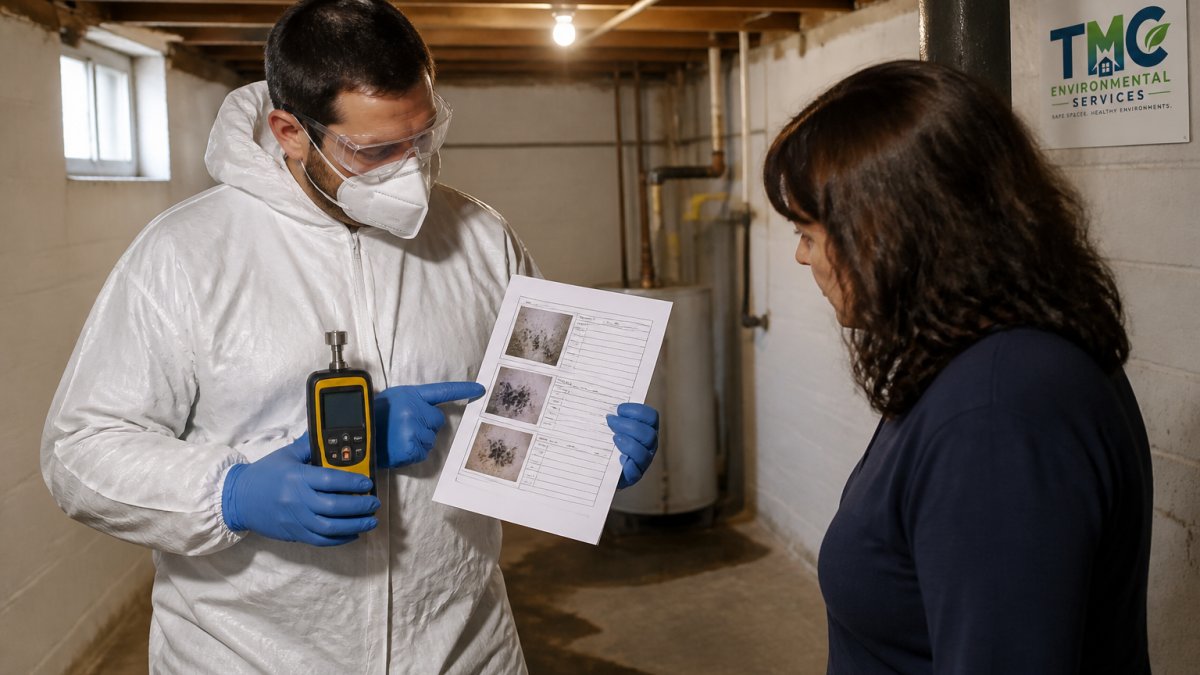
The visual inspection section documents what the inspector observed: visible mold, water staining, efflorescence, deteriorating building materials, and conditions conducive to mold growth such as poor ventilation or previous leaks. If your HVAC system is a concern, see how do you test for mold in air ducts. Moisture readings come next. A moisture meter gives numeric readings at specific locations, while humidity readings establish the ambient conditions.
Sampling data covers air samples and surface samples sent for laboratory analysis. The lab reports spore counts, culture results, and colony-forming units, along with mold identification to genus or species where possible. A common mistake is treating sample results as the whole report. They are one section of it, and they mean little without the site conditions and moisture assessment that explain them.
Mold Inspection vs Mold Testing: How the Two Differ
Mold inspection and mold testing are not the same thing. Inspection is the broader assessment of the building: visual findings, moisture readings, humidity, and the conditions that allow growth. Testing is the narrower act of collecting samples and having a laboratory analyze them. Inspection determines whether testing is even warranted, and where samples should be taken.
This distinction matters because sampling without inspection produces numbers with no context. Readers comparing the two often want to understand why visual mold inspections are insufficient. An inspector who takes air samples in three rooms without first finding the moisture source is guessing. The building assessment should always lead, and sampling should follow the evidence.
How to Read Mold Test Results Without Overreacting
Read mold test results by comparing indoor samples against outdoor baseline samples, then interpreting the numbers alongside the inspection findings. Mold spores exist in every building. The question is whether indoor counts and types differ meaningfully from what is present outdoors.
Sampling Strategy Comes First
Sampling is context-dependent, and the strategy should follow the inspection. A common pattern is to take an outdoor baseline plus indoor air samples in the affected area and in a comparison area, and surface samples (tape lift, swab, or bulk) where visible growth is present. The number and location of samples should be driven by what the inspector found, not by a fixed package. If an inspector takes three air samples without first locating the moisture source, the numbers have no context.
Interpreting the Numbers
Watch out: the single most common error is reading a spore count in isolation. For a deeper walkthrough of reading lab reports, see How to Interpret Mold Lab Results: A Homeowner’s Guide. A lab report showing elevated counts means little if the outdoor baseline was also elevated on a windy day. Look for the ratio, the species present, and whether the inspector’s moisture readings support the lab’s conclusions. A useful pattern is to compare indoor and outdoor totals and the dominant genera: if indoor Penicillium/Aspergillus is substantially higher than outdoor and the moisture readings show an active source nearby, the data and the site conditions agree. If the results and the site conditions disagree, that discrepancy is itself a finding worth investigating.
Negative and Conflicting Results
A negative sample does not necessarily rule out a moisture or mold problem. Spores are not distributed evenly, sampling captures a moment in time, and some problems (hidden growth behind a wall, for example) may not release spores into the sampled air at detectable levels. Conflicting results, elevated air counts but no visible growth, or visible growth but low air counts, are common and should be resolved by returning to the inspection findings: moisture readings, water stains, and the building conditions that support growth. The report should explain those limits rather than present a single number as a verdict.
What the Results Can and Cannot Establish
Lab results can establish what genera or species were present in the sample and roughly how the indoor mix compared with the outdoor baseline at that time. They cannot establish a medical diagnosis, a safe or unsafe exposure level for a particular person, or that a building is mold-free. Treat the results as one line of evidence alongside the visual and moisture findings.
A Mold Inspection Report Sample, Annotated
A useful report follows a predictable structure: property details, scope of inspection, site conditions, room-by-room observations, moisture and humidity readings, sampling data, and recommendations. The table below shows what each section should contain and what to check. Below the table, we walk through a representative example so you can see how the pieces connect.
| Report Section | What It Should Contain | What to Check |
|---|---|---|
| Property and scope | Address, date, areas inspected, limitations | Were problem areas excluded without explanation? |
| Site conditions | Weather, humidity, recent water events | Do conditions match the findings? |
| Visual observations | Room-by-room notes, photographs | Are findings tied to specific locations? |
| Moisture readings | Meter readings at named locations | Are numbers given, not just “damp”? |
| Sampling data | Air and surface samples, lab results | Is there an outdoor baseline? |
| Recommendations | Source control, remediation, retesting | Is the water source named? |
Walkthrough of a Representative Report
Consider a report for a single-family home with a finished basement. The property and scope section lists the address, the inspection date, and the areas inspected: basement, first floor, attic, and HVAC closet.
The site conditions section records the weather that day (for example, clear and dry, outdoor relative humidity around 55%), recent water events (a sump pump failure two weeks earlier), and whether the HVAC system was running. These details matter because they frame every reading that follows. A moisture reading taken on a rainy day means something different from one taken in dry weather.
The visual observations section is room-by-room. In the basement, the inspector notes discoloration along the baseboard on the north wall, efflorescence on the concrete block, and a musty odor. Photographs are numbered and tied to those locations.
Moisture readings come next, and they should be numeric and location-specific.
Sampling data covers air and surface samples sent for laboratory analysis. The lab reports spore counts, culture results, and colony-forming units, along with mold identification to genus or species where possible.
The recommendations section should name the water source and the next step.
When you receive a report, read the scope and limitations first, then the moisture readings, then the sampling data. If the recommendations do not name a water source, ask the inspector to clarify before you authorize any work.
A report that skips the moisture numbers or omits the outdoor baseline is thin. Ask for clarification before you act on it.
Mold Remediation Verification Testing and What Comes After the Report
After remediation, verification testing confirms whether the work actually solved the problem. Post-remediation assessment compares new samples and moisture readings against the pre-remediation report. This is where a good initial report pays off: without a documented baseline, there is nothing to verify against.
The follow-up sequence typically runs: source repair, removal of affected materials, cleaning, then clearance testing. If the moisture problem was never fixed, mold returns regardless of how well the visible growth was removed (the EPA). That is the failure mode most people describe when they say remediation did not work. Our guide on verifying post-remediation mold clearance walks through the steps, and if you are weighing inspection costs against insurance, see how to claim mold remediation on homeowners insurance.
Schedule Your Mold Inspection with The Mold Consultant
Our inspections use non-destructive testing to identify hidden moisture intrusion points.
Our team holds Certified Microbial Remediation Supervisor, Certified Restorer, and Certified Residential Mold Inspector credentials, and we offer discounts for veterans, teachers, and first responders. We also provide neutral mediation for mold-related property disputes. Contact The Mold Consultant, LLC to request an inspection.
Frequently Asked Questions
Is it worth doing a mold inspection?
Yes, when you have a reason to suspect moisture. A mold inspection report documents hidden water intrusion, elevated moisture readings, and visible growth that a visual walkthrough misses. If you have had a leak, flooding, or persistent dampness, an inspection gives you evidence and a repair plan. If you have no moisture history and no symptoms, the value is lower. The Mold Consultant, LLC offers inspections across the Oklahoma City metro so you can decide with facts rather than guesswork.
What is included in a mold inspection report?
A complete mold inspection report typically includes site conditions, moisture readings from a moisture meter, humidity readings, a description of visible mold and affected areas, laboratory analysis of air and surface samples, spore counts or culture results, and the inspector’s observations, opinions, and recommendations. It should also note limitations and any areas that could not be accessed. Ask for the sample report before you book so you know the format.
What is the difference between a mold inspection and a mold test?
A mold inspection is the broader assessment: a visual walkthrough, moisture and humidity readings, and identification of conditions conducive to mold growth. A mold test is one part of that, the laboratory analysis of air or surface samples. Testing without an inspection often produces numbers with no context. The inspection explains where the moisture comes from and what to fix, while the test quantifies what is airborne or on surfaces.
Can a mold inspection report be used as evidence?
A well-documented mold inspection report can support insurance claims, landlord-tenant disputes, real estate negotiations, and legal matters. It helps that the inspector is independent of the remediation company, so findings are neutral. Keep the full report, lab results, photos, and moisture data together. For disputes, ask whether the inspector can provide neutral mediation support.
What should you do after receiving a mold inspection report?
Read the recommendations section first. It usually separates the water source fix from the mold cleanup. Address the moisture problem before any remediation, or mold returns. If remediation is needed, hire a contractor and plan mold remediation verification testing afterward to confirm the work succeeded. Keep the original report for insurance or resale. If the report shows no elevated mold, file it and monitor the area during wet seasons.
