
Table of Contents
- Introduction to Post-Remediation Mold Clearance
- What Mold Clearance Actually Confirms
- Post-Remediation Mold Testing: What It Involves
- Why You Need an Independent Mold Clearance Inspection
- Mold Air Sampling After Remediation: How It Works
- Interpreting Mold Clearance Test Results
- What to Do If Your Property Fails Mold Clearance
- Frequently Asked Questions
Last Updated: October 8, 2026
Introduction to Post-Remediation Mold Clearance
A mold clearance is the final, independent proof that a remediation job actually worked. It answers one question: is the mold gone, or did the cleanup just hide it? If you’ve already paid a company to remove mold, this step is how you confirm you got what you paid for.
Here’s the part most people get wrong: a receipt from the cleanup crew is not proof. The company that removed the mold should not be the one grading its own work. That’s a conflict of interest, and it’s why an independent check matters so much.
Below, we break down what clearance really confirms, how testing works, and what to do if your property fails.
What Mold Clearance Actually Confirms
A mold clearance confirms one thing: the remediation worked and the air is back to normal. It is not a guarantee that mold will never return. It is a snapshot that says “this job is done right now.”
Clearance usually covers three checks:
- Visible mold is gone from the affected area
- Moisture levels are back to dry standard
- Air and surface samples show normal mold levels
Many people assume a passed clearance means the problem is solved forever. That’s not true. If the water source isn’t fixed, mold comes back. Clearance confirms the cleanup, not the cause.
Skipping clearance to save money is a common mistake. If mold returns weeks later, you have no paperwork proving the original job was ever done correctly. That weakens any insurance claim or dispute.
Post-Remediation Mold Testing: What It Involves
Post-remediation mold testing is the process of collecting samples after cleanup to prove the area is safe. It happens after the work is done, not before.
A typical test includes:
- A visual inspection of the cleared area
- Moisture readings on walls, floors, and framing
- Air samples inside and outside the building
- Surface samples from any spots of concern
The outside sample matters most. It sets a baseline. Your indoor air should not have more mold than the air outside. That comparison is the whole point.
Testing should happen only after the area is dry and the work area is cleaned. Testing too early gives false results.
Why You Need an Independent Mold Clearance Inspection
An independent mold clearance inspection is a check done by someone who did not do the cleanup. That separation is the entire value.
Think about it this way. You wouldn’t let a student grade their own exam. The same logic applies here. When the remediation company also runs the clearance test, there’s no neutral party.
An independent inspector:
- Has no financial stake in the cleanup passing
- Reports what the samples actually show
- Can back findings in writing if a tenant or insurer disputes them
This matters for landlords, real estate agents, and anyone filing an insurance claim. A neutral report carries weight. A self-issued one does not.
The Mold Consultant, LLC provides neutral mediation and actionable remediation strategies, so the findings hold up when someone questions them.
Mold Air Sampling After Remediation: How It Works
Mold air sampling after remediation measures the mold spores floating in the air. A calibrated pump pulls air through a small cassette, and the lab counts what it catches.
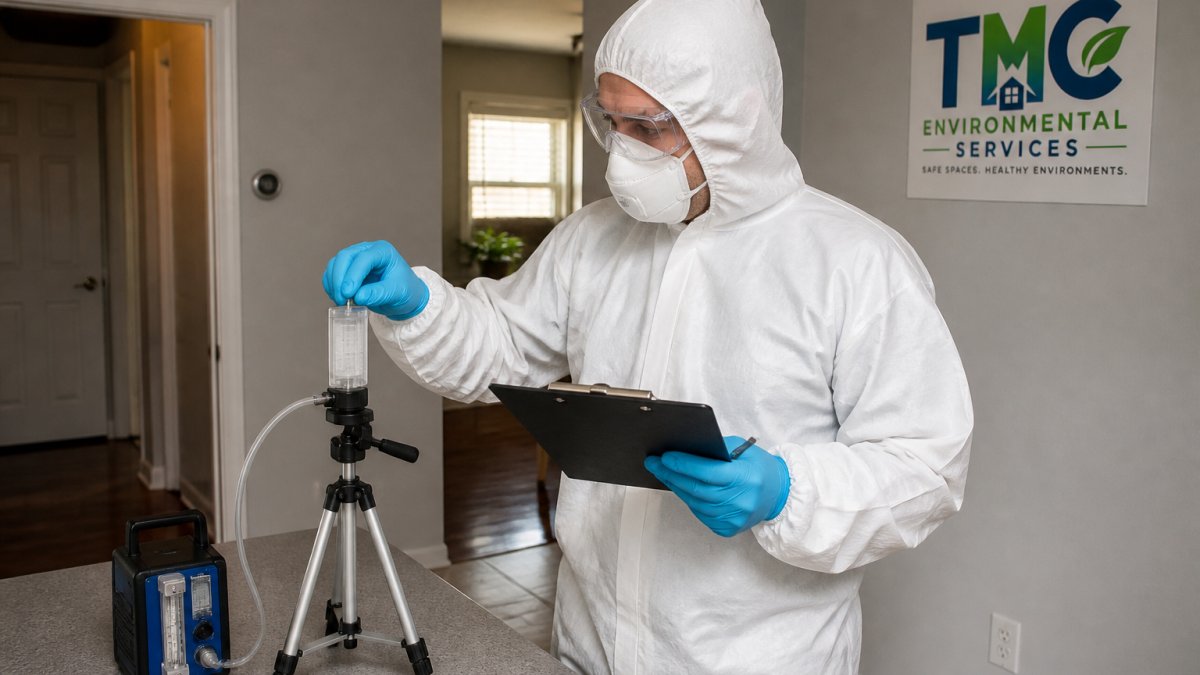
Here’s the basic flow:
- The inspector sets up an outdoor baseline sample
- Indoor samples are collected in the cleared area
- A pump runs for a set time to pull a known volume of air
- The cassette goes to a lab for analysis
- Results come back as spore counts by type
The pump must be calibrated. An uncalibrated pump gives numbers you can’t trust. Always ask if the equipment was calibrated before the visit.
Air Sampling vs. Surface Sampling
Air sampling and surface sampling answer two different questions. Air sampling shows what you’re breathing right now. Surface sampling shows what has settled on a specific spot.
| Method | What It Measures | Best For | Limitation |
|---|---|---|---|
| Air sampling | Spores floating in the air | Overall air quality | Can miss settled mold |
| Surface sampling | Mold on a specific spot | Confirming a stain or growth | Only tests that one spot |
Most clearances use both. Air sampling gives the big picture. Surface sampling confirms anything the eye can’t settle.
Ask for the outdoor baseline sample every time. Without it, there’s nothing to compare your indoor numbers against, and the results mean far less.
Interpreting Mold Clearance Test Results
Mold clearance test results compare your indoor spore counts to the outdoor baseline. If indoor levels match or sit below outdoor levels, the area usually passes.
Three things decide a pass or fail:
- Total spore count indoors vs. outdoors
- The types of mold found
- Whether any mold type indoors is one that shouldn’t be there
Some mold types are common outdoors and indoors. Others, like certain water-damage molds, should not show up indoors at all. If they do, that’s a red flag even when the total count looks fine.
A good report lists each mold type with a count. A vague report that just says “mold present” tells you nothing useful. Ask for the full lab breakdown.
The outdoor baseline is the key to reading any result. Indoor levels at or below outdoor levels usually mean a pass. Indoor levels above outdoor levels usually mean a problem.
What to Do If Your Property Fails Mold Clearance
A failed clearance is not the end of the story. It means the job isn’t finished yet.
When a property fails, the usual next steps are:
- Find the source the first cleanup missed
- Fix any hidden moisture or water intrusion
- Re-clean the affected area
- Retest before anyone moves back in
The most common cause of a failed clearance is a moisture source that was never fixed. Mold can’t grow without water. If the leak, condensation, or humidity problem is still there, new growth starts fast.
Don’t let anyone tell you to just clean again and skip the retest. If you don’t retest, you don’t know if it worked. The retest is the proof.
If you’re dealing with a failed clearance, our post-remediation service can confirm what was missed and give you a clear path forward. Depending on what the retest turns up, we may also recommend a mold inspection or an air quality test to pin down the source before any further cleanup begins.
Frequently Asked Questions
What does post-remediation mold clearance testing involve?
Post-remediation mold clearance testing involves a visual inspection by an independent third party and air sampling to measure airborne mold spore levels. The inspector confirms that the remediation work removed all visible mold and that moisture sources are fixed. Air samples are collected inside the remediated area and outdoors for comparison. The samples are sent to a laboratory for analysis, and results are compared to outdoor baseline levels to determine if clearance is achieved. This process verifies that the space is safe for reoccupancy.
Who should conduct post-remediation verification?
An independent mold clearance inspection should be performed by a certified mold inspector who has no financial interest in the remediation work. Using the same company that performed the remediation creates a conflict of interest. For legal or insurance purposes, a neutral third party provides credible documentation. In the Oklahoma City metro area, The Mold Consultant, LLC offers independent post-remediation verification to ensure unbiased results.
Can a home pass a visual inspection but fail air sampling?
Yes, a home can pass a visual inspection but fail air sampling. Mold spores are microscopic and can remain airborne even after visible mold is removed. If the remediation did not address hidden moisture or if spores were disturbed during cleanup, air samples may show elevated levels. This is why both visual inspection and air sampling are part of a thorough mold clearance test. If air sampling fails, further cleaning or remediation may be needed before clearance is granted.
What should happen if a property fails mold clearance testing?
If a property fails mold clearance testing, the remediation contractor should identify the cause, which may include missed mold growth, inadequate cleaning, or unresolved moisture. The contractor must then perform additional remediation and cleaning. Afterward, a new clearance inspection and air sampling should be conducted. It is important to document the failure and the corrective actions for insurance or legal purposes. The Mold Consultant, LLC can provide re-testing and guidance on next steps to achieve clearance.
A failed or unclear mold clearance leaves you stuck: you’ve paid for cleanup but can’t prove the air is safe. The Mold Consultant, LLC handles independent mold inspections, air quality tests, and post-remediation verification with over a decade of experience and non-destructive methods. We give you neutral findings you can use for tenants, insurers, or your own peace of mind. Call now to schedule your clearance inspection and get written proof that the job is truly done.