
Table of Contents
- Why Commercial Property Air Quality Assessments Matter in 2026
- Your Commercial Property Air Quality Inspection Checklist
- Commercial VOC Testing: What It Involves and When It’s Required
- Commercial Building Fresh Air Requirements and HVAC Standards
- What to Expect in an Indoor Air Quality Assessment Report
- How to Meet Commercial Property Air Quality Assessment Requirements: A Step-by-Step Guide
- Common Mistakes to Avoid in Commercial Air Quality Assessments
- Conclusion: Prioritizing Air Quality for a Healthier Commercial Property
- Frequently Asked Questions
Last Updated: October 6, 2026
Why Commercial Property Air Quality Assessments Matter in 2026
Commercial property air quality assessment requirements exist because indoor air can be measurably worse than outdoor air. More than a decade of inspecting commercial buildings shows problems consistently hide where tenants never look and owners rarely check.
Three realities make this urgent right now.
- Occupant complaints escalate quickly. A persistent headache or sinus issue in one office becomes a tenant demand for documentation within weeks.
- Environmental due diligence is now standard. Lenders, buyers, and insurers increasingly expect an environmental assessment before a commercial transaction closes.
- Regulations vary by jurisdiction. There is no single federal rule that covers every commercial building, so owners must know which local air district, state, or municipal requirements apply to them.
This guide covers what a commercial property air quality assessment involves, what triggers one, and how to meet requirements without wasting money on testing that proves nothing.
Your Commercial Property Air Quality Inspection Checklist
A commercial property air quality inspection checklist should cover eight areas: occupant complaints, HVAC condition, moisture intrusion, visible mold, chemical odors, ventilation rates, building materials, and prior water damage.
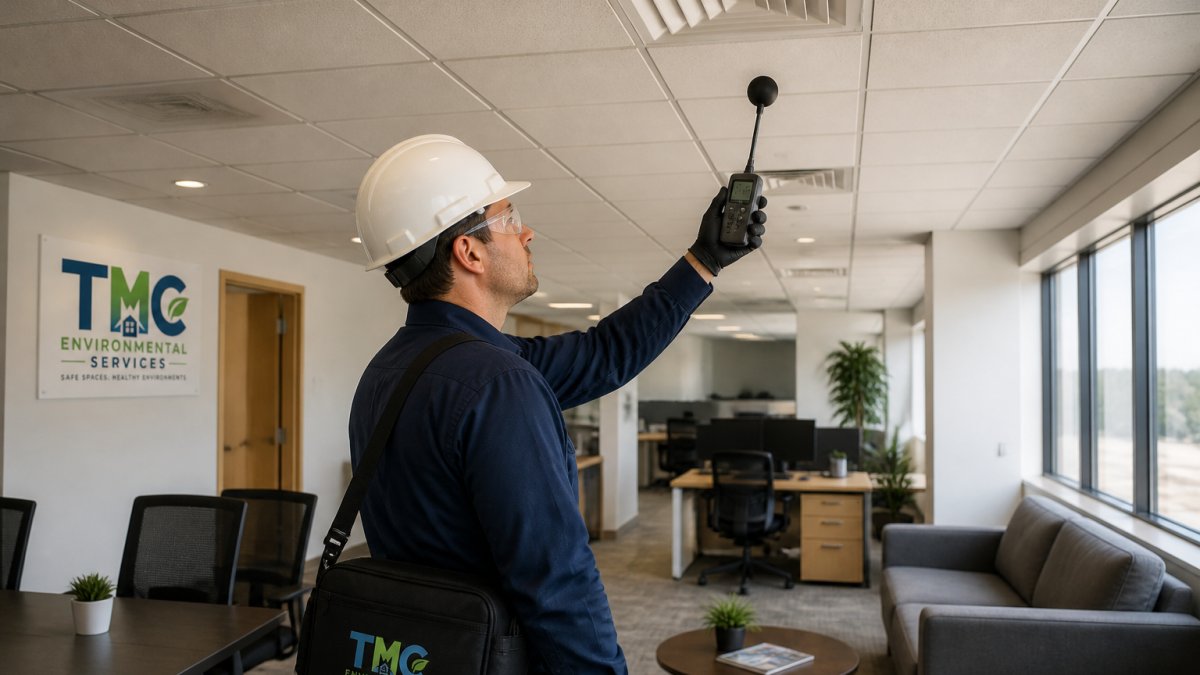
Here is a checklist to consider for commercial jobs:
- Review occupant complaint logs and any prior inspection reports
- Walk the HVAC system: filters, coils, drain pans, ductwork condition
- Check for moisture issues: stains, efflorescence, musty odors, condensation
The most common mistake is treating the checklist as a one-time exercise. A commercial building’s air quality changes with every tenant improvement, roof repair, and HVAC modification. Re-run the checklist after any significant building change, not just when a problem surfaces.
What to measure, where, and when
A checklist tells you what to look at; sampling protocols make the numbers defensible. The right protocol depends on the suspected pollutant:
- Moisture. Pin-type or pinless meters at suspect materials, plus thermal imaging for hidden intrusion. Record readings against dry-standard baselines.
- Mold. Air sampling (spore traps or impact samplers) plus surface or tape-lift samples where growth is visible. Collect an outdoor control sample simultaneously to compare indoor counts against background.
- VOCs. Sorbent tubes or summa canisters collected over 8 to 24 hours with the building normally occupied; short grab samples miss slowly off-gassing compounds.
Sample in occupied zones at breathing height, during normal operating hours, with HVAC running normally. Sampling an empty building or with the system off produces numbers that do not reflect what occupants breathe.
Thresholds and interpretation
There is no single pass/fail number for indoor air quality. Each pollutant is judged against a benchmark depending on who is exposed and for how long:
- Occupational limits. OSHA permissible exposure limits (PELs) and ACGIH threshold limit values (TLVs) apply to workplace exposures, set for healthy adult workers over a shift, not children, the elderly, or sensitive occupants.
- Reference concentrations. The EPA publishes reference concentrations (RfCs) for chronic inhalation exposure, health-based screening values, not regulatory limits, but widely used to interpret indoor results.
- Ventilation benchmarks. ASHRAE Standard 62.1 sets minimum outdoor air rates per occupant and per square foot. Carbon dioxide is a practical proxy: outdoor air is roughly 400 to 450 ppm, and indoor readings well above that suggest under-ventilation.
A result is only meaningful when paired with the comparison standard, sampling method, and collection conditions. A number without that context is not actionable.
Do not treat a single below-threshold reading as a clean bill of health. Many indoor air problems are episodic, they appear after a roof leak, during a renovation, or when a damper sticks. One good day of sampling does not rule out a recurring condition.
Property owners and managers who need results they can defend to a tenant, a lender, or a regulator. A protocol that names the method, the location, and the comparison standard survives scrutiny; a vague walkthrough does not.
Commercial VOC Testing: What It Involves and When It’s Required
Commercial VOC testing measures volatile organic compounds that off-gas from building materials, furnishings, cleaning products, and industrial processes.
VOCs include formaldehyde, benzene, toluene, and hundreds more. Some cause immediate irritation; others have long-term effects at sustained exposure.
Testing usually involves:
- Source identification. Walk the space to catalog potential emitters, such as new carpet, adhesives, paints, and composite wood.
- Air sampling. Collect samples using sorbent tubes or canisters over a defined period, following established sampling protocols.
- Laboratory analysis. Submit samples to an accredited lab for compound-specific results.
- Interpretation. Compare results against applicable thresholds and occupational exposure limits.
Not every building needs full VOC testing. A targeted assessment based on recent activity and occupant complaints usually delivers more useful information than a broad panel.
Commercial Building Fresh Air Requirements and HVAC Standards
Commercial building fresh air requirements are set by ventilation standards specifying minimum outdoor air rates per occupant and per square foot. Meeting those rates is the most effective way to dilute indoor pollutants and control moisture.
The practical targets come from ASHRAE Standard 62.1 ventilation guidance, which building codes and mechanical engineers reference when designing and commissioning HVAC systems. In practice, this means:
- Outdoor air intake rates sized to occupancy, not just square footage
- Proper air exchange so stale air leaves and fresh air enters
- Filtration matched to the pollutants present
Under-ventilating HVAC systems concentrate VOCs, particulate matter, carbon monoxide, and moisture. Over-ventilation wastes energy but rarely harms air quality. The most common failure is a correctly designed system that drifted out of balance through years of ad-hoc modifications.
Blocked or closed outdoor air dampers are a frequent culprit. A damper stuck closed can cut fresh air intake dramatically while the system still appears to run normally. Occupants notice the stuffiness before anyone checks the damper.
What to Expect in an Indoor Air Quality Assessment Report
An indoor air quality assessment report documents what was tested, what was found, and next steps. A useful report is specific enough that a remediation contractor, insurer, or lawyer could act on it without follow-up questions.
Reports typically include:
- Scope and methodology. What was inspected, which instruments were used, and how samples were collected
- Findings by area. Room-by-room or zone-by-zone observations, including photographs
- Laboratory results. Raw data with interpretation against applicable thresholds
A report saying “mold was found” without identifying the moisture source is not actionable. Documentation matters for disclosure, insurance claims, and tenant disputes, so the report must stand alone months or years later.
How to Meet Commercial Property Air Quality Assessment Requirements: A Step-by-Step Guide
Meeting commercial property air quality assessment requirements starts with identifying which rules apply to your building. No single federal indoor air quality law covers every commercial property; obligations stack in layers, and confusing them is the most common compliance error.
The four layers of requirements
**1.
2. State rules. States regulate specific contaminants and activities, most commonly asbestos and lead: many require notification or a licensed inspector before renovating or demolishing older buildings.
3. Local air district and municipal rules. Air districts and city building departments issue the permits and questionnaires that most often trigger an assessment.
4. Private obligations. Lease terms, lender requirements, insurer conditions, and purchase agreements can require an assessment even when no government rule does.
The step-by-step process
- Determine your jurisdiction’s requirements. Contact your local air district and building department to confirm what applies to your property type, occupancy, and planned work. Ask specifically whether a permit, questionnaire, or pre-demolition survey is required.
- Identify assessment triggers. Common triggers include tenant complaints, water damage, renovations, property transactions, change of occupancy, and post-remediation verification.
- Engage a qualified assessor. Look for credentials such as Certified Residential Mold Inspector (CRMI) or Certified Microbial Remediation Supervisor (CMRS), confirm appropriate insurance, and verify recognized sampling protocols. Ask whether they also remediate, an assessor with no remediation revenue may offer a neutral perspective.
- Conduct the assessment. Inspection, sampling, and laboratory analysis proceed according to an agreed scope that names the contaminants, the sampling locations, and the analytical methods.
- Review the assessment report. Confirm the report identifies sources, not just symptoms, and that it states the standard each result was compared against.
- Implement corrective action. Address moisture issues, HVAC problems, and identified pollutant sources in priority order.
- Verify and document. Re-test where needed and retain records for disclosure and compliance purposes.
| Step | Typical Duration | Who Is Responsible |
|---|---|---|
| Determine jurisdiction requirements | 1-2 weeks | Property owner |
| Identify triggers | Ongoing | Property manager |
| Engage qualified assessor | 1-2 weeks | Owner or manager |
| Conduct assessment | 1-3 days on site | Assessor |
| Review report | 3-7 days after sampling | Owner or manager |
| Corrective action | Varies by scope | Contractor |
| Verification and records | 1-2 weeks | Assessor and owner |
Documentation, disclosure, and record retention
A compliant assessment produces a paper trail, not just a clean result. Keep these together in one file per property:
- The assessment report, including scope, methodology, instruments, sampling locations, laboratory results, and interpretation.
- Corrective-action records, including contractor invoices, product data sheets, and clearance or verification results.
- Tenant communications, including complaint logs and the notices you sent in response.
Most practitioners retain IAQ records at least as long as the statute of limitations for property and personal injury claims, and longer for buildings with ongoing remediation or regulatory obligations.
Federal guidance from the EPA’s indoor air quality resources is a useful starting point for understanding general obligations, but it does not replace local requirements. State and local rules often go further, especially around asbestos, radon, and post-remediation clearance.
The single most important step is confirming jurisdiction-specific requirements before testing begins. An assessment that meets the wrong standard wastes money and can fail to satisfy the actual regulator. Document every step, because the record is often what protects you when a dispute arises.
Common Mistakes to Avoid in Commercial Air Quality Assessments
Mistakes in commercial air quality assessments fall into four categories: wrong scope, wrong timing, wrong assessor, and poor documentation. Each costs money and delays resolution.
- Testing without a hypothesis. Sampling everything without a suspected source produces data that is hard to interpret and easy to dispute.
- Skipping source identification. Results that name a pollutant but not its origin leave the problem in place.
- Using an assessor with a conflict of interest. When the same company inspects and remediates, findings can be shaped by the incentive to sell remediation work.
Property owners and managers who need neutral findings they can act on, disclose, or defend in a dispute. An assessor who only inspects, and does not remediate, may offer a neutral perspective.
Conclusion: Prioritizing Air Quality for a Healthier Commercial Property
Commercial property air quality is not a one-time checkbox but an ongoing responsibility shaped by occupant health, workplace safety, regulations, and property value.
At The Mold Consultant, LLC, we provide mold inspection, air quality testing, and post-remediation verification for commercial clients, backed by more than a decade of experience and credentials including Certified Microbial Remediation Supervisor (CMRS) and Certified Residential Mold Inspector (CRMI).
Get started with The Mold Consultant, LLC and give your building the clear, defensible air quality assessment it deserves.
Frequently Asked Questions
What are the fresh air requirements in commercial buildings?
Fresh air requirements in commercial buildings are primarily governed by ASHRAE Standard 62.1, which specifies minimum ventilation rates based on occupancy and building use. For example, office spaces typically require 17 cubic feet per minute (cfm) of outdoor air per person. Local building codes may adopt or modify these standards. Regular HVAC maintenance and proper design ensure compliance. The Mold Consultant, LLC can help assess your building’s ventilation and air exchange rates to meet these requirements.
What pollutants are commonly checked during a commercial air quality assessment?
Common pollutants checked include volatile organic compounds (VOCs) from paints and adhesives, particulate matter (PM2.5 and PM10), carbon monoxide, carbon dioxide, mold spores, and asbestos fibers. Testing may also cover radon and chemical contaminants from cleaning products. The specific pollutants depend on building age, location, and activities. A thorough assessment identifies pollutant sources and recommends mitigation. The Mold Consultant, LLC uses advanced tools to test for these pollutants and provide actionable reports.
When should a commercial property have its indoor air quality assessed?
Assessments are recommended after water damage, tenant complaints about odors or health symptoms, renovations, or when purchasing a property. The EPA suggests periodic evaluations as part of preventive maintenance. Certain regulations, like OSHA’s indoor air quality guidance, may require assessments if workers report issues. For due diligence, assessments are often conducted before lease signings or sales. The Mold Consultant, LLC offers comprehensive inspections to identify hidden problems and ensure compliance.
Who is responsible for addressing indoor air quality concerns in a commercial property?
In commercial properties, the property owner or manager is typically responsible for maintaining indoor air quality to protect occupant health and comply with regulations. Under OSHA, employers must provide a safe workplace, which includes addressing air quality complaints. Landlords may share responsibility depending on lease agreements. Failure to address issues can lead to legal liability. The Mold Consultant, LLC provides neutral assessments and documentation to help property owners meet their obligations and resolve disputes.
How is indoor air quality tested in a commercial building?
Testing involves a combination of visual inspection, air sampling, and surface sampling. Inspectors use devices like particle counters, VOC meters, and moisture meters. Air samples are collected for mold spores, allergens, and chemicals, then analyzed in a lab. The process follows protocols such as those from ASTM or NIOSH. Results are compared to outdoor baseline levels. The Mold Consultant, LLC uses non-destructive methods to identify issues without disrupting business operations.
What does an indoor air quality assessment report include?
An indoor air quality assessment report typically includes a summary of findings, lab results, and recommendations for remediation or mitigation. It documents sampling locations, methods, and any observed moisture issues or mold growth. The report may also outline compliance with regulations like OSHA or ASHRAE standards. This documentation is crucial for legal or insurance purposes. The Mold Consultant, LLC provides detailed reports with clear, actionable steps to improve air quality.
Are there specific regulations for commercial VOC testing?
There is no single federal regulation for VOC testing in commercial buildings, but OSHA sets permissible exposure limits (PELs) for individual VOCs in workplaces. State and local air districts may have additional requirements, especially during renovations. The EPA provides guidelines for VOC emissions from building materials. Testing is often part of a broader indoor air quality assessment. The Mold Consultant, LLC can help determine applicable VOC testing requirements for your property.
How often should commercial properties undergo air quality assessments?
The frequency depends on building use, occupancy, and local regulations. As a best practice, assessments are recommended every 2-3 years, or after any water intrusion, renovation, or tenant complaints. Properties with high occupant density or known issues may need annual testing. Regular HVAC maintenance and inspections can help identify problems early. The Mold Consultant, LLC offers customized assessment schedules to fit your property’s needs and budget.