
Quick Summary
Mold remediation insurance coverage usually depends on the cause of the moisture and your policy’s wording. Mold from a sudden, covered water event is often paid, subject to a mold sublimit, while mold from long-term leaks or neglect is frequently excluded.
- Sudden events like a burst pipe are generally treated as covered; slow, repeated leaks often are not.
- Check the separate mold sublimit, the dwelling limit and your deductible before authorizing any tear-out.
- Document with dated photos, moisture readings and a written timeline before cleanup begins.
- Request any denial in writing, citing the exact policy language and form number.
- A mold endorsement or rider can raise the sublimit or broaden coverage, so ask your agent in writing.
Table of Contents
- How Homeowners Insurance Treats Mold Remediation
- Covered Perils Versus Excluded Causes of Mold
- Homeowners Insurance Mold Coverage Limits and Endorsements
- Documentation Needed for Mold Insurance Claims
- Steps to File a Mold Damage Claim and the Duty to Mitigate
- Mold Remediation Cost Estimates and What Your Policy Pays
- Get a Documented Mold Assessment Before You File Your Claim
- Frequently Asked Questions
How Homeowners Insurance Treats Mold Remediation
Last Updated: October 29, 2026
Mold is one of the most misunderstood claims on a homeowners policy. Many owners assume that if water caused the damage, the insurer will pay to fix everything, including the mold.
Mold itself is typically treated as a consequence rather than a standalone cause of loss.
Read your declarations page and the mold sections of your policy before you assume anything.
Covered Perils Versus Excluded Causes of Mold
A covered peril is an event your policy agrees to pay for, such as fire, windstorm, or sudden water discharge. An excluded cause is something the policy specifically refuses to pay for, such as flood, earth movement, or gradual deterioration.
Mold claims hinge on which side of that line the moisture falls. If a covered peril introduced the water and mold followed, the claim may have a path forward.
Sudden Water Damage Versus Long-Term Leaks
The distinction between a sudden event and a long-term leak drives most mold disputes. A washing machine hose that bursts overnight is generally treated as sudden and accidental.
Insurers frequently point to the duration of the leak when denying a claim. Document when you first noticed moisture and what you did about it. Gaps in that timeline give adjusters room to argue the damage was preventable and long-running.
The Role of Negligence and Home Maintenance
Most policies expect owners to maintain their property and to take reasonable steps to prevent further damage once a problem is discovered.
A common mistake is treating a known leak as something to deal with later. Fix the source promptly, even if you have not yet filed a claim, and keep receipts for that repair. Showing you acted responsibly is one of the most effective ways to protect your claim.
Homeowners Insurance Mold Coverage Limits and Endorsements
Even when mold is covered, the policy may cap what it pays. Many policies set a separate sublimit for mold, fungi, or wet rot, and that sublimit is often well below the dwelling limit. Some insurers offer a mold endorsement or rider that raises that cap or broadens the coverage.
Check three numbers before you need them: the dwelling coverage limit, the mold sublimit if one exists, and your deductible. A mold sublimit can leave a large remediation bill partly uncovered even after the claim is accepted. Ask your agent to put the mold terms in writing so you are not relying on memory later.
Documentation Needed for Mold Insurance Claims
Good documentation is the difference between a claim that moves and one that stalls. Start collecting records the moment you find water or mold. The unique angle here is not the checklist itself, every guide has one, but how each document is used against you when it is missing, and how to build a record that survives a denial.
The Core File
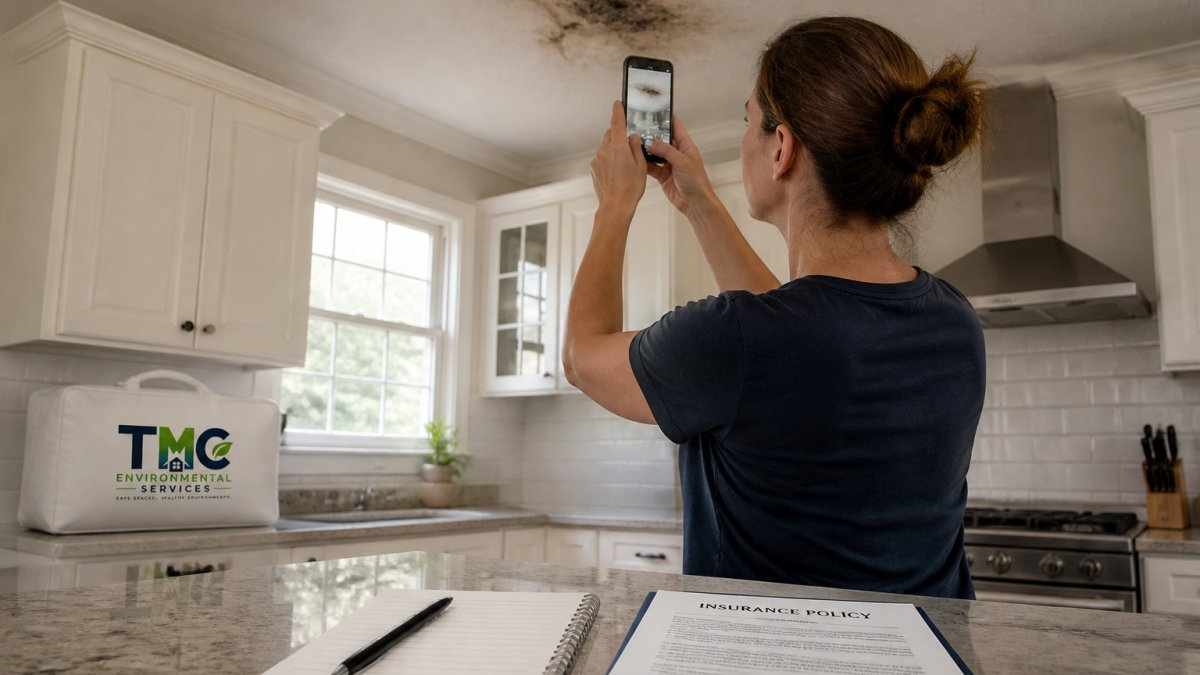
- Dated photos and video of the damage, the moisture source, and any affected materials, taken before cleanup. Adjusters use timestamps to test your timeline; a photo without a date is easy to discount.
- Moisture readings and a location map showing where water or mold was found. A pin-type or non-invasive meter reading with the date and location gives the adjuster a number to compare against the contractor’s report.
- A written timeline of when you noticed the problem and every action you took. This is the document that most often decides a sudden-versus-long-term dispute.
- Plumbing, roof, or appliance repair invoices that show the source was addressed. These support the duty to mitigate and rebut a neglect argument.
Keep originals of everything. Our guide walks through documenting mold step by step so your file holds up to review. Insurers ask for proof of loss documentation, and missing records are an easy reason to reduce or deny a payment.
How a Denial Letter Is Built, and How to Rebut It
Denial letters are usually short and cite a specific exclusion, most often long-term seepage, repeated leakage, or neglect. The practical move is to read the cited language against your timeline.
A rebuttal letter should do four things: quote the exact policy language the insurer cited, state the facts that fall outside that language, attach the documents that support those facts, and request a written response within a set period. Keep the tone factual and avoid speculation about the cause beyond what your records show. Send it by a method that produces a delivery record.
Ask for the denial in writing with the specific policy language and form number cited. A vague denial is easier to challenge than a precise one, and a precise one tells you exactly which facts you need to rebut.
What Not to Do
Do not discard damaged materials before the adjuster inspects them, and do not authorize tear-out before you have the estimate and the sublimit in hand. If you must remove materials to prevent further damage, photograph and bag a sample and note the location. Owners who receive a denial may consult a public adjuster or an attorney who handles property disputes, but the strength of that case rests on the file you built in the first week.
Steps to File a Mold Damage Claim and the Duty to Mitigate
Most policies require you to act promptly and to prevent additional damage. This is the duty to mitigate, a legal standard that generally obligates you to take reasonable steps to limit loss once you know about it.
Filing a claim usually follows this sequence:
- Stop the water source and dry the area within a reasonable time.
- Notify your insurer promptly, in writing, and get a claim number.
- Document everything before any cleanup or demolition.
- Obtain a professional assessment to define the extent of the mold.
- Submit a proof of loss with supporting estimates and records by the deadline in your policy.
- Respond to adjuster requests in writing and keep copies of all correspondence.
If a claim is denied, request the denial in writing with the specific policy language cited. Denial letters are often vague, and a precise reading of the cited exclusion frequently reveals an argument worth contesting.
Mold Remediation Cost Estimates and What Your Policy Pays
Remediation costs vary widely with the area affected, the type of materials involved, and whether removal extends beyond surface cleaning to tear-out and replacement. Cost is therefore best understood in terms of scope rather than a single figure. Many owners are surprised to learn that a covered claim may still leave them responsible for their deductible, any amount above a mold sublimit, and any work the policy excludes.
How the Mold Sublimit Actually Works
Most standard homeowners forms treat mold, fungi, and wet rot as a separate category with its own cap. The two numbers that matter are the dwelling limit and the mold sublimit.
A worked example makes the interaction clear. Suppose your policy has a $500,000 dwelling limit, a $10,000 mold sublimit, and a $2,000 deductible. A covered burst-pipe loss produces $18,000 in mold remediation.
What Drives the Estimate
Ask for itemized estimates that separate containment, removal, cleaning, and rebuilding. This makes it easier to see what the policy covers and to challenge items that fall outside it. In practice, the largest cost drivers are:
- Containment and negative air, sealing the work area and running HEPA filtration, which scales with the number of rooms affected.
- Material removal, porous materials such as drywall, insulation, and carpet usually cannot be cleaned and must be removed and replaced. Learn why mold can come back after work is completed so you can plan to prevent a repeat claim.
- Structural drying, dehumidification and air movers, billed by the day, which is why a slow response raises the bill.
- Rebuild, patching, painting, and reinstalling finishes, which is often excluded or capped separately from remediation.
Pricing depends on the size and complexity of the job, so request a written quote from a licensed remediation contractor for your specific situation. Keep the itemized estimate and the contractor’s scope of work; adjusters compare them against the policy’s mold sublimit and against any exclusions for code upgrades or cosmetic repair.
A mold sublimit can leave a large remediation bill partly uncovered even after the claim is accepted. Confirm the sublimit in writing before you authorize tear-out, because once materials are removed the cost is committed whether or not the insurer pays.
Endorsements That Change the Math
Some insurers offer a mold endorsement or rider that raises the sublimit or broadens coverage to mold from any cause, and a few exclude mold entirely unless the rider is added. The endorsement usually carries its own premium and its own cap, so compare the added premium against the size of the sublimit increase.
The table below summarises the key cost and coverage terms the article describes, so you can compare them at a glance.
| Item | Example value | Note |
|---|---|---|
| Dwelling limit | $500,000 | Overall coverage ceiling for the home |
| Mold sublimit | $10,000 | Separate cap on mold-related work per loss |
| Deductible | $2,000 | Applies to the loss; not replaced by the sublimit |
| Mold remediation bill | $18,000 | Covered burst-pipe loss in the worked example |
| Owner’s exposure | Remainder above sublimit | Includes deductible, excess cost and excluded work |
Get a Documented Mold Assessment Before You File Your Claim
An independent assessment gives you objective evidence of what is present, where it came from, and how far it spread. Learn what a pre-purchase or condition inspection involves if you need a documented baseline.
Frequently Asked Questions
Does homeowners insurance cover mold removal?
It depends on the cause. Mold resulting from a sudden, covered water event is often included, subject to the policy’s mold sublimit.
Why was my mold claim denied?
Denials commonly cite long-term seepage, lack of maintenance, or an exclusion for mold.
Do I need a mold endorsement?
If your policy excludes mold or sets a low sublimit, a rider may broaden coverage.
Frequently Asked Questions
Does homeowners insurance cover mold?
Homeowners insurance usually covers mold only when it results from a sudden and accidental covered peril, such as a burst pipe or a storm that opens the roof. Mold caused by long-term seepage, poor maintenance or humidity is commonly excluded. Many policies also cap mold remediation at a sublimit, unless a mold endorsement increases it. Review your declarations page and ask your agent to confirm the exact limit, deductible and any mold exclusion language in writing before you assume a claim will be paid.
How do I prove mold damage for an insurance claim?
Document the source and extent of the damage as early as possible. Take dated photos and video of affected areas, keep the damaged materials until the adjuster has seen them, and save receipts for emergency water mitigation. A written moisture assessment and laboratory or visual inspection report that identifies the water source helps link the mold to a covered event. Submit a proof of loss within the deadline stated in your policy.
Does insurance cover mold caused by a plumbing leak?
Coverage for mold from a plumbing leak depends on whether the leak was sudden and accidental or continuous over time. A pipe that bursts unexpectedly is generally a covered peril, and the resulting mold remediation may be paid up to the mold sublimit. A slow leak that persisted for weeks or months is often excluded, and insurers may deny the claim on the grounds that the homeowner failed to maintain the property or mitigate the damage promptly.
What should I do if my mold claim is denied?
Request the denial in writing and ask the insurer to identify the specific policy language it relied on. Compare that language with your declarations page and any mold endorsement. You can submit additional documentation, request a re-inspection, or hire a public adjuster or attorney. Keep records of all communications, since many states set deadlines for challenging a denial.
